 9 min read
A LACT unit, short for lease automatic custody transfer, is an automated skid that measures, samples, and transfers crude oil from the lease to a purchaser without an operator present. It records the volume and quality that determine what the operator gets paid, which is why it's called the cash register of the lease. Because ownership and payment both change hands there, the measurement has to be accurate and defensible.
This guide explains what a LACT unit is and what custody transfer means, walks through the components in the order oil flows through them, and shows how a transfer executes, how run tickets and net standard volume are calculated, and what happens to the ticket data once the oil is sold.
LACT units replaced manual tank gauging at most sales points. Rather than a person measuring a tank and agreeing on the number with a truck driver, the unit measures continuously and automatically, producing a consistent, auditable record of every barrel sold.
What Is Custody Transfer?
Custody transfer is the point at which ownership of the product passes from one party to another, usually from the producer to a purchaser or pipeline. It is both a legal handoff and a billing event, so the measurement that happens there carries more weight than measurement anywhere else on the lease.
That is why custody transfer measurement is held to certified standards. Contracts and regulations specify how volume and quality are measured, corrected, and documented, so that the seller and the buyer can rely on the same number. A LACT unit exists to produce that number automatically and repeatedly. On federal and Indian leases, measurement also has to satisfy Bureau of Land Management rules, and states impose their own requirements, which is part of what certified custody transfer measurement means.
What Are the Components of a LACT Unit?
A LACT unit contains ten core components arranged in flow order: a charge pump, strainer, BS&W probe, air eliminator, sampler, diverter valve, meter, prover connections, back-pressure valve, and check valve, all sequenced by a PLC controller. Oil moves through the unit in a defined sequence, each component doing one job on the way to sale.
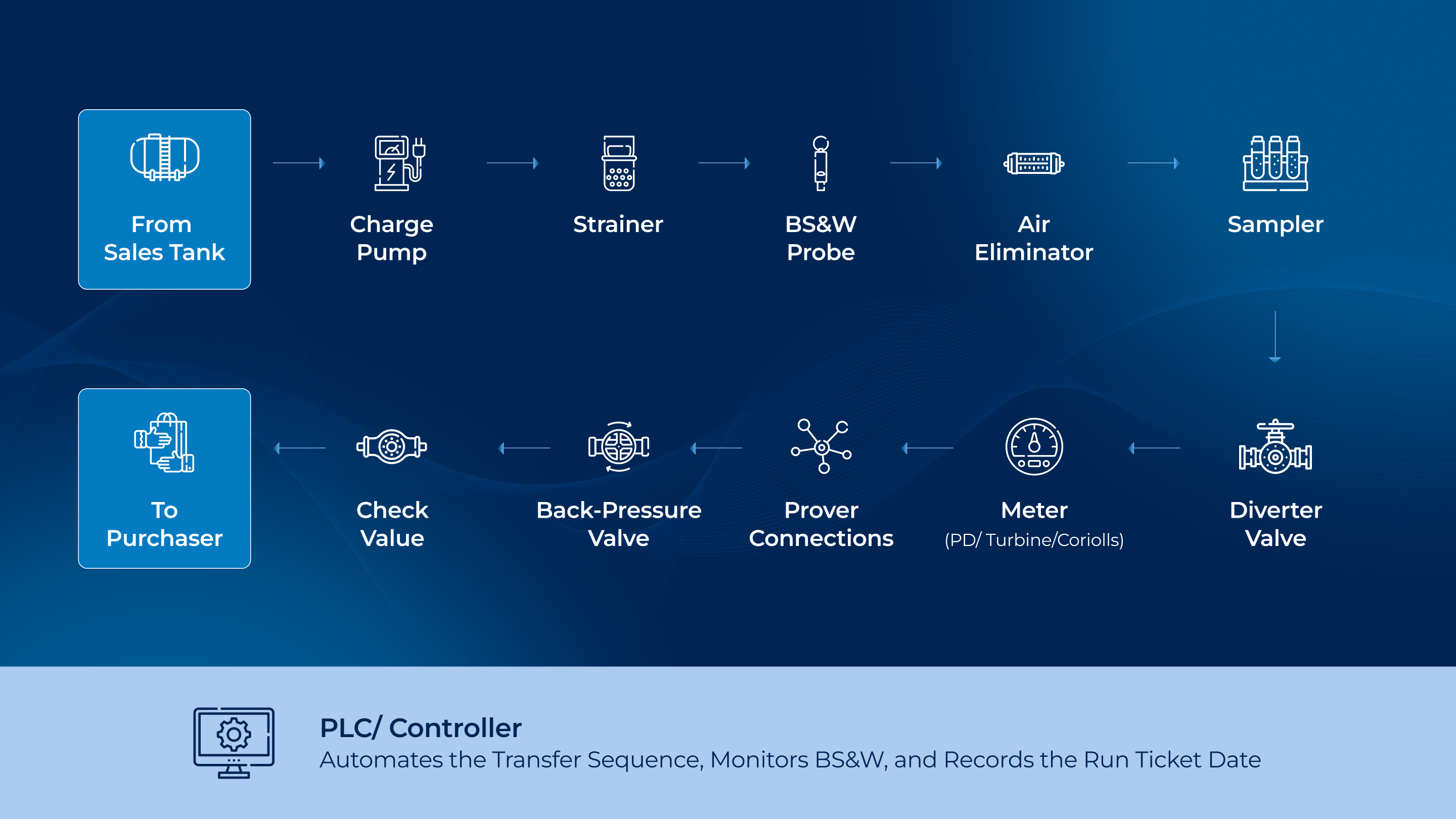
- Charge pump. Draws oil from the sales tank and moves it through the unit at the pressure and flow rate the meter needs.
- Strainer. Removes solids and debris that could damage the meter or distort the measurement.
- BS&W probe. Monitors basic sediment and water content continuously, the quality check that decides whether the oil is fit to sell.
- Air eliminator. Removes entrained gas and air, so the meter measures liquid only and not vapor that would inflate the volume.
- Sampler. Draws a small, representative sample of the oil for laboratory analysis of quality and gravity.
- Diverter valve. Routes off-spec oil back to treating instead of to sale when BS&W exceeds the contract limit.
- Meter. Measures the volume, or mass, of oil transferred. Positive displacement, turbine, and Coriolis meters are all used.
- Prover connections. Provide the taps to connect a meter prover for calibration.
- Back-pressure valve. Holds enough pressure to keep the oil in liquid form and the measurement accurate.
- Check valve. Prevents oil from flowing back into the unit.
- PLC or controller. Automates the sequence, triggers on tank level, and records the data that becomes the run ticket.
How Does a LACT Unit Transfer Custody?
A LACT unit executes a transfer in four automated steps: it triggers on tank level, checks quality and diverts off-spec oil, measures and samples clean oil, then records a run ticket.
- Trigger. When the sales tank reaches a set level, or on a schedule, the controller starts the unit and the charge pump begins moving oil.
- Quality check and divert. The BS&W probe checks the oil. If it is within specification, it proceeds to sale; if it is off-spec, the diverter valve sends it back to treating.
- Measure and sample. Clean oil passes through the meter, which records the volume, while the sampler captures a proportional sample for quality analysis.
- Ticket. The controller records the meter readings, temperature, pressure, and quality data, producing the run ticket that documents the transfer.
Run Tickets and Net Standard Volume
A run ticket is the record of a single custody transfer: opening and closing meter readings, gross volume, temperature, pressure, observed gravity, BS&W, and the meter factor. From that raw data, the billable quantity is calculated by correcting to standard conditions:
- Apply the meter factor from the most recent proving, to correct the meter's reading.
- Correct for temperature and pressure to standard conditions, usually 60 degrees Fahrenheit, using the volume correction factors in API Manual of Petroleum Measurement Standards (MPMS) Chapter 11.1.
- Deduct basic sediment and water to remove everything that is not clean oil.
The result is net standard volume, the clean-oil quantity at standard conditions the operator is actually paid for. API MPMS Chapter 12.2 defines the calculation, and Chapter 6.1 covers LACT systems themselves.
Quality affects value, not only volume. The oil's API gravity, and in some contracts its sulfur content, drive price adjustments, which is why the sampler and the lab analysis matter as much as the meter. A run ticket therefore carries both the corrected volume and the quality that prices it.
How Is a LACT Meter Proved?
A LACT meter is proved by comparing its measured volume against a known reference volume from a prover (a pipe prover, small-volume prover, or master meter) to determine the meter factor that corrects its readings.
Meters are proved on a schedule and after any change that could affect accuracy. A positive displacement or turbine meter is proved on volume, while a Coriolis meter measures mass and is proved using density to convert. Each proving is documented, because the meter factor affects the volume on every ticket until the next proving.
Proving sits alongside routine calibration of the temperature, pressure, and BS&W instruments. Together they keep the measurement inside the tolerance the contract and regulators require. How often a meter is proved depends on the contract, the throughput, and the meter type, with higher-value or higher-volume points proved more frequently. A meter factor that shifts more than a small tolerance between provings is a signal to investigate.
When Measurement Errors Become Revenue Disputes
Because custody transfer is the billing point, a measurement error there is a payment error. A meter that drifts, a temperature correction that is wrong, or a BS&W reading that is off changes what one party pays and the other receives, on every barrel until it is caught. Purchasers and pipelines audit custody transfer measurement, and operators audit what they are paid on, so both sides rely on the same tickets and proving records.
These are the disputes that measurement documentation exists to prevent. When volumes, corrections, and proving results are recorded and traceable, a question about a ticket can be answered from the record rather than argued into a stalemate. An Oklahoma E&P operator saw the difference firsthand: facing a measurement-data backlog and inconsistent run-ticket records across its sales points, the company struggled to reconcile volumes and stay ahead of audit requirements. After standardizing its liquid measurement data and validation in FLOWCAL, it brought every ticket and proving result into one traceable system of record, closed the gaps that invite disputes, and could answer volume questions from the data rather than from memory.
Read the Oklahoma E&P compliance case study
From Run Ticket to Settlement: Managing LACT Data
A run ticket is only useful once its data is validated, corrected, and carried into settlement. Across many wells and sales points, that becomes a data management problem in its own right.
FLOWCAL manages that liquid measurement data. It brings run ticket and meter data into a single system of record, validates it against configurable rules and industry standards, applies the corrections that produce net standard volume, and keeps a complete audit trail of every change. It works alongside dedicated proving and calibration tools such as PROVEit and CALCit, and it integrates with accounting systems so validated volumes flow into settlement without manual reconciliation. FLOWCAL handles gas and liquid measurement in one platform, which matters for operators that sell both.
Those net volumes carry downstream to revenue and to owner payments, where they feed the decimal interests on a division order. For the gas side of measurement, see our guide to orifice and ultrasonic gas metering.
Explore FLOWCAL to see how liquid and gas measurement data flows from the field to settlement.
Frequently Asked Questions
What does LACT stand for? LACT stands for lease automatic custody transfer. It refers to the automated unit that measures and transfers crude oil from the lease to a purchaser, and to the process that unit performs.
What is BS&W? BS&W stands for basic sediment and water: the non-oil content in a crude stream. A LACT unit measures BS&W continuously and deducts it, so the operator is paid for clean oil rather than for the water and sediment mixed with it.
Coriolis or positive displacement meter for a LACT unit? Both are used. Positive displacement meters measure volume directly and have a long track record. Coriolis meters measure mass and density, have no moving parts, and tolerate changing conditions well, at a higher cost. The choice depends on flow, accuracy needs, and maintenance preferences.
Who owns the oil during transfer? Ownership passes at the custody transfer point defined in the sales contract, typically as the oil leaves the LACT unit for the purchaser's pipeline or truck. The run ticket documents the quantity and quality at that handoff.
 Previous Page