 12 min read
A division order is a document that states each owner's decimal interest in the proceeds from a well or unit's production. The operator uses it to confirm ownership and distribute revenue correctly. It directs how income is paid — it does not grant ownership or change your lease. If you received one, a well you hold an interest in has started producing.
This guide explains what a division order is, why you received one, what it contains, and how to check the decimal interest it assigns you. It covers whether you have to sign it and what happens when payments are held in suspense. It then goes behind the scenes to show how operators build and maintain the ownership records these documents come from, which is useful whether you are an owner verifying a payment or an operator managing thousands of them.
Ownership itself comes from your mineral rights and your lease. The division order records the decimal share of production revenue that ownership entitles you to, so the operator can pay you accurately.
Why Did You Receive a Division Order?
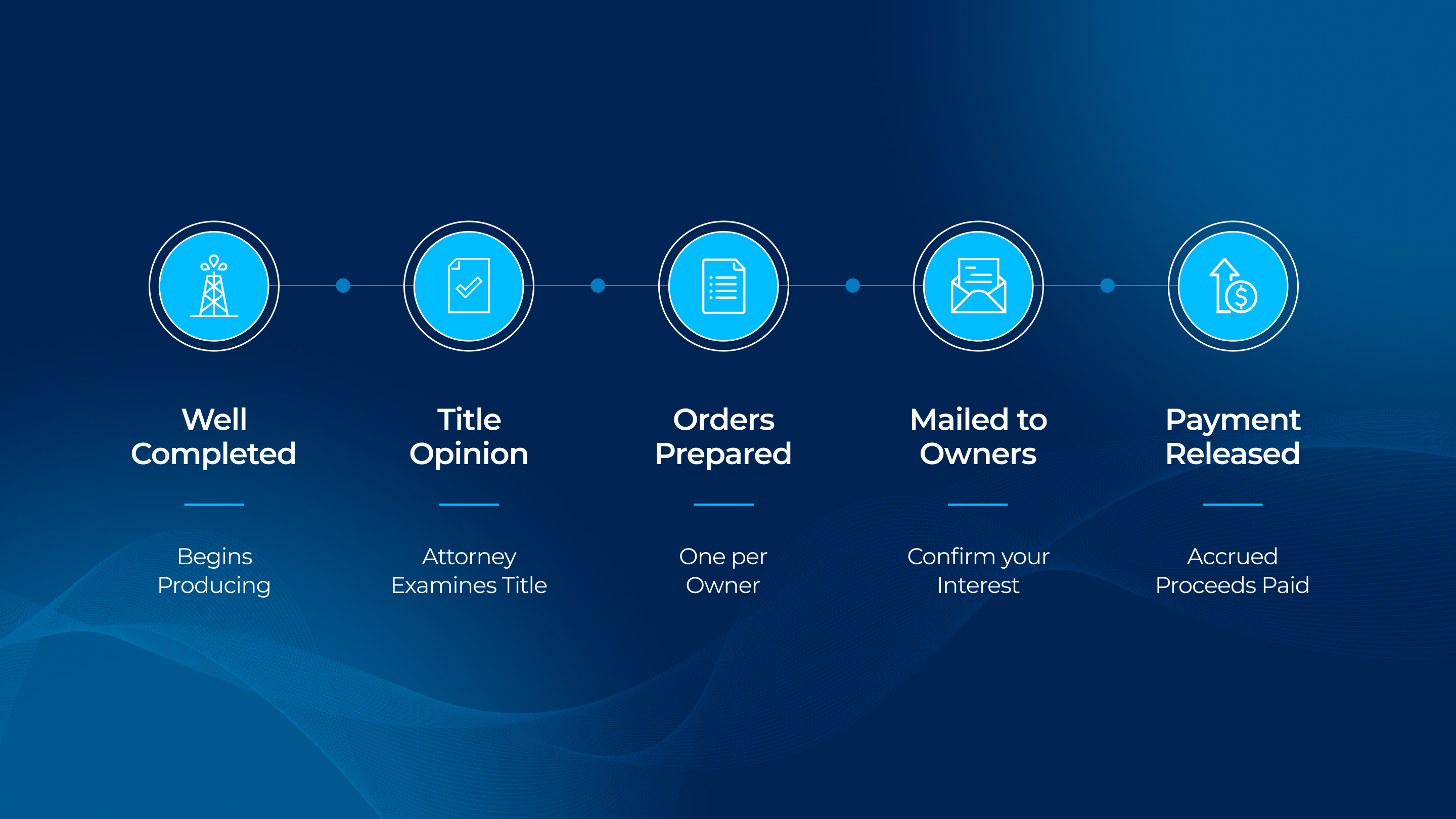
A division order follows a specific sequence:
- A well is drilled and completed, then begins producing and selling hydrocarbons.
- The operator orders a division order title opinion, in which an attorney examines title to determine who owns the production proceeds and in what shares.
- Based on that opinion, the operator prepares division orders and mails one to each owner, including royalty owners, working interest owners, and holders of overriding royalty interests.
The division order is the operator's way of confirming the ownership the title opinion established before releasing payment. Receiving one is a normal step toward getting paid, not a sign of a problem.
The timing can surprise owners. Because the title opinion and ownership work take time, a division order often arrives months after a well first produces. The first payment usually includes proceeds accrued since first production, held until the operator could confirm who to pay. If you own interests in several wells or units, expect a separate division order for each, with a different decimal interest on every one.
What Does a Division Order Contain?
A typical division order includes:
- Payor and property information. The operator or purchaser paying you, plus the well or unit name and number, legal description, and county and state.
- Owner information. Your name, address, owner number, and a request for your tax identification, usually on a Form W-9.
- Interest type. Whether your interest is a royalty, an overriding royalty, a working interest, or a non-participating royalty.
- Decimal interest. Your fractional share of production revenue, commonly carried to eight decimal places, such as 0.01171875.
- Terms and signature. Payment provisions permitted by state law and, where required, a signature line.
- Effective date. The date your interest becomes effective for payment, which determines the production your first check covers.
Many operators use the model form published by the National Association of Division Order Analysts (NADOA), which is designed to confirm interest and payment without altering the underlying lease. State law also limits what a division order may contain. The permitted provisions generally cover how and when you are paid, tax withholding, and notice of changes, not the terms of your lease.
How Is Decimal Interest Calculated?
Your decimal interest is the share of the unit's revenue you are owed. For a royalty owner, the formula is:
Decimal interest = (net mineral acres ÷ unit acres) × royalty rate
Suppose you own 40 net mineral acres in a 640-acre unit, and your lease carries a 3/16 (0.1875) royalty:
| Step | Calculation | Result |
| Acreage share | 40 ÷ 640 | 0.06250000 |
| Apply royalty rate | 0.06250000 × 0.1875 | 0.01171875 |
Your decimal interest is 0.01171875, meaning you receive that share of the revenue from the unit's production. Working interest and other interest types use different formulas, but the principle is the same: your decimal is the exact share of proceeds your ownership entitles you to. If the acreage, unit size, or royalty rate on your division order does not match your lease, that is worth questioning before you sign.
Working interest owners calculate differently, because they share in revenue in proportion to the acreage they contribute to the unit, before any royalty burden. If you own a 50 percent working interest in the same 40-acre tract within that 640-acre unit, your gross share of unit production is (40 ÷ 640) × 0.50, or 0.03125000. Your revenue decimal is then reduced by the royalties and any overriding royalties carved out of your interest, since those are paid off the top. The result is that a working interest owner's revenue decimal is always smaller than the gross acreage share, while the same owner carries a proportionate share of operating costs. Overriding royalty and non-participating royalty interests each follow their own formula, but every one resolves to the same thing: the exact fraction of proceeds that ownership entitles the holder to.
Two points help make sense of the number. First, the unit is the pooled acreage the well produces from, so your share reflects your acreage within that whole. Second, every owner's decimal in a unit adds up to exactly 1.0, because the decimals divide 100 percent of the revenue among all owners. A small decimal usually reflects a large unit, not an error.
To run the calculation yourself, you need three inputs: your net mineral acres from your deed or lease, the unit size from the plat or pooling declaration, and your royalty rate from your lease. The operator bases the decimal on the same inputs, confirmed through the title opinion.
Do You Have to Sign It?
Whether a signature is required depends on your state and the payor's policy. A few principles hold broadly:
- A division order should not change your lease. It confirms your interest and payment, and it does not amend lease terms. You are not obligated to sign a document that tries to alter your lease.
- State law sets payment timing. In Texas, the Natural Resources Code Section 91.402 requires payors to begin paying proceeds within 120 days after the end of the month of first sale, and to make later payments within 60 days for oil and 90 days for gas after the month of sale.
- Payment can be withheld for cause. A payor may hold proceeds without interest when title is in dispute or unclear, or, in Texas, when an owner has not signed a division order that contains only the provisions the statute permits.
Other states differ. Oklahoma, for example, sets its own payment timelines and provides for interest on proceeds that are held, under its production revenue statutes. Because these rules vary and carry legal consequences, treat this as general information rather than legal advice, and consult an attorney about your specific situation.
Before signing, it is reasonable to confirm a few things:
- The well, unit, and interest type match your records.
- The decimal interest matches your own calculation.
- The document contains no language that changes your lease.
If any of these looks off, contact the operator before returning the form.
What Is Suspense, and Why Payments Get Held
When an operator cannot pay an owner, the money is held in suspense: an account where production proceeds accumulate until the operator can release them. Payments land in suspense for a few reasons:
- Title defects. A gap in the chain of title, a probate not yet completed, or a name discrepancy that has to be cleared.
- Ownership transfers. A sale, inheritance, or assignment that has not yet been processed into the ownership records.
- Missing information. A missing tax identification number or an undeliverable address.
- Disputes. A disagreement over ownership or the size of an interest.
Clearing a title defect is called title curative: the work of obtaining the documents, such as probate records or corrected deeds, that confirm ownership so payment can be released. Until curative is complete, the funds stay in suspense. Suspended funds that remain unclaimed are eventually turned over to the state under escheatment rules, which is why operators track suspense aging closely.
Owners can usually recover suspended or escheated funds. If you believe you are owed proceeds, contact the operator's owner relations department, and check your state's unclaimed property office for funds that have already been turned over.
Owners can usually recover suspended or escheated funds, though the path depends on how long the money has been held. While proceeds are still with the operator, contact the owner relations department, confirm your current name and address are on file, and provide any documentation the operator needs to clear the hold — a completed W-9, a probate order, or a recorded deed, depending on the reason. Escheatment timelines vary by state, but proceeds are commonly turned over after three to five years of no contact. Once funds have escheated, they are no longer with the operator; you claim them through the state's unclaimed property office, which holds them indefinitely on the owner's behalf. Because interest generally does not accrue on suspended funds in most circumstances, it is worth resolving a hold promptly rather than letting a balance age.
Behind the Scenes: How Operators Manage Division Orders
For an owner, a division order is a single document. For an operator, it is one entry in an ownership system that can hold tens of thousands of interests across many wells. Managing that system is the work of division order analysts.
- Building the pay deck. The pay deck is the schedule of every owner in a well or unit and their decimal interest. The decimals on a pay deck must sum to exactly 1.0, or 100 percent of the revenue, and revenue distribution runs off the deck each month.
- Maintaining the ownership records. As owners sell, inherit, or assign interests, the analyst updates the ownership decks, applies effective dates, and preserves an audit trail of every change.
- Processing transfers and curative. Analysts coordinate the documentation that supports a transfer or clears a title defect, releasing interests from suspense once ownership is confirmed.
- Managing suspense at scale. Analysts track held funds by owner and reason, monitor aging, and manage release and escheatment.
Done well, this work is invisible: owners are paid the right amount on time. Done in spreadsheets, it becomes the source of decimal errors, late payments, and growing suspense.
The stakes rise with scale and with acquisitions. Each acquired property brings a new set of owners, decimals, and suspense balances to absorb into the system, often from a different set of records. Errors are expensive: an incorrect decimal means an owner is overpaid or underpaid, which leads to corrected payments, revised tax forms, and eroded trust. Accurate ownership data is also what makes revenue distribution and joint interest billing correct, since both run off the same decks.
Acquisitions are where this work is tested hardest. When one operator buys another's properties, it inherits not just wells but every owner record, decimal, effective date, and suspense balance attached to them — often kept in a different system, or in spreadsheets, with its own conventions and its own accumulated errors. Those records have to be mapped into the acquiring operator's decks without dropping an owner, double-counting an interest, or releasing suspense that was held for a reason. A single mismapped decimal, multiplied across the monthly revenue run and every owner in a unit, surfaces as corrected checks and amended tax forms months later. This is why operators managing division orders at scale treat the ownership system as core financial infrastructure rather than back-office recordkeeping.
On Demand Accounting is a cloud-native accounting platform built for upstream oil and gas. It replaces spreadsheet-driven processes with governed workflows, reducing the manual reconciliation and data duplication that let errors into the books. Through native integration with Upstream On Demand Land, ownership, lease, and payment information stays synchronized with the accounting records, so financial and revenue processes work from connected data rather than reconciled copies. Real-time visibility keeps financial information current, and SOC 2 Type 2 controls support the audit trail.
Explore On Demand Accounting to see how a cloud-native upstream platform keeps accounting connected to the ownership data revenue depends on.
Frequently Asked Questions
Can a division order change my lease terms?
No. A division order confirms your decimal interest and directs how you are paid. It cannot alter or amend your oil and gas lease. If a division order contains language that changes your lease, you are not required to sign it, and you may want an attorney to review it first.
What if my decimal interest is wrong?
Contact the operator's division order or owner relations department with your acreage, unit size, and royalty rate, and ask them to review the calculation. If there is an error, the operator can correct the pay deck and issue a revised division order, adjusting future and, where appropriate, past payments.
How long until my first payment?
It depends on your state. In Texas, payors generally must begin paying within 120 days after the end of the month of first sale. Payments can be delayed if your interest is held in suspense while title is confirmed.
What does a division order analyst do?
A division order analyst maintains ownership records and pay decks, sets up and updates owners, processes transfers, coordinates title curative, and manages suspense. The role makes sure each owner's decimal interest is correct so that revenue is distributed accurately and on time.
 Previous Page