 9 min read
Natural gas is measured by volume and sold by energy. Meters record the volume that flows, corrected to standard conditions of temperature and pressure, and reported in thousand cubic feet (Mcf). That volume is multiplied by the gas's heating value, derived from its composition, to give energy in million British thermal units (MMBtu), the basis most sales contracts use.
Natural gas is bought and sold on the numbers a meter produces. A small error in those numbers is a small error in revenue, repeated on every unit of gas that flows. That is why measurement is one of the most scrutinized functions in the gas business, and why the choice of meter matters.
This guide covers the fundamentals: how gas is measured and sold, how the two most common meter types work, and how they compare. It focuses on the orifice-versus-ultrasonic decision, where each meter fits, how meters are kept accurate, and why a fraction of a percent turns into real money.
How is natural gas measured and sold?
Two measurements drive the sale: the volume the meter records and the heating value of the gas. Both have to be accurate. This guide focuses on volume measurement, where the meter does its work, though composition analysis matters just as much to the final dollar figure.
Contracts specify the base conditions used for the correction, so the same gas can report slightly different volumes under different bases. One MMBtu is also called a dekatherm, the unit many pipelines use in their tariffs and statements.
How do orifice meters work?
The orifice meter is the long-standing workhorse of gas measurement. It measures flow using differential pressure, under American Gas Association Report No. 3 (AGA-3).
An orifice plate, a machined plate with a precise bore, is installed in the flow. Gas speeding through the bore creates a pressure drop across the plate. The meter reads that differential pressure, along with static pressure and temperature, calculates flow rate from the properties of the gas. The higher the flow, the larger the differential.
Accuracy depends on physical conditions. The meter needs a straight run of pipe, the meter tube, so the flow profile is stable, and the plate must stay clean, flat, and sharp-edged. A worn or dirty plate reads incorrectly, which is why plates are inspected on a schedule. Orifice meters are inexpensive, robust, and backed by decades of precedent, though they lose accuracy at low flow and create a permanent pressure drop.
How do ultrasonic meters work?
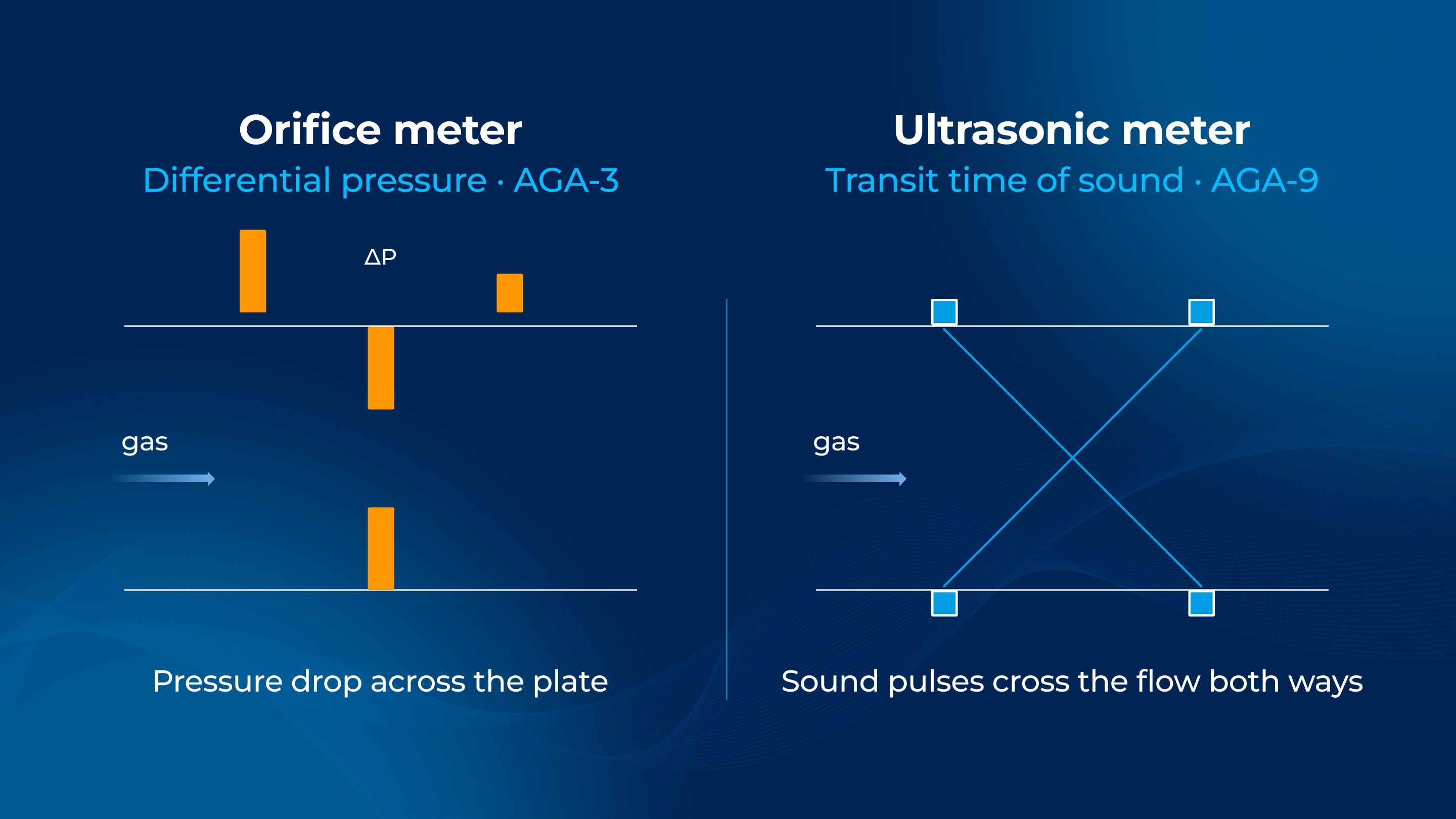
A multipath ultrasonic meter measures flow with sound instead of pressure, under AGA Report No. 9 (AGA-9) for custody transfer.
The meter sends ultrasonic pulses across the flowing gas, both with and against the flow. Gas moving downstream speeds the pulse traveling with it and slows the one traveling against it, and the difference in transit time gives the gas velocity. Multiple acoustic paths across the pipe, the multipath design, sample the flow profile and improve accuracy.
Because the bore is open, an ultrasonic meter adds almost no pressure loss and has no moving parts to wear. It holds accuracy across a wide range of flow, tolerates changing conditions better than an orifice plate, and runs continuous self-diagnostics that report path performance and the speed of sound in the gas. The trade-off is a higher upfront cost.
The multipath design also adds resilience. If one acoustic path degrades, the others continue and the diagnostics flag the problem. Ultrasonic meters can measure flow in both directions as well, which suits bidirectional lines and storage injection and withdrawal.
Orifice vs Ultrasonic: A Side-by-Side Comparison
| Factor | Orifice (AGA-3) | Ultrasonic (AGA-9) |
| Measurement principle | Differential pressure across a plate | Transit time of sound across the flow |
| Accuracy | High within its design flow range | High across a wide flow range |
| Turndown | Limited | Wide |
| Pressure loss | Permanent drop across the plate | Negligible, open bore |
| Diagnostics | Limited | Built-in self-diagnostics |
| Maintenance | Periodic plate inspection and replacement | No moving parts; electronic verification |
| Upfront cost | Lower | Higher |
| Governing standard | AGA Report No. 3 | AGA Report No. 9 |
Neither meter is simply better. The orifice meter is proven and economical where flow is steady and volumes are modest. The ultrasonic meter earns its higher cost where flow varies, volumes are large, or diagnostics and low pressure loss carry real value.
Where does each meter fit?
The choice usually follows the application.
- Wellhead and allocation. At the wellhead and in allocation measurement, where volumes are smaller and cost sensitivity is high, orifice meters are common and often sufficient.
- Custody transfer and transmission. At custody transfer points and on transmission lines, where volumes and dollar values are large, multipath ultrasonic meters are increasingly the choice, for their turndown, diagnostics, and negligible pressure loss.
Many systems use both, matching the meter to the value and behavior of the stream at each point. The deciding questions are the flow range, the value of the gas, and how much a measurement error at that point would cost. For liquids, custody transfer typically runs through a lease automatic custody transfer (LACT) unit, covered separately.
Calibration, Inspection, and Meter Proving
A meter is only as accurate as its upkeep. Three practices keep measurement defensible.
- Transmitter calibration. The pressure, differential-pressure, and temperature transmitters that feed the flow calculation are calibrated on a schedule, because drift in any one biases the result.
- Plate and meter inspection. For orifice meters, the plate is inspected for wear, damage, and cleanliness, and the meter tube is checked. For ultrasonic meters, electronic diagnostics and path checks verify performance, and the meter can be flow-calibrated at an accredited facility.
- Composition analysis. Because gas is sold on energy, the heating value from a gas chromatograph or sampling program must be current and correct.
Measurement accuracy is a system, not a single device. Meter, transmitters, and composition all have to be right for the volume and the energy to be right. Records matter as much as the checks themselves, because calibration and inspection results are the evidence that resolves measurement disputes between parties, so they are documented and retained.
Why is measurement accuracy a revenue issue?
Gas measurement runs on small percentages, and small percentages compound. Because every unit of gas is priced, a measurement bias applies to all of it, in the same direction, every day.
Consider a custody transfer point that moves 10,000 MMBtu a day at $3.00 per MMBtu, which is $30,000 of gas daily. A measurement error of half a percent misstates that by $150 a day, roughly $55,000 over a year, at a single point. Multiply across many points and the exposure is significant, whether the error runs in the operator's favor or against it.
Across a gathering system, the sum of these small differences appears as lost and unaccounted for gas, the gap between what is measured into the system and what is measured out. A large or growing gap points to measurement problems worth investigating, which is why operators watch it closely.
Choosing and validating measurement well is a business decision, not only an engineering one. When Howard Energy Partners evaluated measurement software, accuracy was the priority. The company had outsourced measurement to a third party, and as it nearly doubled in size in about two years, it decided to own its data and its process. FLOWCAL was the front-runner throughout that evaluation, and the company points to improved measurement accuracy and reporting. Sr. Director Jeremy Rieger described FLOWCAL as "a more sophisticated and effective tool than we were previously using."
From Meter to Settlement: Validating Measurement Data
A meter produces raw data. Turning that into a number fit for settlement takes several steps: validating the meter data for gaps and anomalies, correcting volume to standard conditions, applying energy content, and balancing measurement across the system so that what enters matches what leaves.
This is where FLOWCAL fits. FLOWCAL is a hydrocarbon measurement data management platform that serves as a single source of truth for hydrocarbon quantity and quality reporting. It collects data from field systems and SCADA, validates it against configurable rules built on industry standards such as AGA, API, and GPA, and flags suspect data and anomalies for review through certification and approval workflows. It corrects and balances volumes at the product and component level, supports lost-and-unaccounted-for analysis, and keeps a complete audit trail of every measurement change. Approximately 80 percent of North American midstream companies use FLOWCAL.
Because FLOWCAL integrates with accounting systems, validated volumes flow into settlement without the manual reconciliation that introduces error. Those volumes carry downstream to revenue and to owner payments, where they feed the decimal interests on a division order.
Explore FLOWCAL to see how validated measurement data supports accurate settlement.
Frequently Asked Questions
What are AGA-3 and AGA-9?
They are American Gas Association measurement standards. AGA Report No. 3 governs orifice metering using differential pressure, and AGA Report No. 9 governs multipath ultrasonic meters used in custody transfer. Each defines construction, installation, and calculation so that measurement is consistent and defensible between parties.
How often are orifice plates inspected?
On a schedule set by contract, gas conditions, and regulation, commonly ranging from quarterly to annually, and after any upset. Dirty, wet, or corrosive gas warrants more frequent inspection, because plate condition directly affects the reading.
What is turndown ratio?
Turndown ratio is the span between the highest and lowest flow a meter can measure accurately, expressed as a ratio. A wider turndown means the meter stays accurate across a broader range of flow, which matters where rates vary. Ultrasonic meters generally offer wider turndown than orifice meters.
 Previous Page