 9 min read
Plant accounting is the accounting for an oil and gas company's fixed assets, also called property accounting. It capitalizes the cost of wells, facilities, and equipment, depreciates or depletes that cost while the assets are in service, and removes them at disposal or retirement, keeping the fixed asset register accurate and audit-ready.
This guide covers plant accounting for oil and gas from spend to retirement: the capitalize-or-expense decision, construction in progress, depreciation and depletion methods, asset retirement obligations, and the disposals and reconciliations that keep the asset register clean. The term itself is a common source of confusion, so the guide starts there.
What's the Difference Between Plant Accounting and Gas Plant Accounting?
The word plant carries a second meaning in energy, and two different disciplines share it.
Plant accounting (property accounting). The general-ledger discipline of capitalizing, depreciating, and retiring fixed assets: wells, facilities, and equipment. This is the subject of this guide.
Gas plant accounting (midstream). The accounting for a physical natural gas processing plant, including product allocations, plant statements to producers, and processing contracts such as percentage-of-proceeds and keep-whole arrangements.
If you are here for the midstream meaning, see Quorum's gas plant accounting solution. The rest of this guide addresses fixed asset, or property, accounting.
When Should a Cost Be Capitalized or Expensed?
Plant accounting starts with one question asked of every cost: is it capital or expense. A capitalization policy answers it consistently.
A cost is capitalized when it acquires or improves a long-lived asset and its benefit extends beyond the current period. It is expensed when it keeps an existing asset running. Most policies set a dollar threshold below which items are expensed regardless, so the register is not cluttered with low-value purchases. The full boundary between capital and operating cost, including the workover-versus-recompletion gray zone, is covered in our CapEx vs OpEx guide.
Capitalized cost includes more than the purchase price. It covers the costs of bringing the asset into use, such as installation, freight, and, for qualifying construction, capitalized interest.
In practice, drilling and completion costs, lease and facility construction, and major equipment are capitalized, while routine maintenance, chemicals, and field labor are expensed as lease operating expense. The capitalization policy records these calls so the same type of cost is treated the same way every period.
What Is Construction in Progress?
While an asset is being built or a well is being drilled, its costs accumulate in a construction in progress (CIP) account. CIP holds capital spend that has been incurred but not yet placed in service.
Two rules govern CIP. First, CIP is not depreciated, because the asset is not yet producing or available for use. Second, costs leave CIP when the asset is placed in service, the point at which it is ready and available for its intended use. For a well, that is typically first production. For a facility, it is commissioning. At that trigger, the accumulated cost transfers from CIP to the appropriate asset class and depreciation begins.
The in-service trigger matters for earnings. Costs sitting in CIP are not yet reducing income, so a delayed or premature transfer misstates both the asset base and depreciation. Auditors routinely check the timing of these transfers.
Operators typically track CIP by project or authorization for expenditure (AFE), so accumulated cost can be tied back to what was approved and reconciled before the asset is placed in service.
How Are Assets Depreciated Once They're in Service?
Once an asset is in service, its capitalized cost is expensed over time through depreciation, depletion, and amortization (DD&A). The method depends on the asset class.
Units of production. Reserve-based assets, such as leasehold, wells, and capitalized drilling costs, are usually depleted on a units-of-production basis, tying expense to volumes produced against reserves. As reserves estimates change, the rate changes.
Straight-line. Facilities and equipment with a defined useful life are often depreciated straight-line by asset class, spreading cost evenly across the years the asset is expected to serve.
The principle behind the choice is matching. Where an asset's value is consumed as production occurs, units of production matches expense to output. Where it is consumed with time, straight-line matches expense to the periods that benefit.
Depreciation is not the only way an asset's carrying value falls. When events suggest an asset or field may not recover its book value, such as a sustained drop in prices or a downward reserves revision, it is tested for impairment and written down if required. Impairment is separate from routine DD&A, and it is an area auditors examine closely.
What Is an Asset Retirement Obligation?
Most oil and gas assets carry a legal obligation to retire them: plugging and abandoning wells, removing facilities, and restoring sites. Accounting for that obligation is the asset retirement obligation (ARO).
Recognition. When the obligation arises, the operator records an ARO liability at the present value of the estimated future retirement cost and capitalizes an equal amount as part of the asset. The capitalized ARO cost is then depreciated over the asset's life.
Accretion. Each period, the liability grows as the present-value discount unwinds. This accretion expense moves the liability toward the undiscounted cost expected at settlement.
Settlement. When retirement occurs, the liability is settled against the actual cost incurred, and any difference is recognized as a gain or loss.
Estimates change over time, and a revision adjusts both the liability and the capitalized asset. Because AROs are small in any single period and large in total, consistent treatment protects the balance sheet over an asset's full life. An obligation recorded today at its discounted present value accretes upward each year, so that by the expected plugging date the liability equals the full estimated cost. Recording that accretion steadily avoids a large catch-up later.
How Do Transfers, Disposals, and Retirements Work?
Assets move and eventually leave the register. Three events close out the lifecycle.
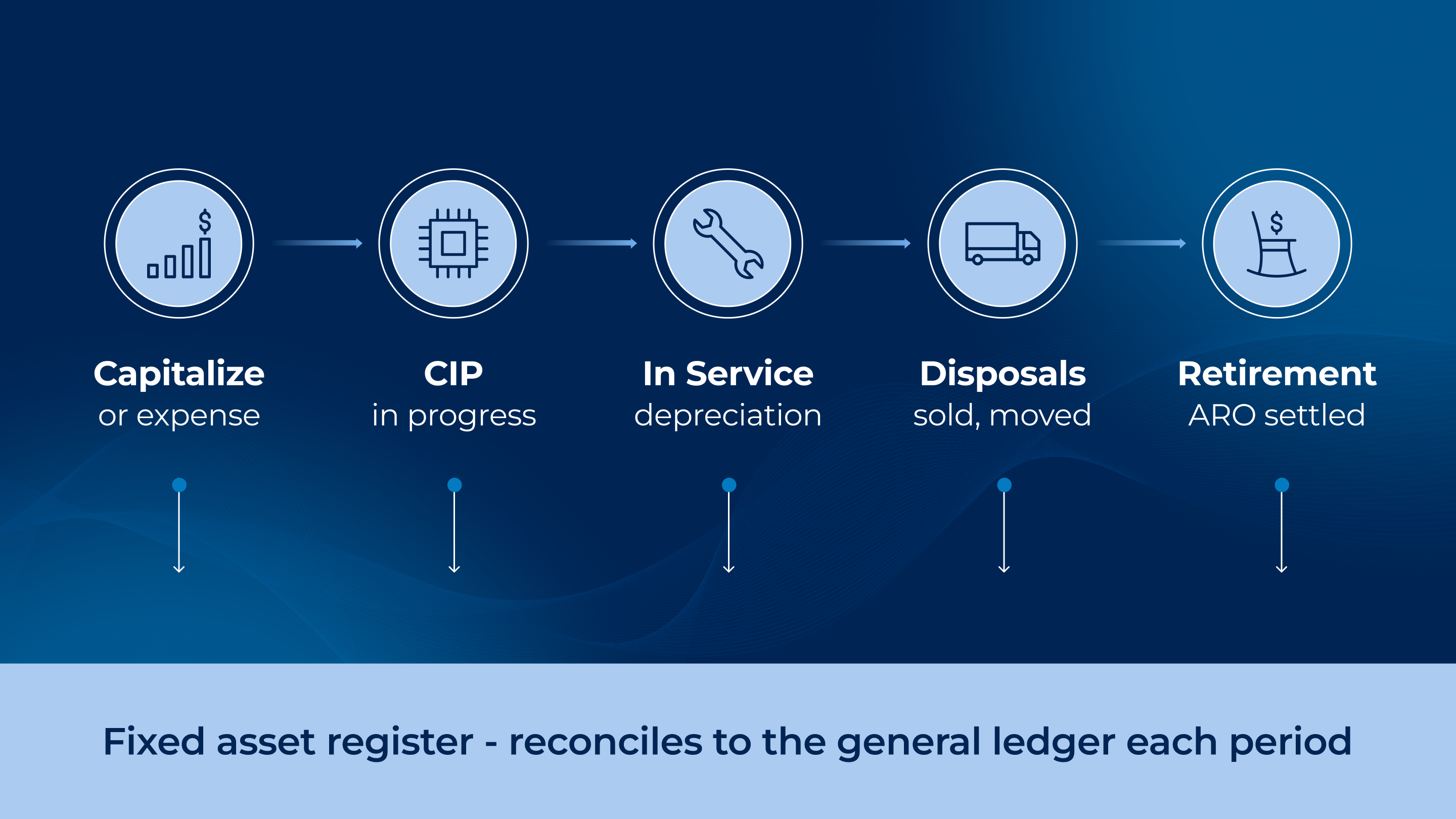
Transfers. Costs move from CIP to an in-service class, or reclassify between classes or entities as ownership or use changes.
Disposals. When an asset is sold, its cost and accumulated depreciation are removed, and the difference between net book value and proceeds is recorded as a gain or loss.
Retirements. When an asset is abandoned, it is removed from the register, its ARO is settled, and any remaining difference is recognized.
One nuance is worth noting. Under some depletion methods, an individual well retired within a larger amortization base does not produce a separate gain or loss, because its cost remains in the group base. The treatment depends on the accounting method and how assets are grouped. As with each area here, the exact treatment follows your accounting framework and policy, so confirm specific method questions with your accountants and auditors.
How Do You Keep the Fixed Asset Register Audit-Ready?
The fixed asset register, the subledger that lists every asset, is the heart of plant accounting. For each asset it records cost, in-service date, class, method, useful life or reserves basis, accumulated DD&A, ARO, and net book value. An accurate register is what makes depreciation, the balance sheet, and the audit straightforward.
A few controls keep it reliable. The register reconciles to the general ledger every period, with the subledger total tying to the GL control accounts and any difference investigated. Capitalization and in-service decisions are approved and documented, so assets enter the register correctly and on time. Periodic physical verification confirms that the assets on the books still exist and remain in use. When these hold, the register supports a clean audit. See our guide to audit readiness for upstream operators for the documentation auditors request.
An accurate register also depends on the accounting system around it. The reconciliations above are easier to sustain when the general ledger, capital data, and operational records already agree, so the register inherits clean data rather than correcting it after the fact. My Quorum Accounting supports that by bringing upstream accounting into one cloud-native platform built for oil and gas. Governed workflows replace spreadsheet-driven processes, reducing the manual reconciliation and data duplication that let errors into the books. Native integration across the Upstream ecosystem, including Execute AFE Management, connects capital spending to accounting, so approved costs and financial records stay aligned instead of reconciled by hand. Real-time visibility and configurable reporting keep financial information current, and SOC 2 Type 2 controls support the audit trail reviewers expect.
Explore My Quorum Accounting to see how a cloud-native platform built for upstream operators connects capital spending, accounting, and reporting in one place.
Frequently Asked Questions
What triggers capitalization?
A cost is capitalized when it acquires or improves a long-lived asset, provides benefit beyond the current period, and exceeds the company's capitalization threshold. Costs that only maintain an existing asset, or that fall below the threshold, are expensed instead.
Is construction in progress depreciated?
No. Construction in progress is not depreciated, because the asset is not yet in service. Depreciation begins only when the asset is placed in service and its cost transfers from CIP to an in-service asset class.
How are AROs different from DD&A?
They account for different things. DD&A spreads an asset's capitalized cost over its productive life, expensing the use of the asset. ARO accounting recognizes and grows a liability for the future cost of retiring the asset, through accretion. One reduces the asset; the other builds the obligation to remove it.
 Previous Page