 5 min read
Utility-scale wind and solar operators face complex, unique royalty scenarios in compensating landowners for turbines and solar arrays. Payment terms are set during development but often aren't triggered until the project reaches commercial operation, with escalations that can apply through both phases. Coal mining operations carry their own version of the same problem: calculations tied to extracted tonnage or revenue, often layered with true-ups and minimum-payment guarantees. In both cases, land and accounting teams have had to manage this complexity outside their system of record in spreadsheets, alongside production data that arrives on its own timeline.
On Demand Land now closes that gap. This release brings a significant expansion of royalty payment capabilities: new advanced calculation formulas, a centralized Production & Revenue feature, and bulk data import for production and revenue records built specifically to support the complex royalty scenarios that show up across wind, solar, and mining operations.
At a glance:
- A new advanced Royalty Calculation Formula Engine for production- and revenue-based royalty payments across wind, solar, and mining operations.
- Handles greater-of and minimum-payment logic, MW-capacity and per-turbine formulas, and tonnage/sales-based mining calculations.
- Includes a centralized Production & Revenue data capability (API or bulk import) so calculations run against clean, auditable data instead of a spreadsheet export.
- Co-designed with wind, solar, and mining land and accounting teams handling these exact scenarios today.
Co-Designed With Wind, Solar, and Mining Operators
This release came out of an extended workshop series covering complex escalations, production-based terms, and long-range forecasting. Participants brought real lease language, real payment examples, and real production data formats to the table, and that feedback directly shaped which calculations Quorum built first and how they work.
What's New
Beyond the fixed and index-rate escalation formulas already available across On Demand Land, this release adds calculation patterns built for production- and revenue-based royalty payments, including:
Fixed scheduled amount on MW capacity and per-turbine rate.
Payments tied to installed nameplate capacity or turbine count, with scheduled escalation.
Greater-of and minimum-payment logic.
The platform evaluates multiple payment paths at once (a percentage of project gross revenue, a fixed amount escalated by a published index like CPI or GDPIP, a fixed $/acre rate) and calculates the greater of them automatically, exactly as most wind and solar lease provisions require.
Tonnage-and-sales-based royalty calculations for mining
Including dollars-per-ton, percentage-of-sales, and combined sales-plus-tonnage formulas, plus scheduled-tonnage ("wheelage") calculations that apply one rate up to a tonnage threshold and another beyond it.
True-ups
Reconciling payments made against estimates with actuals as production, revenue, or tonnage data comes in, including annual minimum-payment true-ups.
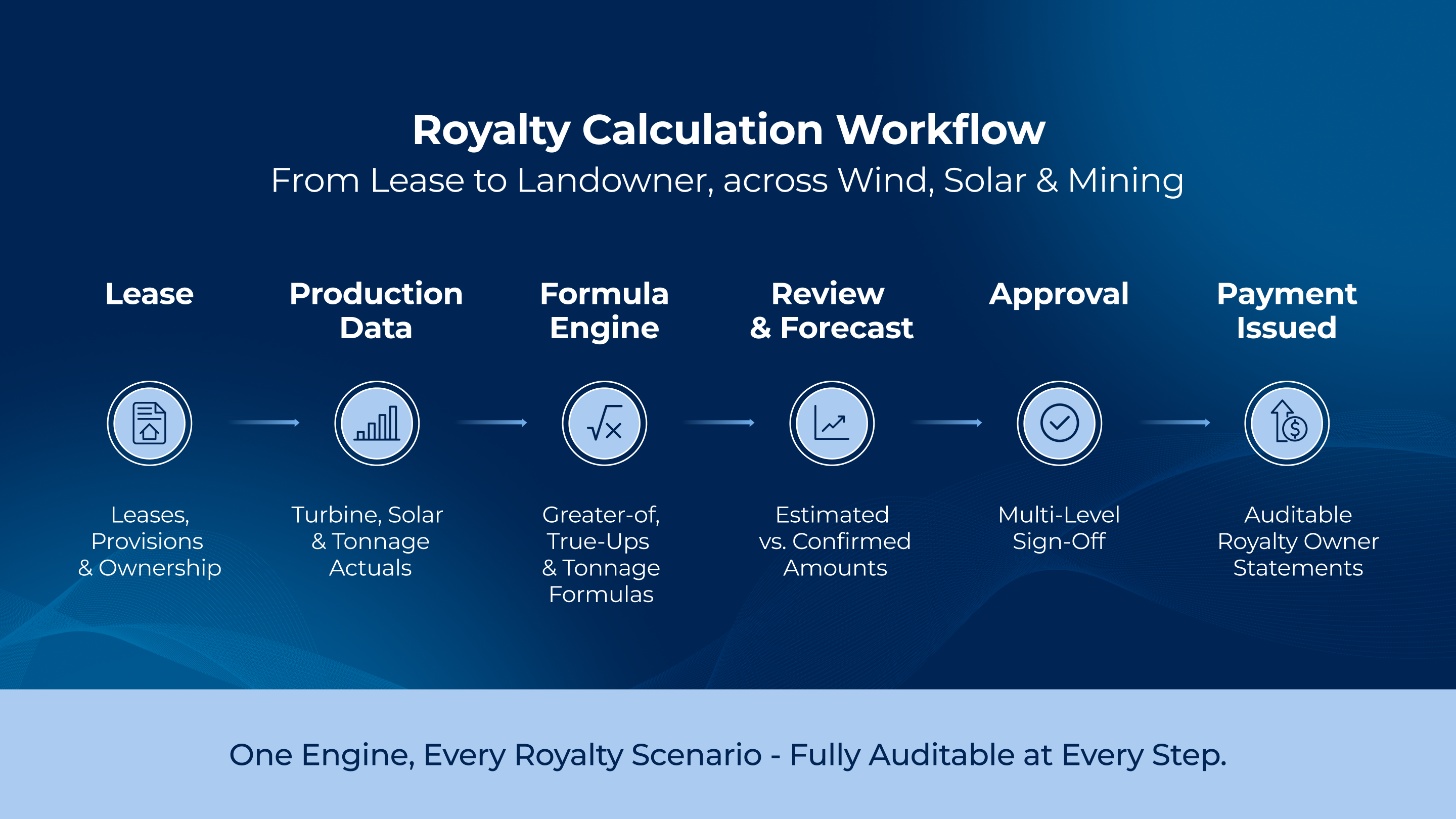
Feeding all of this is a new centralized Production & Revenue data capability: a standard way to capture production, revenue, and tonnage actuals against turbines, solar assets, mines, and other facilities, whether that data arrives through the platform's API or a bulk spreadsheet import. Every calculation runs against a clean, auditable data set instead of a disconnected file.
Configurable, Not One-Size-Fits-All
As with the rest of the formula library, every calculation ships with a default name and description that customer administrators can customize to match their own business terminology and can be shown or hidden per environment. The underlying formula logic stays consistent. You're adapting the language, not re-engineering the math for every customer.
Why It Matters
If your team is stitching together SCADA exports, production spreadsheets, and manual greater-of logic every payment cycle, here are four ways it changes what that cycle looks like.
- Removes the reconciliation gap. Between production/tonnage data, the formula, and the payment, they can all live in one system instead of three.
- Cuts the manual work of re-deriving greater-of and true-up logic. Work no longer needing to be done by hand, cycle after cycle, project after project.
- Makes every calculation defensible. Landowner and royalty owner statements trace back to the exact formula and data that produced them, not a spreadsheet version history.
- Scales with the portfolio. Growing a project count or adding a new mine doesn't have to mean growing the spreadsheet sprawl alongside it.
This isn't a set of spreadsheet macros stitched to your land system. The lease, the production or tonnage data, the formula, and the resulting payment all live in the same governed platform. That's the difference between a calculation you can defend in an audit and one you have to reconstruct from memory.
The advanced Royalty Calculation Formula Engine is included for all On Demand Land customers at no additional cost. Already a customer? Talk to your Quorum account team about enabling it for your environment. Evaluating On Demand Land? Request a demo to see it run against your own wind, solar, or mining royalty scenarios.
 Previous Page