 8 min read
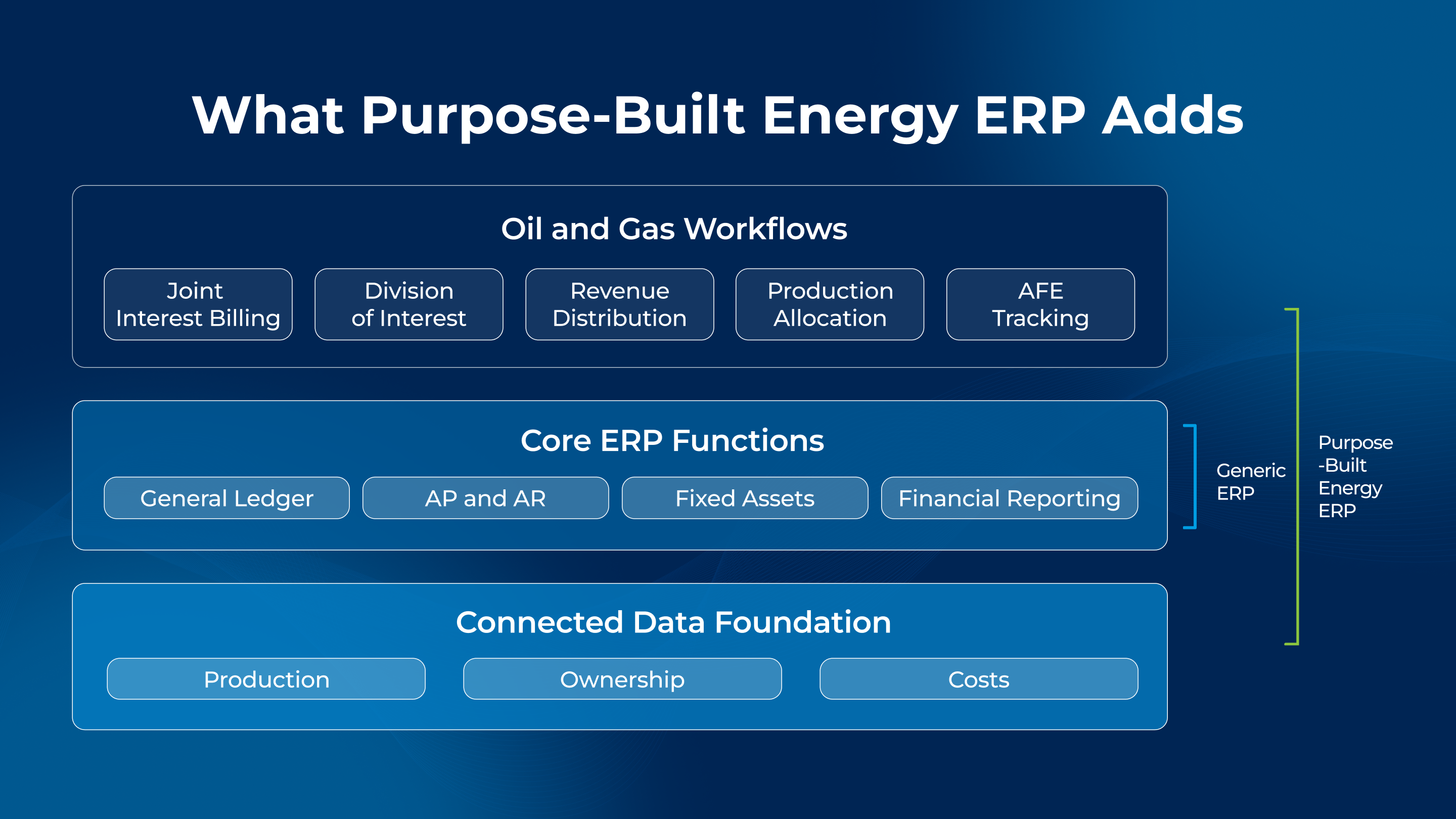
Oil and gas companies run financial and operational workflows that standard enterprise resource planning systems were not built to handle. Joint interest billing, division of interest tracking, revenue distribution, production allocation, and authorization for expenditure management require field-specific logic that generic platforms cannot provide without significant configuration. Quorum Accounting runs these workflows natively, connecting financial, production, and operational data in one accounting environment. Understanding what energy ERP has to cover is the starting point for evaluating whether a platform fits the business or simply requires workarounds.
Key Takeaway
Oil and gas ERP has to run five processes that generic platforms cannot support without heavy customization: joint interest billing, division of interest, revenue distribution, production allocation, and AFE tracking. Purpose-built energy software handles these natively. That determines whether financial close, ownership management, and capital control are manageable as the business scales.
The Five Processes Oil and Gas ERP Has to Run
Joint interest billing applies when multiple working interest owners share costs on a well. Each owner's share has to be billed correctly, tracked by expense category, and reconciled against ownership records that change over time. JIB logic in a purpose-built system accounts for ownership percentages, non-consent elections, and cutback dates without requiring custom code. Generic platforms require significant configuration to replicate this, and that configuration often breaks down as interests are transferred or reassigned.
Division of interest tracks the ownership split for revenue purposes, which is a separate record from the cost ownership that JIB manages. When interests are divided, sold, or reassigned, those changes cascade through revenue calculations, check runs, and owner statements. Managing division of interest outside a connected accounting system creates reconciliation differences that accumulate across periods and become harder to trace as well count grows.
Revenue distribution assigns proceeds received from purchasers to each working interest and royalty owner according to their decimal interest. The calculation depends on production volumes, pricing, and ownership records being current and consistent at the time of distribution. A system that holds production, pricing, and ownership data in the same environment reduces the risk of distributing revenue on stale or mismatched records.
Production allocation assigns produced volumes back to individual wells and leases when gas is gathered, compressed, or processed before reaching a sales point. Getting allocation right determines whether the revenue recorded in the accounting system reflects what actually came out of the ground. When volumes allocated in production operations feed revenue accounting without a manual transfer, discrepancies surface at the source rather than in a downstream reconciliation.
AFE tracking authorizes well and facility spending before it occurs and connects that authorization to actual cost coding. Without a system that ties approvals to cost codes, operators work from static documents that cannot prevent overspend in real time. Purpose-built energy platforms maintain an audit record for each approval and allow cost code restrictions to enforce budget limits at the point of entry.
Generic ERP Versus Purpose-Built Energy Software
Standard ERP platforms handle general ledger, accounts payable and receivable, fixed assets, and financial reporting. Those capabilities are necessary for any energy company, but they do not include the field-specific logic the five processes above require. A generic platform that adds an oil and gas industry module addresses some of these gaps, but the module still sits on top of a financial architecture that was not built to hold production data, track ownership changes over time, or run allocation calculations natively.
Purpose-built energy software starts from the assumption that production, ownership, and financial data have to coexist in the same system. Division of interest records update in the same environment where revenue is calculated. Production volumes from allocation feed directly into the cost and revenue accounting process. When a JIB dispute arises, the data trail is in the same system as the original billing. That continuity determines whether month-end close takes days or weeks.
The fit between platform type and company type generally follows the complexity of the operation. A company with a small well count, no joint ventures, and simple royalty structures can often operate on a configured generic platform for years without running into significant problems. A company with hundreds of wells, multiple working interest partners, and complex division of interest records will encounter the limits of a generic platform as transaction volume and ownership complexity increase.
Suite Versus Point Solution
A point solution handles one process well, and some operators build a stack of point solutions across land, production accounting, operations, and reporting. The recurring problem is data movement. When production volumes are calculated in one system, ownership records are maintained in another, and revenue distribution runs in a third, each handoff between systems creates an opportunity for reconciliation differences to emerge.
A suite built around connected modules reduces these handoffs. When land records, production allocation, joint interest billing, and revenue distribution operate within the same platform, ownership changes update across relevant workflows without requiring a manual export and import cycle. After deploying Quorum's integrated suite across 15 legal entities, Venator increased production accounting team efficiency by 75% by eliminating the reconciliation work that had accumulated across disconnected systems.
The suite model matters most when field measurement and SCADA data are part of the workflow. Production allocation depends on accurate volume data from the field. If that data arrives in the accounting system through a manual transfer, the allocation calculation is only as current as the last export. Platforms that connect to field measurement and SCADA environments can bring volume data into the allocation workflow without manual steps, which reduces the gap between what happened at the wellhead and what gets recorded in production accounting.
What Integration with SCADA and Measurement Changes
SCADA systems capture real-time field data including flow rates, pressures, and equipment status. When that data connects to a production operations platform that feeds the accounting system, operators can identify production exceptions, confirm volume data before the accounting close, and respond to downtime events with current information rather than delayed field reports. An Oklahoma E&P operator reduced costs by more than $600,000 per month by connecting SCADA data to production monitoring through Quorum, replacing manual data collection across 25 well sites with automated capture and real-time visibility.
Measurement accuracy determines whether the volumes entering the allocation calculation are reliable. If measurement data is validated before it reaches the accounting system, it arrives with a known level of quality. If it arrives as raw input without validation, the accounting team carries the burden of identifying and correcting bad data before the close. Energy ERP platforms that integrate with measurement solutions allow the accounting team to work from data that has already been validated at the source, which improves allocation accuracy and reduces the number of adjustments that follow the initial close.
Questions to Ask a Vendor
These questions help distinguish platforms that support energy workflows natively from those that rely on configuration or third-party tools to fill the gap.
How is division of interest managed when interests are transferred or reassigned? The answer should describe a workflow internal to the system that updates ownership records and cascades changes through revenue calculations. An import process from a separate land system is a sign that the two functions are not connected.
How does the system handle JIB cutbacks and non-consent elections? Ownership-driven cost adjustments should be part of the billing logic, not a manual adjustment applied after the initial billing run.
How does production allocation connect to the revenue distribution calculation? The system should describe a data path from volume measurement to owner check run that does not require manual extraction at any step.
How does AFE approval connect to cost coding in accounts payable? Approvals should restrict cost code entry in the payable workflow, not exist as a separate authorization document that the AP team references manually.
How does the platform handle prior-period adjustments to volumes or ownership? This is where many systems generate reconciliation work. A purpose-built energy platform should carry adjustments forward through the affected revenue periods without requiring a manual recalculation.
Conclusion
Oil and gas ERP is a distinct category because the financial and operational workflows of upstream energy companies require logic that general-purpose platforms do not provide natively. The five processes that define the category, joint interest billing, division of interest, revenue distribution, production allocation, and AFE tracking, create a baseline requirement that determines whether a platform fits the business or requires workarounds that grow harder to manage over time. Evaluating vendors against that baseline before shortlisting reduces the risk of selecting a platform that handles general accounting well but creates operational problems as ownership complexity and transaction volume increase.
FAQ
What is the difference between oil and gas ERP and standard ERP?
Oil and gas ERP includes upstream-specific logic for joint interest billing, division of interest, revenue distribution, production allocation, and AFE management. Standard ERP covers general accounting functions but does not include the field-level calculations required to manage ownership-driven cost and revenue workflows at scale.
What does joint interest billing require in an ERP system?
JIB requires the ability to apply ownership percentages across expense categories, track non-consent elections and cutbacks, and generate billing statements that reconcile with the accounting system. It also requires the system to hold a current ownership record so that billing reflects the active working interest split rather than a prior-period state.
What is the role of SCADA in oil and gas accounting?
SCADA captures field data including production rates and equipment status. When SCADA data connects to the production accounting system, it provides the volume inputs needed for allocation and reduces the manual steps required to bring field information into the close process.
What is the difference between a production accounting suite and a point solution?
A suite connects land, production, accounting, and reporting functions in one environment, which reduces the data handoffs that generate reconciliation differences. A point solution handles one of those functions well but requires integration or manual data movement to connect with the rest of the workflow.
Do small operators need oil and gas ERP?
Small operators with few wells, simple royalty structures, and no joint ventures can often manage with a configured general accounting system for some time. As well count increases, joint ventures form, and division of interest records grow in complexity, the manual effort required to maintain accurate ownership and revenue calculations increases faster than the business. Purpose-built energy software addresses that complexity at the process level.
 Previous Page
