 10 min read
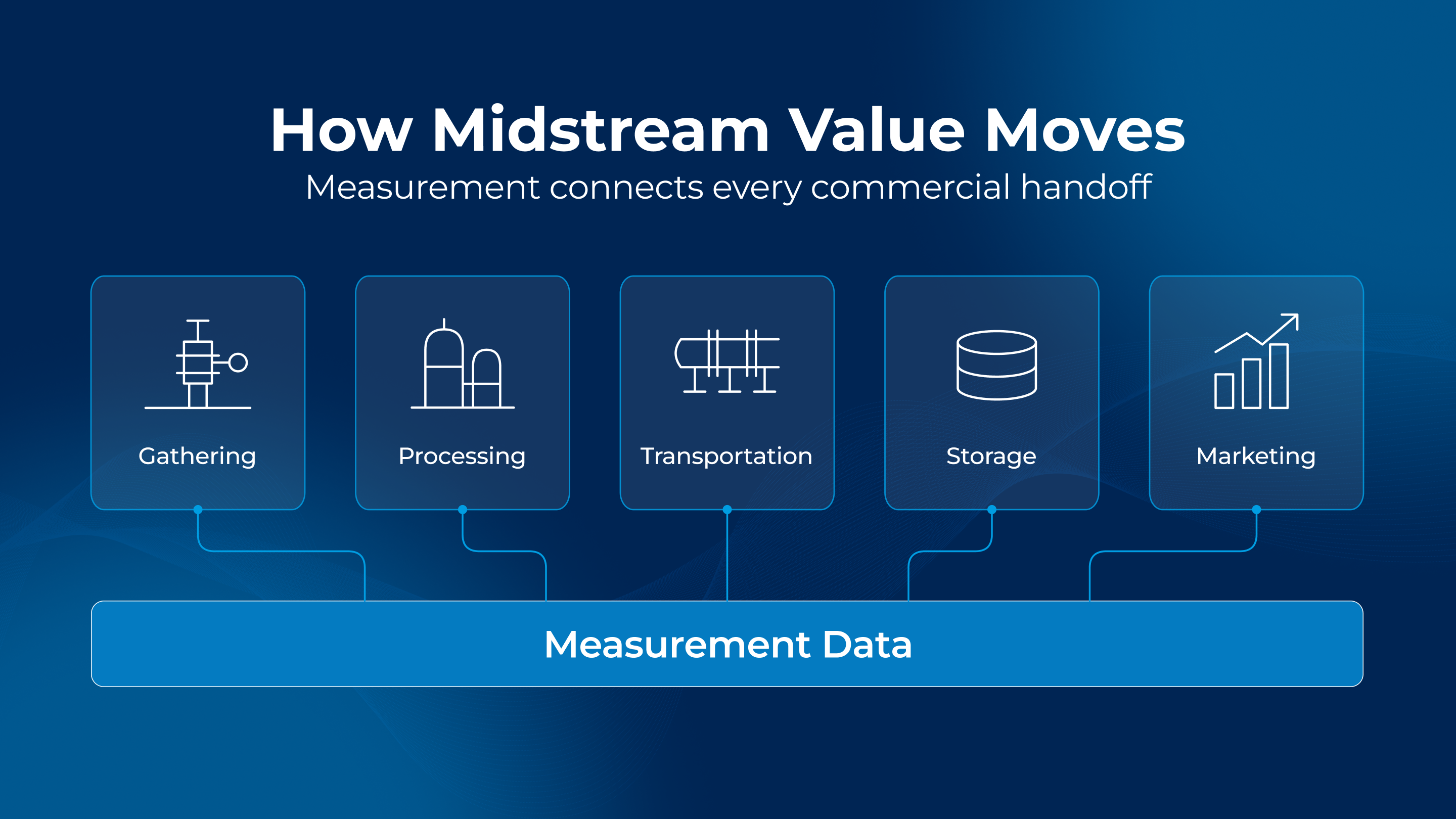
The midstream sector moves hydrocarbons from the wellhead to end-use markets through five connected segments: gathering, processing, transportation, and storage. Energy is marketed at sales points along the way. Each segment has its own commercial logic, its own accounting requirements, and its own data dependencies. Quorum Gas Gathering & Processing manages gathering, processing, and plant accounting at one end of that chain — the workflows continue across pipelines and storage facilities, and through marketing, accounting, and sales invoicing.
Understanding how these segments connect is useful whether you manage one asset or oversee a portfolio. A discrepancy at the wellhead meter shows up later in the plant statement and, eventually, in the producer's payment. The traceability between those events determines how fast an operator can close, settle, and respond to disputes.
Key Takeaway
Midstream operations span five segments, each generating distinct commercial and accounting obligations. Measurement data connects them all. Traceability across the handoffs between segments determines close speed, settlement accuracy, and audit readiness.
Gathering
Gas gathering begins at the wellhead meter or lease automatic custody transfer unit, where produced volumes are measured and documented before entering the gathering system. Operators collect volumes from multiple producers across multiple leases. The accuracy of measurement at each receipt point determines the integrity of everything that follows — volume discrepancies discovered weeks later require prior-period adjustments, which generate disputes and delay settlements.
Gathering lines carry gas through a network of smaller-diameter, lower-pressure infrastructure to a processing plant or transmission interconnect. Along the way, operators track receipts by producer, apply compression and fuel allocations, and account for line loss. These entries form the basis of the allocation that will eventually tell each producer how much gas was gathered in their name and what deductions apply.
The gathering close cycle is time-sensitive. Producers expect statements on a defined schedule. When measurement validation is manual or disconnected from the allocation system, the process slows and the error rate rises.
For a detailed breakdown of how allocations work within a gathering system, see our article on Midstream Allocation and Settlement.
Processing
At the gas plant, raw inlet gas is treated to remove water, CO₂, and other contaminants, then processed to extract natural gas liquids such as ethane, propane, and butane. Residue gas is redelivered to a pipeline or end user; the liquids are fractionated and sold separately. Processing agreements define how the plant and producers share the resulting volumes and value, which makes contract terms the controlling input for plant accounting.
Plant accounting converts processing results into settlement statements. The accountant applies shrinkage factors, fuel usage, processing fees, and liquids splits according to each producer's contract terms. When those terms vary by producer or by product, the allocation logic becomes complex quickly. A rules-based allocation engine applies contract-specific formulas consistently across every settlement cycle, reducing the manual reconstruction that causes close delays and prior-period adjustments.
Nominations and scheduling also govern the plant. Producers must nominate volumes they expect to deliver; the plant operator schedules receipts against available capacity. When actual volumes differ from nominations, the system tracks the imbalance and either carries it to a future settlement or generates an out-of-tolerance notification.
For a detailed breakdown of plant allocation mechanics and how imbalances are tracked, see Midstream Allocation and Settlement.
Transportation
After processing, gas moves through pipelines to market. Transportation is governed by tariffs, contracts, and regulatory requirements that vary by asset type. Interstate pipelines must comply with NAESB standards for nominations, confirmations, and scheduling. Intrastate pipelines and local distribution companies operate under state jurisdiction but follow similar commercial workflows.
Pipeline transportation management centers on the daily nomination cycle. Shippers submit gas day nominations for each path on the pipeline; the operator confirms, schedules, and allocates capacity. Actual flows are measured at receipt and delivery points. Any difference between scheduled and actual volumes creates an imbalance that must be tracked and settled.
Quorum's pipeline nomination and scheduling solution handles NAESB-compliant workflows across interstate and intrastate pipelines, connecting nominations, scheduling, allocations, and invoicing in one transaction workflow. The same solution supports customer portals that give shippers real-time visibility into their nominations, confirmations, and imbalances, which reduces the volume of service calls and off-system inquiries that slow commercial operations.
Invoicing follows the scheduling cycle. The operator generates statements for transportation charges, fuel, and retainage, then issues them to shippers. Prior-period adjustments arise when meter data is corrected or when scheduling errors are identified after the fact.
For more detail on nominations, confirmations, and the pipeline scheduling cycle, see Pipeline Nomination 101.
Storage
Storage fields and LNG peaking facilities hold gas during low-demand periods and release it when demand rises. The commercial workflow around storage includes injections, withdrawals, and inventory balances. Each injection and withdrawal is measured and priced according to storage contracts, which typically specify capacity rights, injection and withdrawal rates, and pricing formulas.
Storage accounting tracks inventory using a combination of physical measurement and contractual attribution. When multiple shippers hold storage rights on the same field, the operator allocates inventory to each shipper's account based on their contract terms and activity. Balancing storage inventory against pipeline nominations requires the same measurement discipline that governs gathering and transportation.
Marketing
Marketing sits at the commercial end of the midstream chain, where physical gas and liquids volumes are bought, sold, and delivered under contracts ranging from spot transactions to long-term agreements. A marketing operation handles deal capture, scheduling, inventory management, pricing, invoicing, and settlement. These activities generate a high transaction volume daily, and the margin on each deal depends on accurate pricing, clean measurement data, and timely settlement.
Commercial workflows in marketing start with contract and deal management. Traders capture transactions against pricing indices, fixed prices, or complex formula-based arrangements. Scheduling follows: volumes must be nominated into pipelines, confirmed with counterparties, and tracked against inventory balances. At month-end, the marketing desk reconciles actual volumes against contracted volumes, prices each transaction, and generates invoices.
Quorum Energy Marketing handles this commercial workflow for gas, NGLs, crude oil, and refined products. It connects deal capture through scheduling, inventory, and settlement, providing the position and cost visibility that marketing operations require to close quickly and avoid month-end surprises.
Profitability reporting ties marketing performance back to the cost of the underlying commodity, transportation, and storage. When those costs are embedded in the same system as the sale, the margin calculation is traceable. When costs sit in a separate system or are estimated late in the cycle, reconciliation consumes significant time and introduces error.
Where Measurement Connects the Chain
Every segment of the midstream chain depends on trusted measurement data. The wellhead meter establishes the basis for gathering allocations. The plant inlet meter determines what enters processing. The pipeline receipt and delivery meters govern transportation and storage attribution. The marketing desk relies on confirmed volumes for settlement. Errors in any of these measurements propagate through the chain, surfacing as allocation variances, invoice disputes, or prior-period adjustments.
Quorum's measurement data management solution serves as the central repository for hydrocarbon measurement data across all of these points. It collects, validates, balances, and reports measurement volumes, maintaining a complete audit trail of every data change. The platform is used across approximately 80% of North American midstream companies — a scale that reflects how foundational measurement management is to midstream operations.
For a detailed explanation of how line loss, shrinkage, and unaccounted-for gas are tracked and reconciled, see Volumetric Balancing 101.
Where Issues Occur
Midstream operations concentrate risk at a few recurring points. Measurement data quality at receipt and delivery meters determines the accuracy of everything downstream. When meters are not validated on a regular schedule, or when field corrections are not systematically recorded, allocation and settlement statements reflect those errors.
Nomination cutoff windows create time pressure in transportation. Shippers must submit nominations before the pipeline's scheduling cycle closes. Late or inaccurate nominations result in curtailments, imbalances, or lost capacity, all of which generate exceptions that must be resolved before invoicing can proceed.
Plant accounting complexity scales with contract variability. A single plant serving producers under 15 different processing agreements must apply 15 different allocation formulas in each close cycle. The more those formulas are maintained outside a rules-based system, the greater the risk of error and the longer the close takes.
| Risk Area | Source | Downstream Impact |
| Measurement inaccuracy | Unvalidated or uncorrected meter data | Allocation variances, disputed statements |
| Nomination timing | Manual or disconnected nomination workflows | Imbalances, curtailments, lost capacity |
| Contract complexity | Formula errors in plant accounting | Prior-period adjustments, close delays |
| Disconnected systems | Separate measurement and accounting tools | Reconciliation effort, audit exposure |
Role of Systems and Data
Midstream systems serve different functions depending on where they sit in the workflow. At the gathering and processing end, the priority is allocation accuracy and settlement integrity. Quorum Gas Gathering & Processing manages scheduling, allocations, settlements, and plant accounting in a single platform, applying rules-based logic to measurement data to produce statements producers can verify.
Pipeline nomination and scheduling addresses the nomination, scheduling, and allocation lifecycle from receipt to delivery. Quorum Gas Pipeline supports NAESB-compliant workflows across interstate and intrastate pipelines and connects the commercial workflow to measurement data and accounting.
For operators managing hydrocarbon volumes across multiple functions, Quorum Hydrocarbon Pipeline Accounting provides broader hydrocarbon accounting, custody transfer, and commercial settlement capabilities — particularly useful for organizations with international operations or integrated LNG workflows.
Quorum FLOWCAL underpins all of these workflows by establishing a validated, auditable measurement foundation before data moves into allocation, reporting, or settlement.
Scalable Process State
A midstream operation reaches a stable, scalable process state when measurement, allocation, scheduling, and settlement run through a consistent, connected workflow. The close cycle becomes predictable. Prior-period adjustments decrease. Producers receive accurate statements on schedule. The accounting team can answer questions about any payment without reconstructing the calculation from raw data.
This state is harder to maintain as assets grow. An operator that doubles its plant count, adds new producers, or acquires a pipeline must extend its commercial and accounting workflows to the new assets without creating parallel processes. Purpose-built systems support that extension by applying consistent rules across assets regardless of size or age.
Conclusion
Midstream oil and gas operations span five segments, each with its own commercial and accounting requirements. Gathering and processing generate allocation and settlement obligations tied directly to measurement accuracy. Transportation runs on nomination and scheduling workflows governed by regulatory standards. Storage adds inventory tracking and shipper attribution. Marketing connects the commercial outcome to the physical flow. Measurement data connects all of them.
The articles linked throughout this piece go deeper on specific workflows. The processes described here are interdependent: getting them right at each stage reduces adjustment volume, shortens the close cycle, and builds the traceability that audits and disputes require.
FAQ
What is midstream oil and gas?
Midstream refers to the segment of the oil and gas industry that gathers, processes, transports, stores, and markets hydrocarbons between production and end-use. It includes gas gathering systems, processing plants, pipelines, storage fields, and marketing operations.
What is the difference between gathering and transportation?
Gathering collects produced volumes from individual wells or leases through a lower-pressure, smaller-diameter network and delivers them to a plant or transmission interconnect. Transportation moves processed or treated gas through a larger-diameter, higher-pressure pipeline to market or end user. The two workflows operate under different regulatory frameworks and commercial agreements.
What is plant accounting in midstream?
Plant accounting converts gas processing results into settlement statements for producers. It applies contract-specific formulas for shrinkage, fuel usage, processing fees, and liquids splits to allocate value between the plant and each producer. The accuracy of plant accounting depends on measurement data quality and the correct application of each producer's contract terms.
What is midstream allocation?
Midstream allocation attributes measured volumes to individual producers, shippers, or contractual accounts based on defined rules or contract terms. In a gathering system, allocation distributes total inlet volumes to each producer's account. In a plant, it distributes residue gas and liquids according to each processing agreement. In a pipeline, it distributes delivery volumes to each shipper's account.
What is a nomination in pipeline operations?
A nomination is a shipper's request to move a specified volume of gas through a pipeline on a given gas day. Shippers submit nominations before the pipeline's scheduling deadline. The pipeline operator confirms and schedules nominations against available capacity, then compares actual flows to scheduled volumes at the end of the gas day.
What is volumetric balancing in midstream?
Volumetric balancing reconciles measured volumes at receipt points against measured volumes at delivery points, accounting for line loss, shrinkage, fuel, and flare. Unaccounted-for gas is the remaining difference after all known deductions are applied. Regular balancing identifies measurement discrepancies and supports prior-period adjustments when corrections are needed.
What digital tools run midstream operations?
Midstream operators use purpose-built software for gas gathering and plant accounting, pipeline transaction management, hydrocarbon measurement, commercial marketing, and midstream hydrocarbon accounting. These tools manage allocation logic, scheduling workflows, measurement data, and settlement across the five midstream segments. Quorum Software provides purpose-built solutions across each of these workflow areas.
 Previous Page