 10 min read
The upstream month-end close is the process of finalizing a period's financial records — reconciling accounts, recording accruals and adjustments, and producing statements. For oil and gas operators, it also converts measured production volumes and current ownership interests into recognized revenue and owner payments, and it typically runs five to ten business days.
For an upstream operator, revenue begins as a calculation. Measured volumes, current ownership, and contract terms determine every dollar the close recognizes, and many of those inputs settle days after the period ends. That dependency shapes the entire close calendar.
This guide walks the upstream close in three phases: pre-close preparation, close execution, and post-close review. It flags the upstream-specific reconciliations that generic finance checklists leave out, and it ends with the automation that lets operators hold a tight calendar as they grow. It is written for the controller or accounting manager who owns the close and answers for its accuracy.
What Is the Month-End Close?
At its core, the close reconciles accounts, records accruals and adjustments, and produces statements that reflect actual performance. The upstream version adds work that horizontal accounting software rarely addresses. Volumes have to be estimated before they are measured, ownership has to be current before revenue can be distributed, and owner payments depend on both. The sections below break the cycle into tasks an accounting team can assign, sequence, and track.
Why Is the Close Harder for Upstream Operators?
Four conditions make the upstream close more demanding than a standard corporate close.
Revenue depends on measured volumes. Sales revenue reflects what wells actually produced, and measured volumes often arrive after the accounting deadline. Teams accrue revenue on estimated volumes, then true it up when final measurements land. Every accrual is a temporary number waiting for correction.
Ownership changes constantly. A division of interest (DOI) defines who owns what share of production from each property. Acquisitions, divestitures, and title corrections all change those decks. Revenue distributed on a stale DOI produces incorrect owner payments and rework in the following month.
Joint operations create billing complexity. Most upstream properties are jointly owned. The operator pays the costs, then bills the other owners through joint interest billing (JIB). The close has to allocate shared costs correctly before statements go out.
Specialized entries carry real dollars. Severance and production taxes, asset retirement obligation (ARO) accretion, depreciation, depletion, and amortization (DD&A), and authorization for expenditure (AFE) reconciliation each require upstream judgment. None of them appear on a generic close checklist.
These conditions concentrate risk in one place: the inputs. When production data and ownership are clean at the start of the close, the rest of the cycle runs on schedule. When they are not, every downstream step inherits the problem.
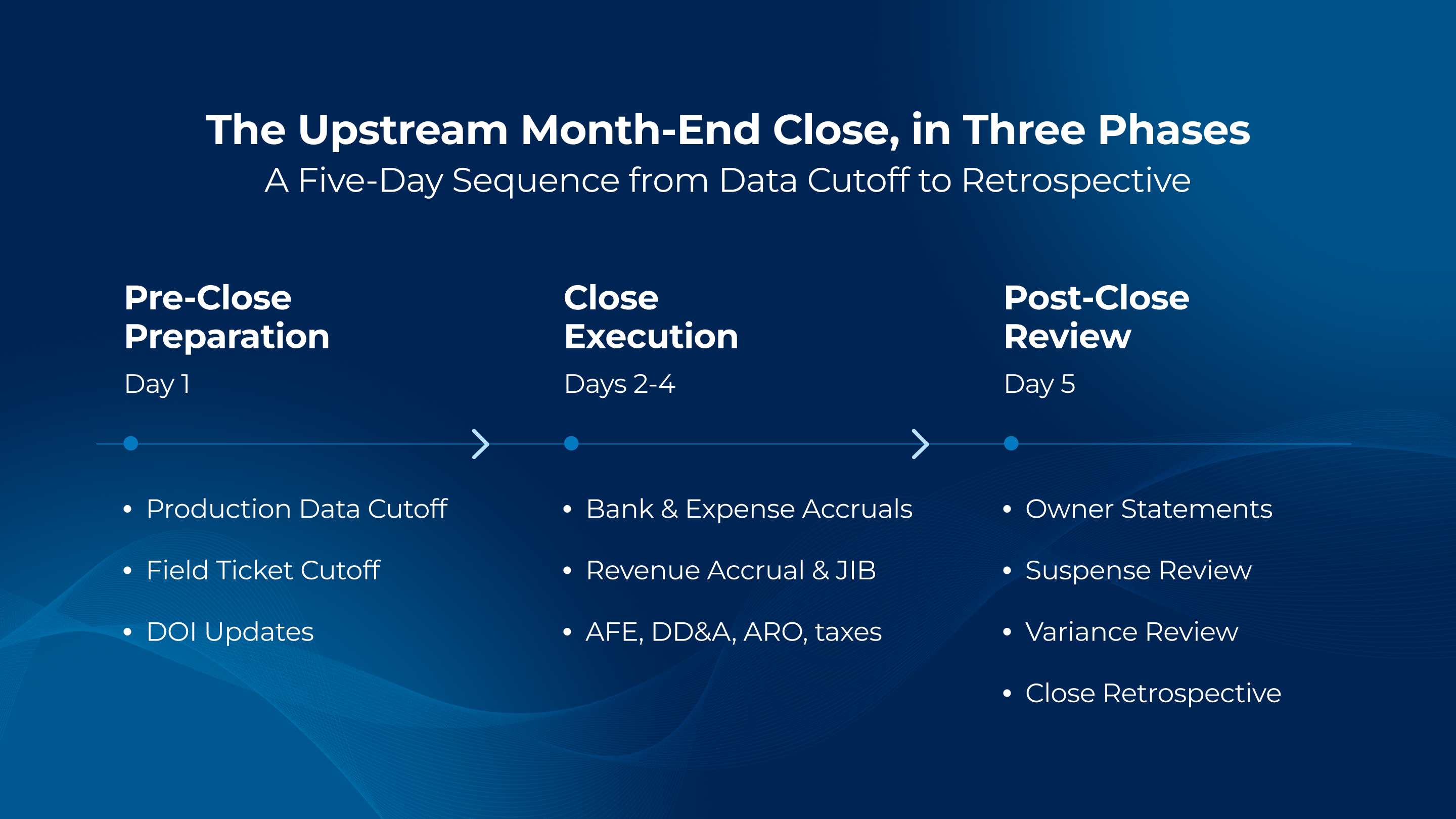
Phase 1: Pre-Close Preparation
Most upstream close problems trace back to Phase 1. This is the phase where the numbers are assembled, not only reconciled, and it deserves more attention than most calendars give it. Assign an owner to each item below and confirm completion before execution starts. The close moves faster when Phase 1 is treated as a gate rather than a warm-up.
Production data cutoff
Set and enforce a firm cutoff for production volumes. Field data, run tickets, and measurement records feed revenue and allocation, so the close cannot begin until volumes are locked. Oil and gas volumes rarely finalize on the same schedule, and pipeline or plant statements for gas often lag crude. Build the cutoff around your latest reliable source and hold the rest to estimates you can defend. The goal is a defensible volume for every producing property, not a perfect one.
Field ticket and invoice cutoff
Apply the same discipline to costs. Field service tickets, purchase orders, saltwater disposal charges, and vendor invoices that relate to the period need to be captured before accruals are calculated. Late-arriving costs are a leading cause of post-close adjustments and JIB restatements.
Division of interest updates
Confirm that ownership decks reflect every executed acquisition, divestiture, and title change. Pull pending changes from the land team before revenue distribution begins. A DOI corrected after distribution forces a rerun of revenue, JIB, and owner statements, which is the most expensive rework in the close.
Phase 2: Close Execution Checklist
With inputs locked, execution becomes a defined sequence. Work the items in dependency order so that each step builds on validated data.
Bank and cash reconciliations
Reconcile operating, royalty, and suspense bank accounts. Confirm that cash movements match recorded transactions and that any variance is identified and explained.
Accounts payable and expense accruals
Record accruals for costs incurred but not yet invoiced, using the field ticket data captured in Phase 1. Confirm expense coding by property and cost center so that allocations and JIB are accurate.
Revenue accrual and reconciliation
Accrue revenue on estimated volumes for the current period and true up prior-period accruals as final volumes and prices settle. Reconcile accrued revenue to expected sales by product stream: crude, natural gas, and natural gas liquids. Price the accrual on the best available index or contract terms, and separate volume true-ups from price true-ups when you review the following month, so it is clear whether a swing came from production or from the market. This is usually the single largest reconciliation in the upstream close, and it depends entirely on the volume cutoff from Phase 1.
Joint Interest Billing
Allocate operated costs across working interest owners and generate JIB statements. Verify that only billable costs are included and that each owner's share matches the current ownership deck. Watch for non-billable items, owner-level prepayments, and any non-consent penalties, since each changes what a specific owner sees on a statement. Errors here surface as owner disputes, so accuracy protects both cash and relationships.
AFE and Capital Reconciliation
Reconcile capital spending against each authorization for expenditure. Confirm that costs are classified correctly as capital or expense, and flag any AFE approaching or exceeding its approved amount for management review.
DD&A and Depletion
Calculate depreciation, depletion, and amortization for the period based on current reserves and production. Units-of-production methods tie the calculation to reserves, so a reserves revision changes the rate. Confirm which reserves basis the period uses, and that new properties and recently completed capital projects are included in the depletable base.
Asset Retirement Obligation
Record ARO accretion for the period and adjust for any revised abandonment estimates or newly acquired obligations. These entries are small each month and material over time, so consistency matters. Revisit the underlying estimates at least annually, and whenever a well's expected life or abandonment scope changes.
Severance and Production Taxes
Calculate severance and production taxes by jurisdiction, applying the correct rates and any exemptions. Rates and exemptions vary by state and by product, and some jurisdictions offer reduced rates for marginal or newly completed wells. Confirm the current schedule rather than carrying forward last period's assumptions, and reconcile tax accruals to expected filings so that liabilities are neither understated nor carried incorrectly.
Intercompany and Entity Eliminations
For operators with multiple entities, reconcile and eliminate intercompany transactions before consolidation. Confirm that shared costs and allocations net cleanly across entities. Resolve differences as they appear rather than after consolidation, since a single unexplained intercompany balance can hold up the entire consolidated close.
Phase 3: Post-Close Review
The close is not finished when the books are closed. Phase 3 converts a closed ledger into accurate owner communication and a faster next cycle.
Owner statements and payments
Generate and review revenue and JIB statements before they reach owners. Confirm that ownership, volumes, pricing, and deductions are correct, and that suspense is applied where required. Apply minimum-pay and small-balance thresholds consistently so that owners are paid on the schedule their agreements require. A statement error reaches an external audience, so this review carries weight beyond the ledger.
Owner suspense review
Review balances held in suspense for unresolved title, unlocatable owners, or pending elections. Track aging so that suspended funds are released or escheated on the correct schedule. Suspense that grows quarter over quarter signals an upstream data problem, usually in the DOI.
Variance and flux review
Compare actual results to the prior period and to budget. Investigate significant variances in revenue, expense, and production, and confirm each has a supported explanation before results are reported.
Close retrospective
Capture what delayed the cycle and where estimates required large true-ups. A short retrospective each month is how the close calendar actually shortens over time, rather than repeating the same bottlenecks. Track the two or three tasks that most often run late, and target one of them for improvement in the next cycle.
What Does an Upstream Close Calendar Look Like?
The following calendar shows a typical five-day upstream close. Operators with more entities or manual systems may run longer. The sequence, not the exact days, is the point.
| Day | Focus | Key Tasks |
| Day 1 | Cutoff and preparation | Lock production volumes; close field ticket and invoice intake; finalize DOI updates |
| Day 2 | Costs and accruals | Bank reconciliations; AP and expense accruals; AFE and capital reconciliation |
| Day 3 | Revenue and JIB | Revenue accrual and reconciliation; JIB allocation and statements |
| Day 4 | Specialized entries | DD&A and depletion; ARO accretion; severance and production taxes; intercompany |
| Day 5 | Review and statements | Variance review; owner statement review; suspense review; close retrospective |
What Are the Most Common Bottlenecks in the Upstream Close?
A handful of recurring problems account for most late closes:
- Late production data. When volumes arrive after the cutoff, revenue accruals slip and the whole sequence compresses.
- Stale ownership decks. DOI changes discovered during revenue distribution force reruns of revenue, JIB, and statements.
- Manual reconciliation between systems. Rekeying data between land, production, operations, and accounting introduces errors and consumes the days a close can least afford.
- Spreadsheet-based accruals. Disconnected spreadsheets make prior-period true-ups hard to trace and easy to duplicate.
- Growing suspense balances. Unresolved owner and title issues push work into future cycles and mask revenue accuracy problems.
- Unreconciled intercompany balances. Entities that do not net cleanly hold up consolidation until someone tracks down the difference.
Most of these share a root cause: the same data lives in several systems and has to be reconciled by hand. Removing that manual reconciliation is where automation earns its return.
How Do Operators Shorten the Close?
Every task in this guide depends on data moving cleanly between the land, production, operations, and accounting functions. When those systems are disconnected, the close absorbs the cost of reconciling them by hand. Removing that manual work is the most reliable way to compress the cycle.
On Demand Accounting is a cloud-based accounting platform built specifically for small and mid-sized exploration and production (E&P) companies. On Demand Accounting AP Workflow can detect potential duplicate invoices, helping accounting teams identify issues before payment and reducing manual review during the close. It integrates natively with the Upstream On Demand ecosystem, so the inputs the close depends on flow directly into accounting:
- Upstream On Demand Land synchronizes ownership, lease, and obligation data, which keeps the DOI current for revenue and JIB.
- On Demand Production Operations provides validated production volumes for revenue distribution and expense allocation.
- On Demand Well Operations aligns operational and accounting data and reduces reconciliation effort.
- Execute AFE Management connects capital spending to accounting, which supports AFE and capital reconciliation.
Native integration removes the manual handoffs and duplicate data entry that stretch the upstream close. Real-time financial visibility gives controllers current information instead of waiting for a system to catch up. The platform is SOC 2 Type 2 compliant and delivered as software as a service (SaaS) with zero-downtime upgrades, which supports audit readiness while reducing the infrastructure burden on the team.
The result is a close built on connected data instead of manual reconciliation. That is what lets an upstream team hold a tight calendar as the asset base grows.
Explore On Demand Accounting to see how connected upstream data supports a faster, more reliable close.
Frequently Asked Questions
How long should the month-end close take?
Most finance teams target five to ten business days. Upstream operators often sit at the higher end of that range because revenue depends on measured volumes and current ownership, both of which can settle after period end. Locking production data early and keeping the DOI current are the two changes that move the close toward the shorter end.
What is the difference between the close and the JIB cutoff?
The close finalizes all financial records for the period. The JIB cutoff is the specific deadline for capturing joint operating costs so they can be allocated and billed to working interest owners. The JIB cutoff sits inside the close as one of its dependencies. A missed JIB cutoff delays owner billing even when the rest of the close is on time.
What is a soft close?
A soft close is an abbreviated close that produces management numbers quickly by relying more on estimates and deferring some reconciliations. Upstream teams sometimes use a soft close for interim reporting, then complete a full close, including final revenue true-ups and owner statements, on the standard cycle.
 Previous Page