 6 min read
In today's energy operations, the speed gap is widening. Teams are more connected, more data-rich, and under greater pressure to respond faster, yet decision-making still isn't keeping pace with the business.
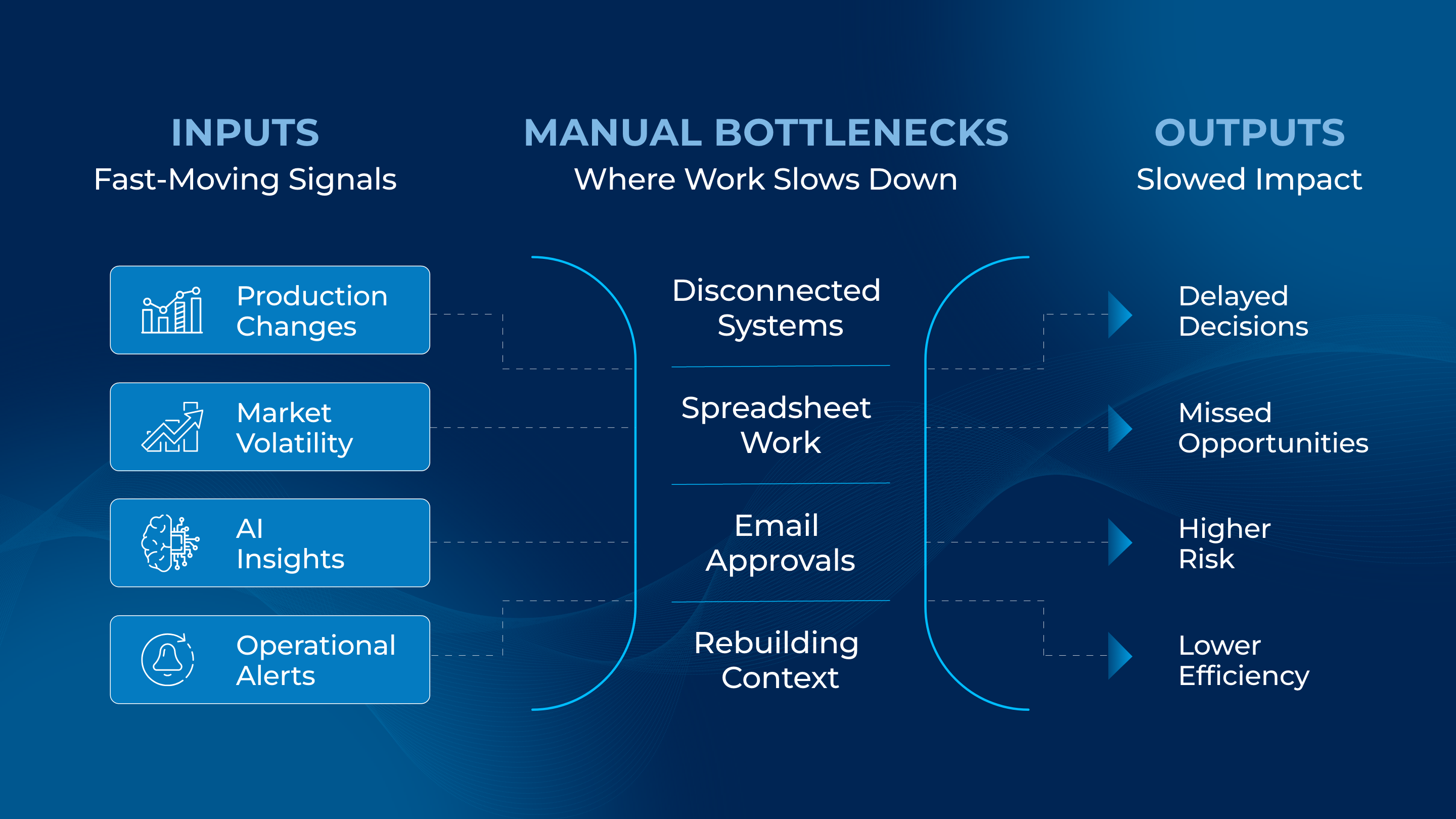
Energy companies are pulling data from disconnected systems, reconciling numbers across departments, and rebuilding context before decisions can move forward. As Radhika Krishnan, Quorum Software's Chief Product and Technology Officer, explains, "manual work becomes a serious bottleneck… that bottleneck slows decisions."
Since AI is rapidly becoming operational in energy, the question is no longer whether it will impact the industry. The real question is whether operational systems are ready for it. That readiness comes down to two ideas: connectedness and agency.
The Root Problem: Fragmentation Across the Business
Most energy systems were built in pieces as operational tools, financial systems, and planning models developed independently and never expected to work together in real time. Today they are. Data moves across operations, finance, planning, and commercial teams, and decisions are expected to reflect what's happening as it happens, while the underlying structure hasn't kept up.
This leaves data spread across systems and work creeping step by step across teams, where each transition depends on someone checking, reconciling, or reworking what came before. That structure slows everything: understanding what’s happening, aligning on numbers, building enough context to act. And as operations become more connected, those delays scale across the enterprise. According to research, 75% of data and analytics decision-makers say they are adopting DataOps practices, while 72% are adopting continuous integration or deployment for business intelligence, analytics, and data science — a reflection of how organizations are reworking operational workflows to move faster, reduce manual coordination, and turn data into action. (Goetz et al., 2023)
AI Increases Both Opportunity and Pressure
AI alone doesn't solve disconnected operations. If it is added on top of fragmented workflows often this accelerates confusion instead of improving decisions. When data lacks shared context and approvals happen outside governed systems, AI outputs become difficult to trust. So, AI is only as operationally trustworthy as the systems underneath it.
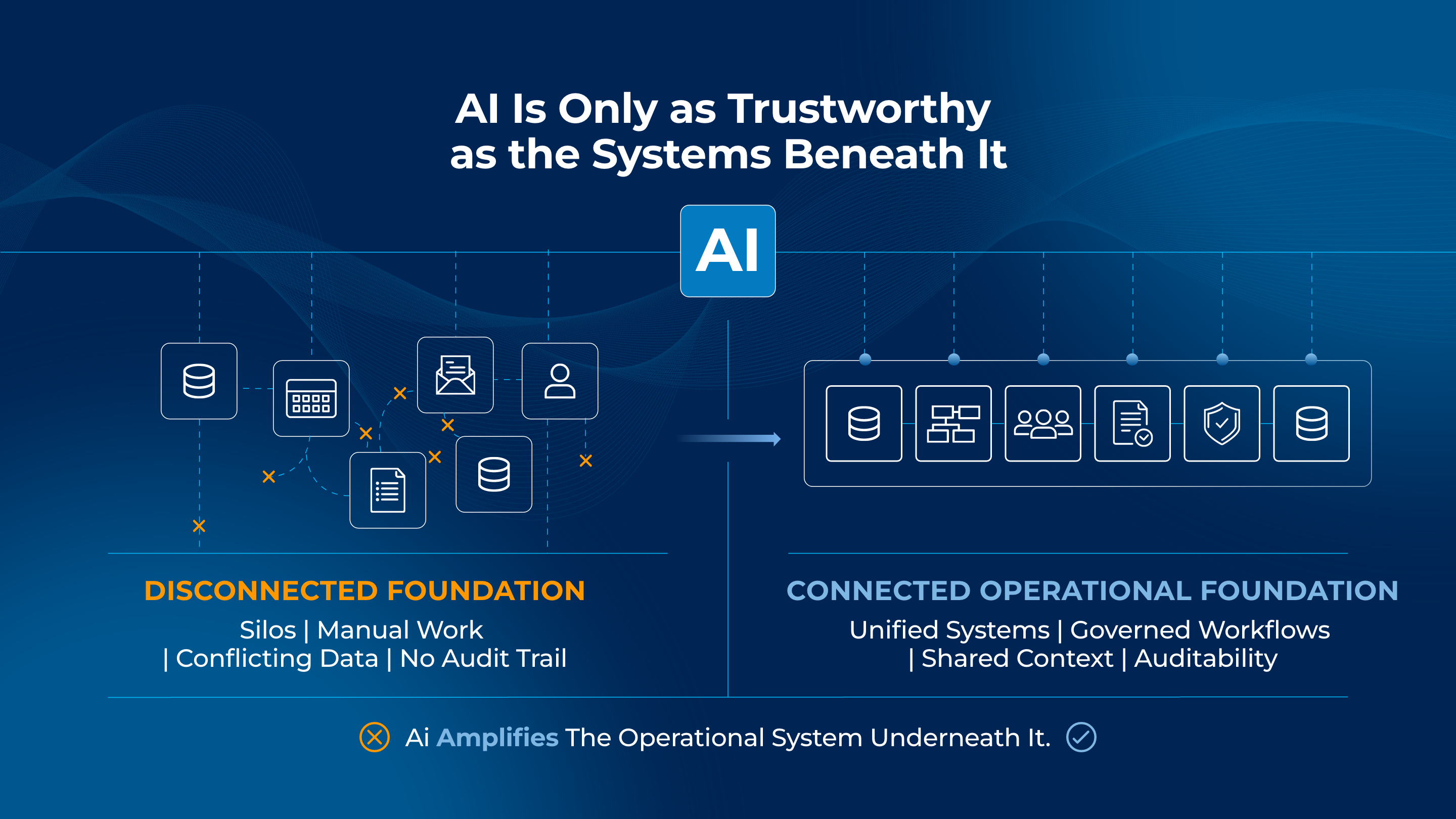
The future of AI in energy isn't about adding a chat interface on top of existing processes. It's about creating connected operational systems where AI can work with business context, governance, and auditability built in. That requires a different foundation than most organizations have today.
Where the Friction Lives Today
The friction inside many energy organizations isn't caused by a lack of expertise. It comes from the coordination required just to move work forward.
Operational and financial workflows are deeply connected: what happens at the wellhead affects production accounting, revenue distribution, planning assumptions, regulatory reporting, and cash flow. But when systems operate independently, errors don't stay contained; they propagate. Data integrity failures don't require malicious intent to cause serious damage. A coding error, a manual handoff, a spreadsheet that didn't get updated? These are enough.
For one global supermajor the cost showed up in planning cycles that never really ended. Teams were starting next year's plan before the current one was finished, with three or four employees per business unit trapped in re-cycles and manual validation instead of doing work that mattered. After implementing an energy-native corporate planning solution, email-based signoffs dropped to zero, FTE burden fell 60% per shale business unit, and re-cycle turnaround improved 10x.
Not because the software was faster but because the work finally flowed. So now, the shift is larger than planning modernization alone.
From Reactive Coordination to Connected Operations
The organizations moving fastest are changing how work flows across the enterprise. Instead of relying on teams to coordinate every transition manually, connected workflows allow information, approvals, and operational context to move together.
Consider what happens today when a field disruption occurs: a well goes down, a compressor trips, a measurement anomaly surfaces. What follows is a scramble across operations, measurement, and finance to understand the impact. That's disconnectedness under pressure. In a connected environment, a field disruption automatically triggers the right decision flow. Operational impact and financial exposure are visible together. Approvals go to the right people. Every step is tracked.
When exceptions surface, teams receive context alongside the issue: what changed, why it matters, and where action is needed — not just an alert, but a path forward.
This is where agency becomes critical. A system with agency doesn't simply notify users that something happened, it handles repeatable processes automatically, escalates meaningful exceptions, and helps teams focus where judgment matters most. As Krishnan puts it, "dashboards are just billboards showcasing all your pain." The goal is reducing the distance between signals, decisions, and action.
Building the Foundation for Connected, Agentic Operations
Connectedness and agency require modern operational infrastructure built on three layers:
| Foundation | Why it matters |
| Cloud and SaaS | Provide scalability, resilience, security, and continuous delivery for AI-enabled workflows |
| Data and AI | Create shared operational context across planning, production, accounting, and commercial systems so AI can operate with trusted business context |
| APIs and interoperability | Allow workflows, operational systems, AI services, and partner ecosystems to interact securely across the enterprise |
The Future of Energy Operations Is Connected and Agentic
The companies that move fastest won't necessarily be the ones with the most AI tools. They'll be the ones that create connected operational environments where AI can work with context, governance, and trust — reducing manual coordination, shortening the distance between signals and action, and letting systems handle repeatable work while people focus on judgment and strategy.
That's where connectedness and agency converge. And that's the foundation for the next generation of energy operations.
Explore how Quorum is building the AI and digital infrastructure for connected energy operations.
Source
Goetz, M., Katz, A., Condo, C., Ellis, B., Betz, C., Lo Giudice, D., Evelson, B., Gualtieri, M., Raymond, G., & Starks, D. (2023, February 8). Seven essential capabilities to enable DataOps for AI development: Enabling CI/CD for data and AI. Forrester Research.
 Previous Page