 9 min read
Audit readiness for upstream operators means every reported number can be traced to its source: revenue to measured volumes and current ownership, costs to approved authorizations and signed field tickets, depletion to a documented reserves report. When those links hold, an audit becomes a retrieval exercise rather than a reconstruction.
For upstream operators, audit season arrives with everything at once. External auditors begin fieldwork, reserve reports come due, royalty and severance filings are prepared, and Form 1099s go out to owners and vendors. All of it lands in the first quarter, on top of the regular close. This guide covers what auditors request by area, the controls they expect, and how to stay ready year-round.
What Does an Oil and Gas Audit Cover?
An oil and gas audit examines whether an operator's financial statements fairly present its results, with particular focus on revenue recognition, joint interest billing, capital and expense classification, reserves and depletion, asset retirement obligations, and tax and royalty compliance. Auditors test the supporting documentation and the internal controls behind each area.
Upstream audits concentrate on the areas where judgment and estimation carry the most weight. Revenue rests on estimated volumes and ownership. Depletion rests on reserves. Asset retirement obligations rest on future cost estimates. Auditors examine both the numbers and the process that produced them, which is why documentation and controls matter as much as the balances themselves.
Why Is Q1 the Pressure Point for Upstream Audits?
Several deadlines converge in the first quarter, and each one draws on the same accounting team.
External audit fieldwork. Auditors typically begin fieldwork after year-end, issuing a prepared-by-client (PBC) list that requests documentation across every major area at once.
Reserve reports. Year-end reserves drive depletion and impairment testing, and the reserves report is a core audit input that has to be reconciled to the general ledger.
Royalty and severance filings. Federal and Indian lease royalties reported to the Office of Natural Resources Revenue (ONRR), along with state severance filings, come due on their own schedules early in the year.
Form 1099s. Owner and vendor 1099s are prepared and issued in January, pulling directly from revenue and accounts payable records.
Each of these depends on clean, reconciled data from the close. When that data is scattered across spreadsheets, the team spends the quarter reconstructing support instead of providing it. Preparation done during the year is what keeps Q1 manageable.
What Documentation Will Auditors Ask For?
A PBC list is organized by area. The checklist below follows the same structure, so an upstream team can map its evidence to what auditors request. Organizing your support the way the PBC list is organized saves days during fieldwork, and it makes gaps visible before the auditor finds them.
Revenue and ownership
Auditors focus here on whether recorded revenue reflects the right volumes, prices, and ownership. Expect requests for:
- Division of interest (DOI) decks supporting each property's ownership, with effective dates
- Pay deck or owner-level distribution support tied to the DOI
- Price verification: the contract or index pricing behind recorded revenue
- Volume support reconciling recorded sales to measured production
- Owner suspense detail, with aging and the reason each balance is held
JIB and operated costs
The testing here confirms that operated costs were valid, correctly classified, and allocated to owners under the operating agreements. Be ready to provide:
- Joint interest billing (JIB) statements with the allocation basis
- Joint operating agreements supporting billable cost treatment
- Field tickets and vendor invoices behind operated costs
- Evidence that non-billable costs were excluded from owner billing
Capital and AFE
Auditors check that capital was authorized, correctly classified, and tracked against its budget. Typical requests include:
- Authorization for expenditure (AFE) approvals for capital projects
- Support for the capital versus expense classification of costs
- Reconciliation of costs incurred to each AFE, with variances explained
- Documentation for any AFE supplement or overrun
DD&A and reserves
Because depletion depends on reserves, auditors tie the calculation back to the reserves report and the asset ledger. Have ready:
- The year-end reserves report and the engineer's certification
- Reconciliation of the depletable base to the fixed asset ledger
- Depreciation, depletion, and amortization (DD&A) calculations by property or field
- Support for any impairment analysis
Asset retirement obligations
ARO testing centers on the reasonableness of the estimate and the consistency of the entries over time. Expect requests for:
- The asset retirement obligation (ARO) estimate and its assumptions
- Accretion and revision entries for the period
- Support for newly acquired or revised obligations
Taxes and royalties
Here auditors confirm that taxes and royalties were calculated, filed, and accrued correctly, including federal obligations. Provide:
- Severance and production tax filings by jurisdiction
- ONRR royalty reporting for federal and Indian leases
- Reconciliation of tax and royalty accruals to filings
- Documentation of any exemptions or reduced rates claimed
Two things separate a fast PBC response from a slow one: whether each item exists, and whether it can be produced without rebuilding it. The first is a documentation question. The second is a systems question.
What Internal Controls Do Auditors Expect at the Close?
Auditors test controls as well as balances. A control that is designed well but not evidenced is treated as a control that does not exist. The practices below are what auditors expect to see around the close.
Approvals with authority limits. Journal entries, AFEs, and payments are approved by someone with documented authority, at defined thresholds.
Segregation of duties. The person who enters a transaction is not the person who approves it. Segregation of duties (SoD) is a frequent focus, and small teams need compensating controls where full separation is impractical.
Access controls. System access is role-based and reviewed periodically, so users can reach only the functions their role requires
Change logs. Changes to master data, such as ownership decks and pricing, are logged with who made the change and when.
Reconciliation sign-offs. Key reconciliations, including revenue, JIB, and bank accounts, are reviewed and signed off, not only completed.
A documented close calendar. A defined calendar with owners and review steps shows the close is repeatable rather than improvised each month.
Private operators not subject to the Sarbanes-Oxley Act (SOX) still benefit from these controls. Lenders, partners, and buyers increasingly expect them, and they are the same controls that prevent errors during the year.
On a small team, full separation of duties is often impractical. Auditors accept compensating controls in that case, such as a manager reviewing a report of all journal entries above a threshold, or a periodic review of user access. Documenting the compensating control is what makes it count during the audit.
What is an Audit Trail and Why Does It Matter?
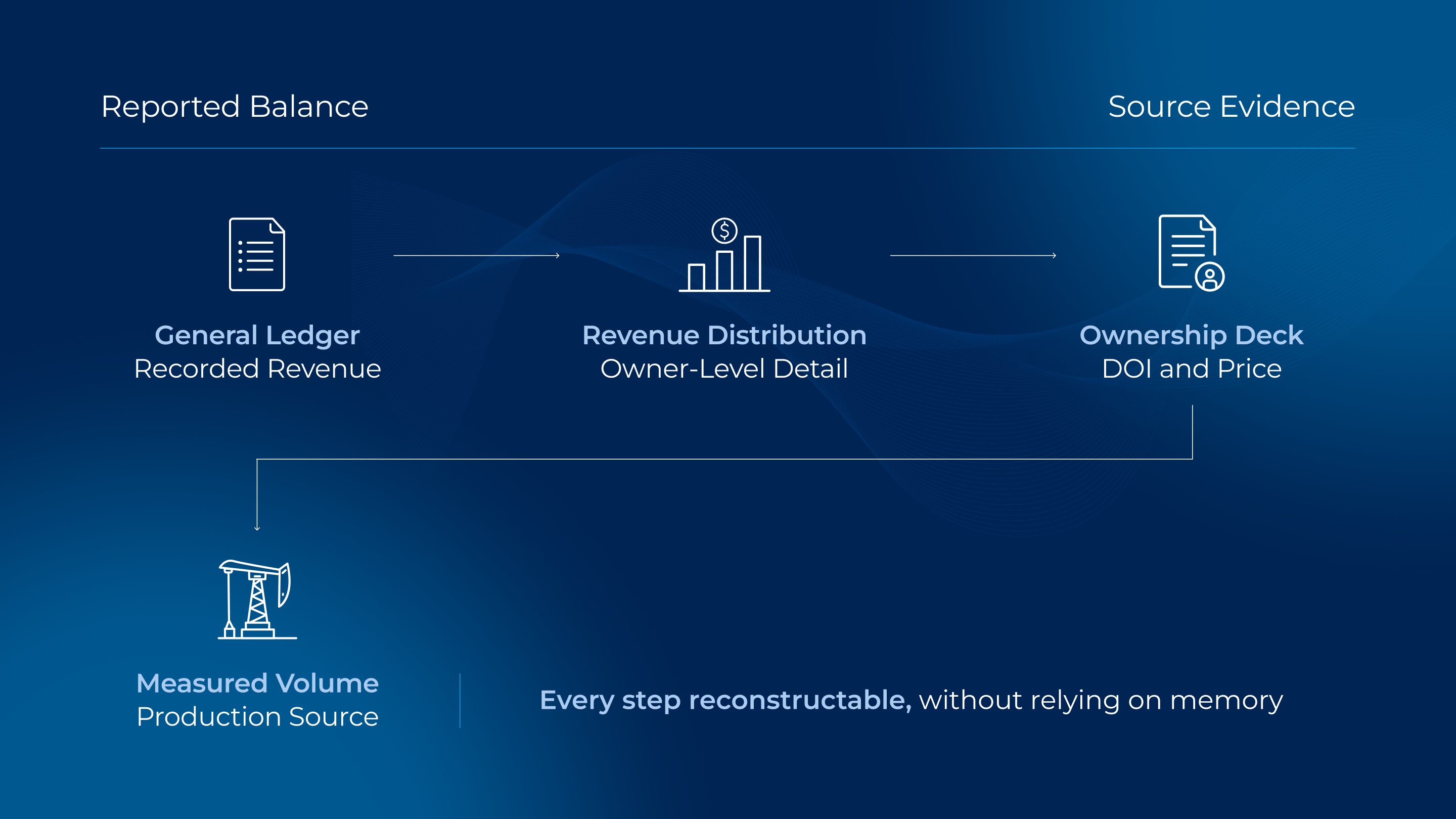
An audit asks two questions about any figure: what is it, and how do you know. Producing the number answers the first. An audit trail answers the second.
An audit trail is the documented path from a reported balance back to its source evidence. For upstream revenue, that path runs from the general ledger to the revenue distribution, then to the ownership deck and price, and finally to the measured volume. Every step should be reconstructable without relying on the memory of the person who booked it.
When that path lives in a connected system, tracing a number is a query. When it lives in a chain of spreadsheets and manual tie-outs, tracing a number means finding the analyst who built the workbook and confirming the formulas still resolve. The difference shows up directly in audit cost and in the number of findings.
Consider a single JIB charge questioned during fieldwork. In a governed system, the reviewer opens the charge and sees the field ticket it came from, the contract rate applied, the AFE it was coded to, and the owners it was billed to, in a few steps. Rebuilding that same chain from spreadsheets can take an hour or more per item, and fieldwork rarely questions only one.
What Are the Most Common Audit Findings for Operators?
Most findings at upstream operators trace to a few recurring habits.
Manual tie-outs. Balances reconciled by hand in spreadsheets, with no durable record of how the tie-out was performed.
Spreadsheet dependency. Revenue, JIB, or depletion calculated in workbooks outside the accounting system, where version control and access are weak.
Undocumented adjustments. Journal entries and true-ups posted without a clear explanation or support attached.
Stale ownership data. Distributions run on ownership decks that were not current, producing owner-level errors.
Weak segregation of duties. One person controlling a process end to end, common on small teams and a routine finding.
These findings share a root cause. The evidence and the calculation live outside a governed system, so neither can be trusted without manual verification. Addressing the habit removes the finding.
How Do You Stay Audit-Ready Year-Round?
Audit readiness is built during the year, not assembled in Q1. The operators who stay ready keep evidence connected to the numbers as they close each month, so the PBC list becomes a matter of retrieval.
Three practices carry most of the weight: close the same way every month with documented reviews, keep master data such as ownership and pricing current and logged, and reduce the manual tie-outs and spreadsheets that break the audit trail. Our guide to the upstream month-end close covers the monthly discipline that supports all three.
On Demand Accounting supports that posture by replacing spreadsheet-driven workflows with governed automation on a cloud platform built for upstream operators. Native integration across the Upstream On Demand ecosystem, spanning land, production operations, and well operations, keeps revenue, cost, and ownership data in one connected source rather than reconciled by hand across systems. Real-time visibility and a configurable reporting suite make it faster to produce support on request, and the platform is SOC 2 Type 2 compliant. By reducing manual reconciliation and data duplication, it helps upstream teams keep the traceable, well-documented records that audits depend on.
Growth raises the stakes. Each acquisition adds properties, owners, and often another set of systems, which expands both the close and the audit. Keeping data connected is what lets an operator absorb that growth without adding audit risk.
Explore On Demand Accounting to see how connected upstream data supports audit readiness and a faster close.
Frequently Asked Questions
What is a PBC list?
PBC stands for prepared by client. A PBC list is the set of documents and schedules an auditor requests from the operator at the start of an audit, organized by area such as revenue, costs, and taxes. A complete, well-organized PBC response is the single biggest driver of a smooth audit.
Do private operators need SOX-style controls?
Private operators are not legally subject to the Sarbanes-Oxley Act (SOX), so formal SOX compliance is not required. Even so, many adopt SOX-style controls, including approvals, segregation of duties, and access reviews. Lenders, joint venture partners, and potential buyers increasingly expect them, and the same controls reduce errors during the year.
How long should close documentation be retained?
Retention depends on tax rules, contractual terms, and regulatory requirements, and it varies by jurisdiction and record type. Many operators retain core accounting and tax records for at least seven years, and some records longer. Confirm the specific schedule with your auditor and legal counsel rather than applying a single rule to everything.
 Previous Page