 8 min read
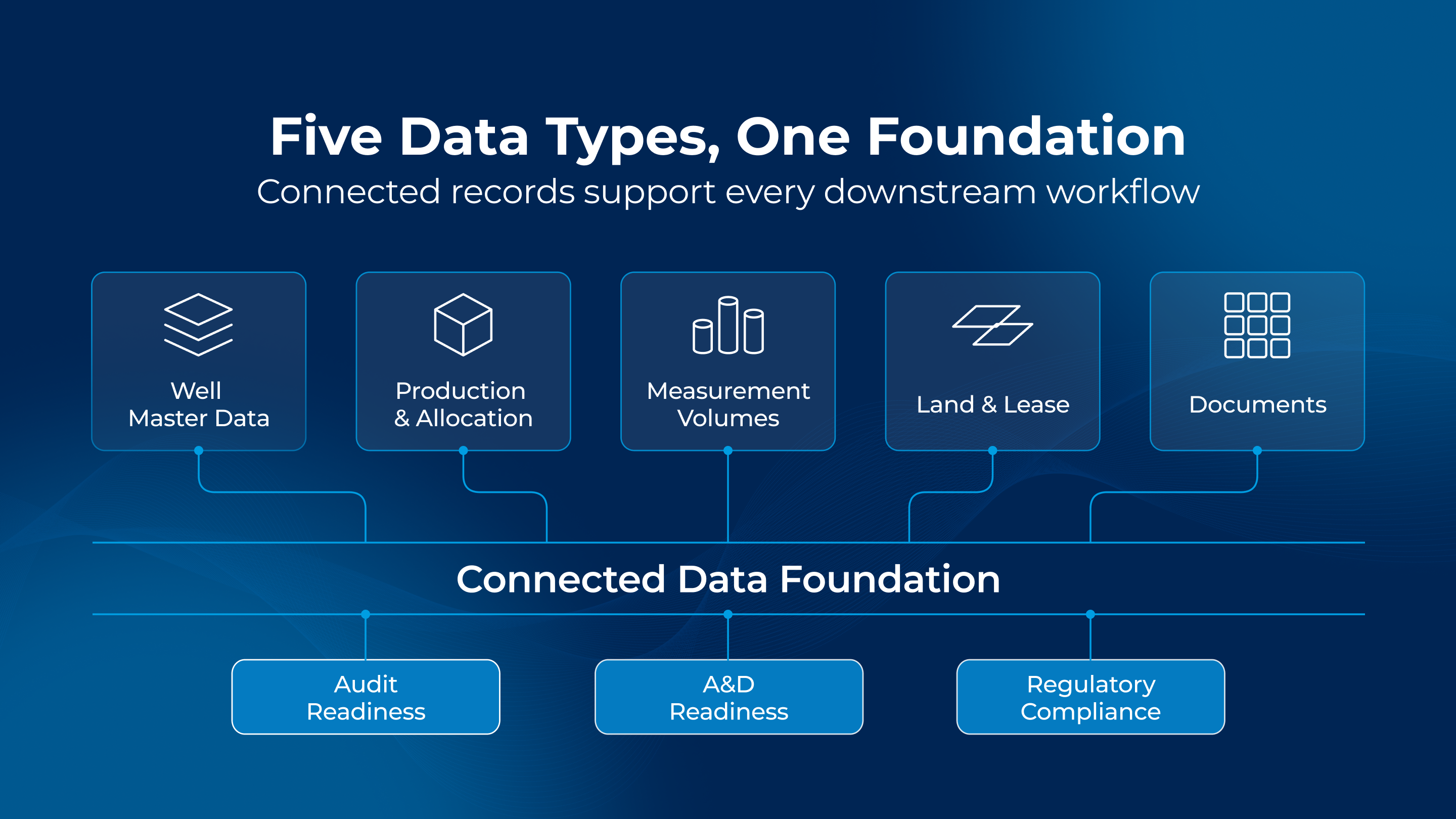
Upstream operators sit at the center of five distinct data categories: well master records, production and allocation data, measurement volumes, land and lease files, and supporting documents. When each category lives in a different system without structured integration, the operational result is version conflicts, slow audits, and fragmented records that cannot support a data room or a regulatory inquiry. Quorum's upstream document management solution addresses the document layer of this problem today. It centralizes records in a cloud-based, searchable repository that integrates with Quorum's Land, Accounting, and Well Operations applications. Extending that connected approach to the other data categories is the direction Quorum is building toward.
Key Takeaway
Upstream data management requires integration, not just storage. Well, production, measurement, land, and document workflows each generate records that other teams depend on. Software that connects those records to the systems and events that produced them reduces reconciliation effort, supports audit readiness, and creates the data foundation that A&D and compliance workflows require. Quorum is building toward this connected foundation, starting with the document layer.
The Data Types Upstream Operators Have to Manage
Well master data establishes the foundation for every downstream workflow. It defines the entity context for production reporting, measurement allocation, land obligations, and capital accounting. Changes to a well record, such as a name change, an API update, or a regulatory classification, propagate through every system that references it. Without a controlled master data layer, those changes require manual updates across multiple platforms.
Production data flows from field capture through allocation into revenue accounting. The path involves multiple handoff points: field measurement, SCADA capture, third-party operator reporting, and allocation models that distribute volumes to ownership interests. Each handoff introduces a reconciliation step. If those handoffs are managed manually, the reconciliation burden compounds with each well added to the operation.
Measurement data sits at the point where field volumes become financial records. Meter readings, calibration certificates, and proving records establish the basis for settlements, regulatory reporting, and dispute resolution. This data requires its own validation workflow before it can be used downstream. Measurement that is not validated before entering allocation creates discrepancies that are difficult and time-consuming to trace.
Land and lease data defines the contractual and ownership structure underlying every well and production record. Lease terms, rental obligations, ownership interests, and regulatory requirements vary by basin and jurisdiction. Operators managing assets across multiple states or countries face the additional complexity of tracking obligations under different legal frameworks simultaneously.
Documents tie all of these categories together. Well files, AFEs, contracts, permits, and regulatory filings create the audit trail from field activity through financial close. When those documents are stored in disconnected locations or tied to only one system, they are not accessible to the full set of teams that need them.
Why Variability Increases Complexity
Data across these five categories does not arrive in a uniform format or on a consistent schedule. Well counts shift through acquisition and divestiture. Measurement configurations vary by meter type, product type, and regulatory requirement. Production data comes from company-operated equipment, third-party operators, and SCADA systems with different data structures. Land files accumulate through years of transactions, title opinions, and amendments.
Each data source introduces its own validation requirement. Operators that manage this variability through manual processes, such as spreadsheet reconciliations, email chains, and shared drives, create a growing gap between the volume of data entering the operation and the team's ability to verify and act on it.
Growth amplifies the problem. A portfolio that doubles in well count does not just double the volume of records. It multiplies the number of handoff points, the number of systems that hold relevant data, and the risk that a discrepancy in one area will propagate before it is caught.
Where Integration Failures Create Operational Impact
Most data management failures happen at handoff points between systems. A document filed in one application is not searchable from another. A lease record in the land system has no direct link to the well file or the accounting entry. A measurement report validated in the measurement system does not automatically update the production allocation record.
These gaps have concrete consequences. Audits take longer when the documentation trail is fragmented across systems. A&D transactions require data room preparation that stretches into weeks if records are not already centralized, linked, and searchable. Regulatory filings require consistent data across well, measurement, and land records simultaneously.
The cost of these gaps is not primarily in the documents themselves. It is in the manual work required to locate, verify, and reconcile records that should be accessible from a single source.
How Quorum Is Addressing Disconnected Data
Quorum's upstream document management solution is the first step. Today it centralizes documents for well files, land records, AFEs, and operational records into a cloud-based repository that integrates with three Quorum applications: Land, Accounting, and Well Operations. Documents created or attached in those workflows file automatically to the same repository. Records are searchable and accessible from the workflow context in which they were created, rather than requiring a separate filing step or a separate search tool.
The integration model matters as much as the repository itself. Integrations with the accounting system ensure invoice documents are captured and linked to the corresponding financial records. AFEs and well records store their supporting attachments through the same platform connection, so all documents associated with a given well or project are accessible from one location. Land records link directly to the leases and operational records they support. This structure is designed to support A&D initiatives and partner data sharing with less manual preparation.
Quorum's direction is to extend this approach beyond documents toward a unified data foundation for master data, production, and measurement records, supporting production accounting, operational reporting, and integration across the upstream suite. Document management integrates with Land, Accounting, and Well Operations today. Connecting the remaining data categories is the direction Quorum is building toward. These services help operators standardize how data is captured, validated, and shared across systems before it reaches reporting or compliance workflows. For a deeper look at building master data controls and a single source of truth across teams, see Data Governance for Upstream Operators.
What a Scalable Data Environment Looks Like
An upstream data environment built on connected systems reduces reconciliation effort as the operation grows. When documents route automatically to the repository as records are created across accounting, land, and well operations, teams spend less time filing and searching. As master data is standardized across systems, production accounting and measurement reconciliation require fewer manual corrections per close cycle.
This matters most for operators managing multiple legal entities or integrating assets from an acquisition. During an acquisition, records from a previous owner arrive in inconsistent formats across inconsistent systems. A centralized document repository with structured integration allows those records to be digitized, classified, and linked to the Land, Accounting, and Well Operations records they support, without rebuilding the entire data structure from the previous owner's architecture.
Over time, a well-governed data environment supports regulatory readiness, partner reporting obligations, and financial close processes without requiring data preparation as a separate project each reporting period.
Conclusion
Oil and gas data management software needs to connect records across the workflows that generate them, not simply provide a place to store files. The five core data categories in an upstream operation, well master records, production data, measurement volumes, land files, and documents, each have their own workflows and dependencies. Software that integrates those layers into a searchable, governed, and connected environment reduces the manual work of reconciliation and creates the data foundation that audit, compliance, and transaction processes require. The operational foundation that enables this is a system architecture decision that determines how much effort those downstream processes will require at every reporting cycle. Quorum's document management solution delivers this connection for the document layer today, across Land, Accounting, and Well Operations. Connecting the remaining data categories is where Quorum is headed.
Frequently Asked Questions
What types of data does oil and gas data management software handle?
Upstream operators need to manage well master data, production and allocation records, measurement data, land and lease records, and supporting documents including contracts, AFEs, and regulatory filings. Effective data management software provides a way to connect these data types and access them through the workflows that use them, rather than requiring separate searches across separate systems.
Which Quorum applications does upstream document management integrate with today?
Quorum's upstream document management solution integrates with Land, Accounting, and Well Operations. Documents created or attached in those applications file automatically to the shared repository. Quorum is working to extend connected data management to additional data categories.
What does a single source of truth mean in practice for upstream operations?
A single source of truth means that every team accessing a record, whether it is a well file, a lease, or a measurement report, is working from the same version of that record. In practice, this requires integration between the systems that generate records and the systems that store them. Without that integration, teams reconcile discrepancies rather than act on shared data, and the effort increases with each system added to the operation.
What does cloud data management change for a distributed operation?
Cloud deployment removes the requirement to access records through a physical office system or VPN connection. Field personnel, accounting teams, and operations staff can access the same document or data record from their location. This matters most during acquisition integration, when records from multiple previous owners need to be consolidated and made accessible to a new operating team under time pressure.
What should operators look for when evaluating upstream data management software?
Look for integration depth across the operational and financial systems already in use. Search and retrieval capability across document types determines usability in practice. The ability to link a document to the underlying well, lease, or operational event determines whether the system supports audit and compliance workflows rather than just providing storage. Governance capabilities, including access controls, version history, and audit trails, establish whether the system can meet regulatory and transaction requirements.
When does a document management system become a data governance problem?
When the system stores documents without linking them to the records they support. A contract stored without a connection to the lease, or a measurement report stored without a link to the well and the meter, creates a document that cannot be found by its relationship to an operational record. Governance requires both storage and linkage. Without linkage, a document repository offers limited value during an audit or a data room review.
 Previous Page