 5 min read
Search for a commercial system for physical gas, crude, or NGL marketing and the results mix two labels almost interchangeably: ETRM and CTRM. Vendors use both terms to describe overlapping capabilities, and buyers are often left comparing systems by label instead of by what each one actually does. The label is the least useful part of the comparison.
Key Takeaway
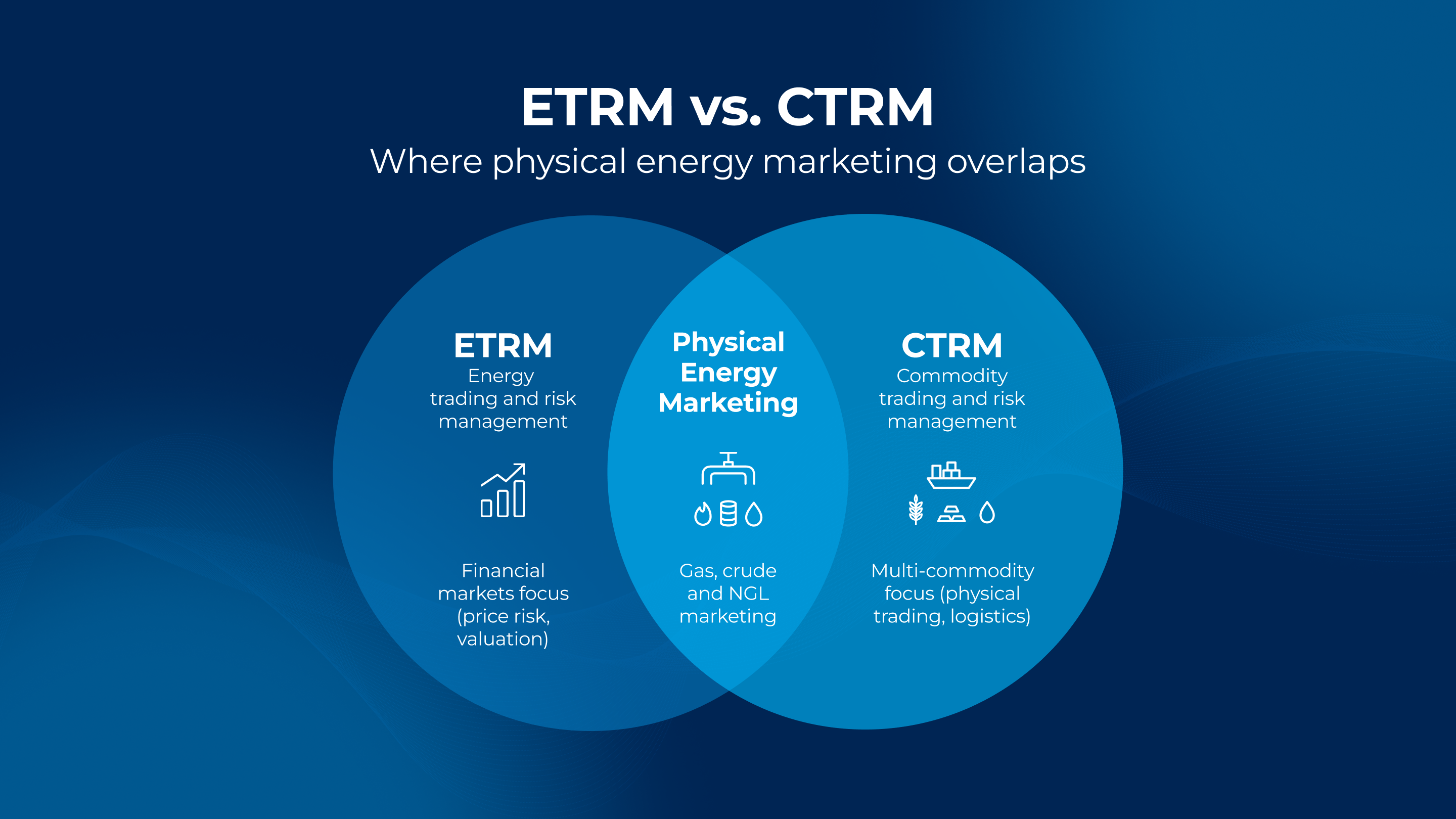
ETRM and CTRM are overlapping categories with different origins. ETRM (energy trading and risk management) developed in financial energy markets, where price risk and valuation are the central concern. CTRM (commodity trading and risk management) developed to cover physical trading across agriculture, metals, and energy, where logistics and delivery carry equal weight. For a midstream gas, crude, and NGL marketer, the deciding factor is not which label a vendor uses — it is how completely the system supports physical operations from contract through settlement.
Where the Terms Come From
ETRM emerged from financial energy trading desks, where the core job was quantifying and hedging price exposure. Mark-to-market valuation and value-at-risk modeling are native to that origin, because a financial trading book is measured by its price risk, not by physical inventory sitting at a terminal.
CTRM emerged to serve firms trading physical commodities more broadly — grain, metals, and energy alongside one another. Because those firms move physical product across multiple commodity classes, CTRM platforms were built to handle logistics, quality specifications, and delivery terms that a purely financial trading book does not need to track.
Neither history maps cleanly onto what a physical gas, crude, and NGL marketer does today. That operation trades a physical commodity, like a CTRM user, but it operates inside a single energy vertical with its own pricing conventions, measurement units, and pipeline scheduling requirements that a general commodity platform was not built around.
Physical vs. Financial: Why the Distinction Matters
A financial energy trading book is defined by price exposure. Contracts frequently settle in cash, and the software's job is to quantify and hedge that exposure accurately. Physical gas, crude, and NGL marketing is defined by product that actually has to move: from wellhead or plant to a delivery point, on a schedule, at a volume that has to reconcile against what was nominated and what was measured.
A system built around financial risk quantification can handle price exposure well and still lack native inventory tracking, scheduling integration, or measurement reconciliation — because those were never the problem it was designed to solve. For a marketer whose daily work is contracts, transactions, inventory, pricing, scheduling, and settlement, that gap shows up as manual work at every handoff between the trading system and the operational reality it is supposed to represent.
Energy vs. Broader Commodities
Platforms built to serve multi-commodity trading houses prioritize breadth: one system that can represent a grain contract, a metals position, and an energy trade with a shared data model. That breadth is valuable for a firm trading across asset classes, but it can come at the expense of energy-specific depth.
Physical gas, crude, and NGL marketing has conventions a horizontal commodity platform typically was not built around: index-based pricing formulas that shift daily, pipeline nomination and scheduling cycles, and measurement data that has to reconcile against contract terms before it becomes an invoice. Systems built specifically for energy marketing carry that logic natively; systems built for breadth across commodities typically require custom configuration to replicate it.
What a Midstream Gas, Crude, and NGL Marketer Actually Needs
| Dimension | Typical ETRM (financial-market origin) | Typical CTRM (multi-commodity origin) | What a Physical Midstream Marketer Needs |
| Primary design focus | Price risk and valuation | Breadth across commodity classes | Breadth across commodity classes |
| Risk quantification | Mark-to-market and value-at-risk usually built in | Varies widely by vendor | Useful if hedging financially; secondary to operational accuracy otherwise |
| Inventory and scheduling support | Often limited or add-on | Varies; sometimes generic across commodities | Needs to be native and connected to the contract record |
| Settlement and accounting integration | Frequently requires custom integration work | Depends on vendor's energy-specific depth | Needs to run from one transaction chain without re-entry |
| Best fit for | Trading desks focused on financial hedging | Multi-commodity trading houses (agriculture, metals, energy) | Physical gas, crude, and NGL marketers running contract-to-settlement operations |
The comparison below is not ETRM versus CTRM as categories — it is what each category tends to prioritize by origin, against what a physical midstream marketer actually has to run day to day.
The practical takeaway: a system's label predicts very little about whether it fits. A vendor calling its platform “ETRM” may have built deep physical operations support because that is who its customers are. A vendor calling its platform “CTRM” may be equally strong, or may have built for breadth over energy-specific depth. The only reliable way to know is to evaluate against the operational chain — contract, inventory, pricing, scheduling, settlement, and accounting — rather than the category name on the pitch deck.
Conclusion
ETRM and CTRM are overlapping labels with different histories, and neither one guarantees fit for physical gas, crude, and NGL marketing. The evaluation that matters is operational: does the system connect contract terms to transactions, transactions to inventory and scheduling, and all of it to invoicing and accounting without manual re-entry at every handoff. A platform that does that consistently outperforms one chosen because of which category it claims on a website, regardless of which acronym is in the name.
FAQ
What does ETRM stand for?
ETRM stands for energy trading and risk management. The term originated in financial energy markets, where systems were built primarily to quantify and hedge price risk through mark-to-market valuation and value-at-risk modeling.
What does CTRM stand for?
CTRM stands for commodity trading and risk management. The term covers physical commodity trading more broadly, including agriculture and metals alongside energy, and CTRM platforms were built to handle the logistics and delivery terms that come with moving physical product.
Is ETRM or CTRM the right category for a midstream gas and liquids marketer?
Neither label answers the question on its own. What matters is whether the system, regardless of what it calls itself, natively supports contract capture, inventory, pricing, scheduling, and settlement for physical gas, crude, and NGL operations, and whether those functions connect without manual re-entry between steps.
Does a physical marketer need mark-to-market and value-at-risk features?
Only if the organization is actively hedging financial price exposure. Many physical gas, crude, and NGL marketers prioritize operational accuracy, inventory control, and clean settlement over risk-quantification features built for a financial trading book. Evaluate whether those features are needed before treating their absence as a disqualifier.
Where can I learn more about what an ETRM system should do for physical marketers?
See What an ETRM System Does for Gas and Liquids Marketers for a full breakdown of contract management, inventory, pricing, scheduling, and settlement in a connected physical energy marketing platform.
 Previous Page