 7 min read
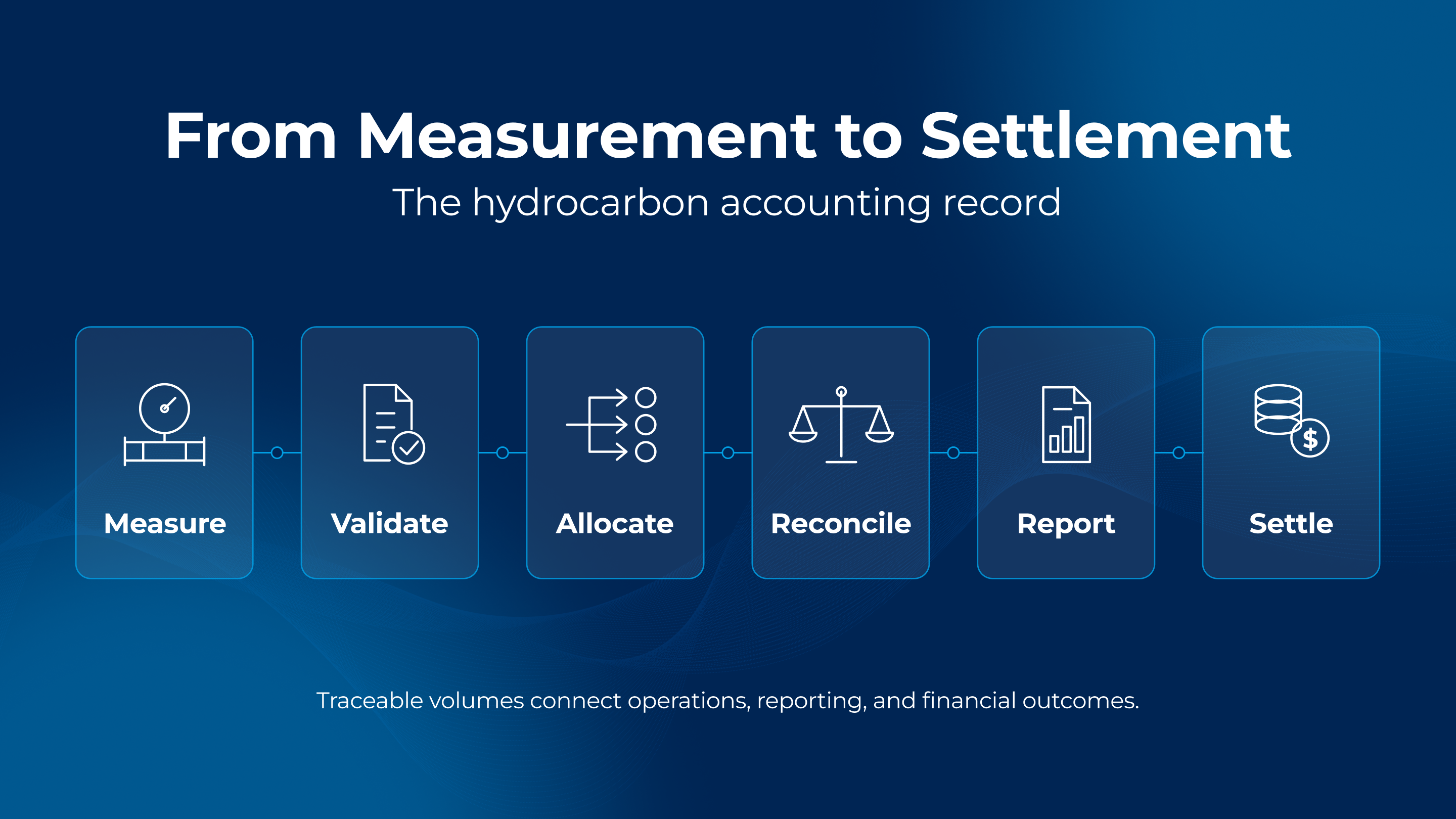
Hydrocarbon accounting is the discipline of tracking oil, gas, and NGLs from the reservoir through processing, transportation and sale. Every volume is measured or estimated, allocated to reservoirs, wells, fields and owners, and reconciled across the value chain. The results drive revenue, royalty and tax payments, partner entitlements and regulatory reporting, so accuracy and auditability are essential. Quorum Hydrocarbon Management supports this process across upstream, midstream, and LNG operations, connecting allocation calculations to auditable reporting and commercial settlement in one platform.
Key Takeaway
Hydrocarbon accounting tracks physical volumes from the reservoir through settlement. It allocates production across ownership interests, feeds royalty calculations, and creates the audit trail behind production reports, revenue recognition, and emissions disclosures. Financial accounting records the dollar value of those volumes after the hydrocarbon accounting record is complete.
What Hydrocarbon Accounting Covers
The scope of hydrocarbon accounting runs from the reservoir to custody transfer and sale. Volumes from each well, pad or facility are measured or estimated and validated. Allocation logic then distributes those volumes back to wells, fields and reservoirs, and across ownership interests, including working interest partners, royalty holders and government entitlements. The result is a set of reconciled volume statements that feed royalties, revenue, partner distributions and regulatory production reports.
Royalty calculations depend directly on allocated volumes. A royalty holder's payment is calculated from the volume attributed to their interest after deductions and adjustments. If the allocation is wrong, the royalty calculation is wrong, and the correction requires reopening the settlement period and adjusting every downstream record.
Emissions reporting naturally extends from hydrocarbon accounting. Emissions calculations for upstream and midstream operations draw on production volumes, flaring, venting, fuel gas use and facility throughput, alongside purchased energy data. Operators who manage hydrocarbon accounting and emissions data in separate systems risk inconsistent disclosures, because the two datasets must align to produce a defensible environmental report. Shared volume data gives financial and environmental reporting a single source of truth.
How It Differs from Financial Accounting
Financial accounting converts volume into value. Hydrocarbon accounting establishes the physical record: reconciled volume statements with a clear allocation path. Revenue and financial accounting then apply pricing, deduct costs, and record the revenue. The output of one discipline is the input to the other.
The separation matters operationally. Financial close can proceed on estimated volumes, but every estimate must later be trued up against final allocated volumes. Delays in allocation reconciliation or data quality problems in measurement inputs lead to larger adjustments, push back final revenue and partner statements, and create risk for royalty payments that carry statutory deadlines.
Where the Process Runs Across Sectors
Upstream
Upstream operators allocate volumes measured at facility and fiscal points back to fields, reservoirs, and wells, then distribute them to working interest owners, royalty holders, and government entitlements. Allocation logic must account for commingled production, well test data, and prior-period adjustments that arise when measurement inputs are corrected after the initial close. The calculation history behind every volume figure must be traceable to support audit requests and regulatory submissions.
Midstream
Gas received from producers at a plant inlet must be allocated back to each producer's account after processing. Shrinkage, plant fuel, and efficiency factors reduce the volume available for settlement. Each processor agreement carries different terms, and the allocation calculation must apply those terms consistently and traceably across all producer accounts. Settlement statements depend on that calculation being correct before they are issued.
LNG
LNG operations extend hydrocarbon accounting through cargo scheduling, terminal inventory management, and delivery confirmation. A cargo loaded at an export terminal carries a volume figure that must be reconciled with the receiving terminal's measurement, adjusted for heel and boil-off, and matched against the commercial contract for settlement. Errors in that reconciliation create invoice disputes and custody transfer complications.
The Problem Hydrocarbon Accounting Addresses
Operational systems record raw measurements in a historian, and allocation starts when that data is extracted. Where no hydrocarbon accounting system exists, extraction is manual, and errors in units, data gaps or tag mapping enter without any check.
Allocation then runs as a chain of dependent calculations. Volumes are allocated back to wells, mass and component quantities follow, ownership is distributed across partners, royalty holders and governments, and the results are valued financially. Each step relies on the one before it, so an early error carries through to royalty statements and invoices. Regulatory and emissions reports draw on the same volumes.
Without a bespoke hydrocarbon accounting system, checks and balances depend on the person running them. Data quality is difficult to verify, and troubleshooting means tracing formulas across linked files. A late measurement correction means repeating the chain by hand, with no record of what changed or why.
What a Hydrocarbon Accounting System Changes
Hydrocarbon accounting systems connect operational data to allocation logic, reporting outputs, and commercial settlement records. Quorum Hydrocarbon Management handles production allocation, inventory valuation, custody transfer management, regulatory reporting, and emissions tracking in a platform that integrates with SCADA, ERP and historians, and laboratory systems. Data moves from field measurement to allocated volume to reported figure without manual transfer steps.
Calculations becomes traceable and auditable. When a regulator or partner requests support for a volume figure, the accountant can produce the full calculation path from raw measurement input through allocation logic to final reported number. That traceability is the operational definition of an auditable workflow.
The solution is available as a fully managed cloud service with SOC 2 Type 2 certification, which supports the security and compliance requirements that upstream, midstream, and LNG operators carry for both financial data and regulatory reporting.
Read Woodside’s Adoption of Quorum Energy Components case study
Operating at Scale
Operators with multiple fields, production units, or geographic regions need allocation logic that applies consistently across the entire asset base. Country-specific regulatory frameworks, production-sharing agreements, and emissions reporting requirements that vary by jurisdiction each add configuration requirements to the hydrocarbon accounting process. A platform that enforces consistent calculation logic while supporting the differences across agreements, geographies, and reporting frameworks gives operators control as the asset base grows and partnership structures evolve.
Conclusion
Hydrocarbon accounting sits between operational data and financial outcomes. Every royalty payment, every revenue entry, every emissions disclosure traces back to the allocated volume record that begins at the wellhead. Operators who maintain a connected, auditable path from production to settlement reduce disputes, close faster, and carry less regulatory risk. The systems that support that process are not peripheral to operations. They are the record of how the asset performed.
Frequently Asked Questions
What is hydrocarbon accounting?
Hydrocarbon accounting is the process of tracking oil, gas, and natural gas liquids from the point of production through allocation, transportation, processing, delivery, and commercial settlement. It produces the volume records that support royalty payments, revenue recognition, partner distributions, and regulatory production reports.
What is the difference between hydrocarbon accounting and financial accounting?
Hydrocarbon accounting tracks physical volumes. Financial accounting converts those volumes into monetary value. A hydrocarbon accounting period must be closed and volume statements validated before a financial accountant can record revenue. The two disciplines are connected but operate on different inputs.
What is a hydrocarbon management system?
A hydrocarbon management system connects production data, allocation logic, inventory records, and reporting workflows in one platform. It maintains the calculation history from measured wellhead volumes through allocation, custody transfer, and settlement, creating the audit trail that operators need for royalty statements, partner distributions, and regulatory submissions.
What does production allocation mean in hydrocarbon accounting?
Production allocation is the process of distributing measured volumes across wells, reservoirs, fields, ownership interests, or delivery points based on defined calculation logic. Allocation results determine what each owner, royalty holder, or settlement party receives. The allocation must be traceable from input data to final distributed volume.
How does hydrocarbon accounting support emissions reporting?
Emissions calculations for upstream and midstream operations are derived from production volumes, flaring data, and facility throughput. A hydrocarbon accounting platform that carries volume and operational data alongside allocation records can feed emissions reporting directly. This reduces the need for a separate manual dataset and improves consistency between production and environmental disclosures.
Which sectors use hydrocarbon accounting?
Upstream operators use it to allocate production, report to regulators, and calculate royalties. Midstream operators use it to settle gas processing agreements and manage plant-level allocation. LNG operators use it to manage cargo scheduling, terminal inventory, and delivery accuracy. The calculation logic differs by sector, but the core requirement is the same: traceable volumes from measurement through settlement.
 Previous Page