 8 min read
Well Cost Tracking 101: From Field Cost Capture to AFE Reporting
Well cost tracking is a workflow that connects field activity to financial reporting. Connected platforms like Quorum’s On Demand Well Operations, Execute AFE, and On Demand Accounting help move cost capture, allocation, and reporting through a controlled workflow, but the outcome still depends on how consistently costs are captured, coded, and tied to the AFE. A cost may originate in the field, move through approval and coding, and ultimately be reported against an AFE that defines the approved scope. When any part of that chain is inconsistent or delayed, reporting loses reliability and more effort is spent explaining results after the fact.
For well cost accountants, the objective is to maintain a clear line of sight from planned work to actual spend. That requires control over where costs enter the process, how they are classified, and how they connect back to the AFE. When that structure holds, the business can answer a basic question with confidence: what has this well cost so far, and why?
Key Takeaway
Well cost tracking depends on timely field capture, consistent coding, and a reliable link to the approved AFE. When those elements stay aligned, cost visibility remains usable during active operations rather than being reconstructed later.
Well cost data feeds economic models, informs future drilling decisions, and supports capital planning assumptions. When tracking breaks down, the impact extends beyond a single well into forecasting accuracy and capital efficiency across the organization.
Where Well Costs Enter the Workflow
Cost data enters the well lifecycle from multiple sources and at different times. Field activity is often recorded first, while invoices and formal accounting documentation may follow later. This timing gap introduces risk if capture, interpretation, and coding are not aligned.
In most upstream workflows, well costs enter through three primary channels:
- Field-originated records such as tickets and service entries
- Vendor invoices processed through accounts payable
- Internal allocations, accruals, and shared-service charges
When these inputs are disconnected, accounting effort shifts toward reconciliation instead of analysis. Cost quality depends on whether each charge can be understood in context, not just whether it has been recorded.
Why Coding Discipline Matters
Coding is where operational activity is translated into financial structure. If categories are unclear or applied inconsistently, reporting loses its ability to explain performance.
| Coding Issue | Impact on Reporting | Control Approach |
| Categories too broad | Limited visibility between drilling, completions, and support costs | Define reporting-aligned categories before invoice volume increases |
| Late or inconsistent coding | Distorted trends and unreliable AFE comparisons | Establish coding rules at AFE approval and apply them consistently |
| Misclassified charges | Inability to compare wells on a like-for-like basis | Use shared coding references across AP and field teams |
Three practices support stronger coding discipline:
- Align cost categories to how performance will be reviewed
- Define coding rules before invoices begin accumulating
- Resolve exceptions early to prevent distortion in reporting
Consistent coding also supports partner billing. When charges are traceable from source to category, billing requires less manual review and disputes are reduced because costs can be explained clearly.
Connecting Costs to the AFE
The AFE establishes the baseline for scope, estimate, and expected spend. Well cost tracking depends on maintaining a direct connection between each charge and that baseline. When the link is weak, teams reconstruct relationships manually, which slows analysis and introduces inconsistency.
A reliable AFE connection requires shared project logic across field activity, invoice handling, accounts payable, accruals, and reporting. When that structure is consistent, variance analysis focuses on performance rather than classification.
This linkage also supports benchmarking. When costs are categorized consistently against the original authorization, teams can compare wells and identify patterns that improve future estimates and planning assumptions.
As well cost tracking workflows mature, maintaining a continuous connection between field costs and the approved AFE becomes essential for sustaining cost visibility during execution. In practice, organizations that strengthened capital tracking and governance—such as in Novus: Capital Tracking and AFE Governance— centralized AFE tracking and implemented structured approval workflows were able to improve control over how costs were recorded, classified, and reported against approved scope. This creates a more consistent and traceable relationship between field activity and financial reporting, reducing reliance on manual processes and improving transparency across teams. By reinforcing that structure within the workflow, cost data remains aligned with the AFE as activity progresses, supporting clearer and more reliable reporting throughout the lifecycle of the well.
What Effective Well Cost Reporting Shows
Well cost reporting should provide visibility into both current spend and emerging variance. The goal is to reduce the effort required to interpret results while maintaining enough detail to support decisions.
Effective reporting answers three operational questions:
- What has been spent and committed by well, activity, and category?
- How do current costs compare to the AFE and expected timing?
- Which variances require attention now?
When reporting aligns with these questions, teams spend less time investigating numbers and more time responding to them.
Where Breakdowns Typically Occur
Breakdowns in well cost tracking usually appear where workflows are disconnected. Delays in field capture, inconsistent invoice interpretation, and unclear coding rules create gaps that accumulate over the life of a project.
These gaps often result in:
- Delayed visibility into actual spend
- Increased manual reconciliation effort
- Reduced confidence in AFE comparisons
Addressing these issues requires coordination across field operations, accounts payable, and accounting rather than isolated fixes within a single function.
The Role of Systems and Data Structure
Well cost tracking improves when systems reinforce a shared structure across workflows. Field capture, invoice processing, coding, and reporting do not need identical interfaces, but they must operate from the same underlying logic.
That structure should support:
- Consistent cost categorization
- Clear linkage to AFE and project definitions
- Timely movement of data from field activity to financial reporting
When systems enforce these controls, the workflow becomes more predictable and less dependent on manual intervention.
Cost Flow and Control Points
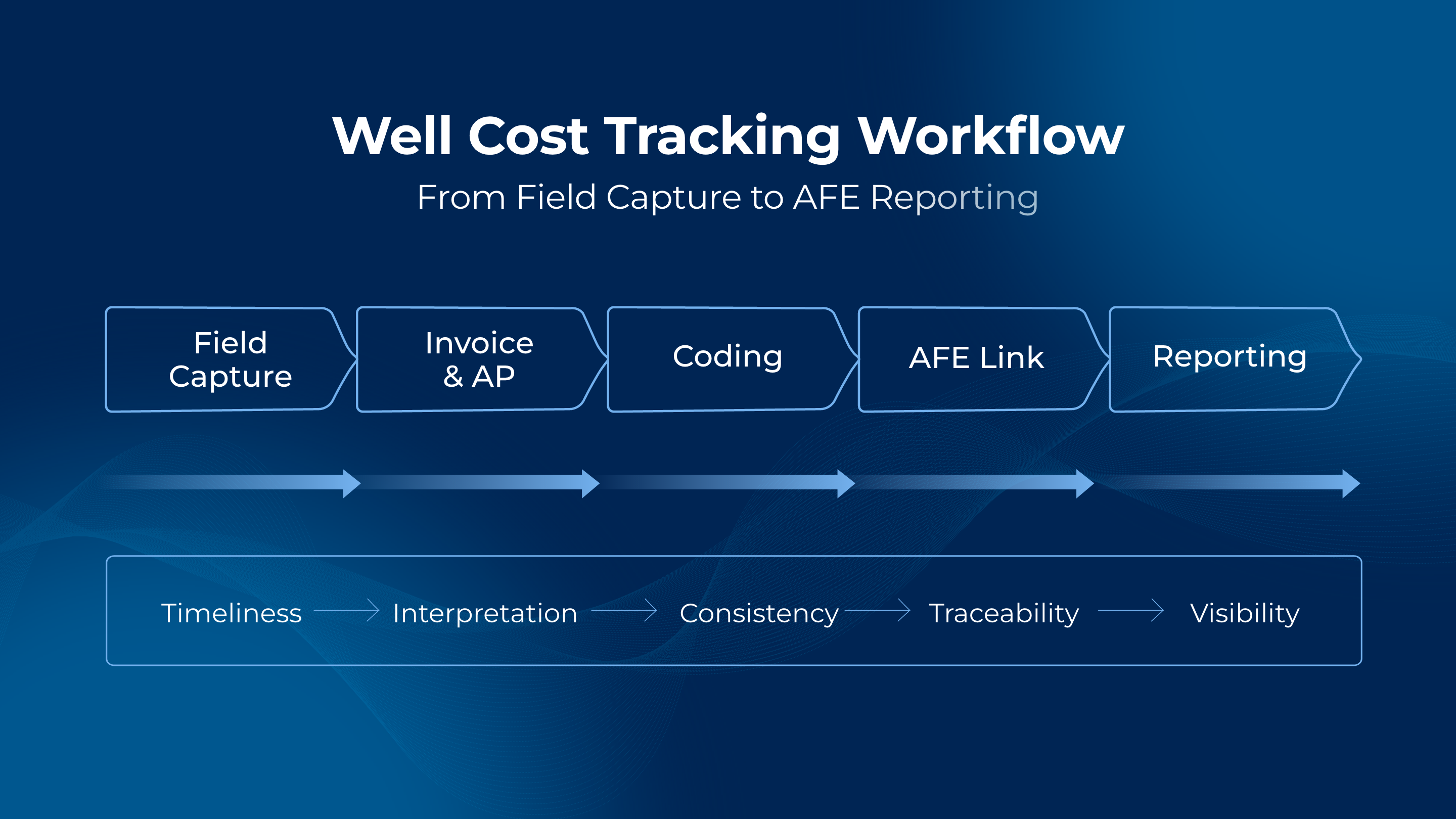
A Scalable Operating Rhythm
Cost visibility improves when organizations establish a repeatable cadence between field activity and financial review. This does not require real-time posting of every transaction, but it does require a defined rhythm for translating operational work into financial insight.
With timely capture, disciplined coding, and visible AFE linkage, well cost tracking becomes a control process. Costs can be explained with less effort, and variances can be addressed earlier in the project lifecycle.
The Results Are Clear
Well cost tracking is a coordinated workflow across field operations, accounting, and project management. Its effectiveness depends on how consistently costs are captured, classified, and connected to the AFE.
When those elements are aligned, reporting supports decision-making during operations instead of after completion. The result is clearer cost visibility, reduced reconciliation effort, and more reliable inputs for future planning.
Visit On Demand Well Operations, Execute AFE, and On Demand Accounting
Frequently Asked Questions
What is well cost tracking?
Well cost tracking is the process of capturing, coding, and reporting all costs associated with a well throughout its lifecycle. It includes field charges, invoices, allocations, and accruals organized against the AFE to support visibility and variance analysis.
How are drilling costs tracked against an AFE?
Each cost is captured, coded to a defined category, and linked to the appropriate well and AFE.
The initial capture of drilling costs often occurs in a field cost tracking software. Tickets from third-party contractors and well-site services are captured and represent a committed ‘field’ cost. These field costs are oftentimes the first indication of committed costs against a given activity.
When coding standards and AFE structures are defined early, actual costs can be compared to the original estimate without reconstruction.
What is the difference between well cost tracking and well cost accounting?
Well cost tracking focuses on capturing and categorizing costs as they occur. Well cost accounting includes broader financial processes such as allocations, accruals, partner billing, and financial reporting, using tracked costs as the underlying data source.
 Previous Page