 7 min read
Where capital approvals are part of the process, tools like Execute AFE help keep AFE creation, approval, and spend visibility connected. From that point forward, preventing cost overruns depends on how clearly the AFE is defined, how consistently spend is tracked, and how early variance is identified while operational decisions are still adjustable.
AFE cost overruns rarely appear as a single event. They build through small disconnects—unclear scope, shifting costs, inconsistent coding, delayed visibility into commitments, and loosely defined approvals. By the time a large variance shows up in a report, the operational drivers are often already complete. Control depends on earlier signals and a process that connects planning, execution, and review.
Key Takeaway
Cost overruns develop through compounding gaps across estimation, approval, and spend tracking. A controlled AFE workflow depends on disciplined estimates, pre-spend controls, consistent coding, and variance reporting that distinguishes timing effects from real overspend. Prevention works as a continuous loop rather than a single reporting step.
Why AFE Cost Overruns Happen
Overruns often start at the estimate stage. When scope is unclear, contingency is inconsistently applied, or cost categories are too broad, the AFE lacks a usable baseline. This does not guarantee overspend, but it reduces the ability to interpret actual costs once activity begins. Finance and operations may both see reasonable numbers, but without alignment to the original structure, variance becomes difficult to explain.
Timing gaps between field activity and financial posting create another layer of risk. Work is completed, tickets are approved later, and invoices arrive later still. If variance analysis depends only on posted costs, it reflects past conditions rather than current exposure. This delays response and reduces the usefulness of reporting as a control mechanism.
Disconnects between AFE structure and well cost tracking add further complexity. Charges may be captured accurately at the field level but coded without clear alignment to the approved categories. Across multiple wells or phases, these small inconsistencies accumulate into material variance without a clear signal of where the drift began.
Contingency treatment also affects control. When contingency is either undefined or embedded within categories, teams lose visibility into expected versus unexpected movement. Without clear rules for when contingency should be used, escalation decisions are delayed and variance classification becomes inconsistent.
Controls That Strengthen the AFE Approval Process
Control begins before spend starts. The AFE approval process defines how the organization will interpret and manage cost from the outset. When scope, assumptions, and categories are clear at approval, downstream tracking becomes more reliable.
Three controls establish the baseline:
- Approval rules tied to both dollar thresholds and business risk
- Coding standards aligned to how costs will be reported
- Variance triggers that define when review or escalation is required
These controls ensure that once activity begins, transactions follow a structure that matches the approved plan. Without this alignment, reporting becomes a reconstruction effort rather than a real-time control.
Standardizing post-approval tracking is equally important. Coding rules, cost category alignment, and escalation thresholds should be defined at the same time as the AFE. This creates a consistent framework for capturing and interpreting spend as it occurs.
How Cost Variance Analysis Should Work
Budget-versus-actual reporting provides a starting point, but it does not explain variance on its own. Effective analysis separates different drivers so teams can respond appropriately.
A practical approach answers three questions in sequence:
- Is the variance driven by timing?
- Is the variance driven by scope change?
- Is the variance a true cost performance issue?
| Variance Type | Typical Cause | Appropriate Response |
| Timing variance | Unposted invoices, delayed capture, accrual lag | Confirm expected postings; monitor without escalation |
| Scope variance | Additional services, changed conditions | Evaluate supplemental AFE or formal revision |
| True cost overrun | Price increase, inefficiency, uncontrolled spend | Escalate for corrective action and joint review |
This structure keeps variance discussions focused on cause and response rather than isolated numbers.
Cadence determines whether reporting supports control or explanation. Monthly reporting supports governance, but active drilling and completions workflows require more frequent visibility. Early indicators—rising commitments, concentration in a category, repeated exceptions—allow teams to respond before variance becomes material.
Variance commentary also needs consistency. Each explanation should identify the driver, quantify the impact, indicate whether the issue will continue, and define whether action is required. This reduces review time and improves decision quality across teams.
Building a Better Response Loop
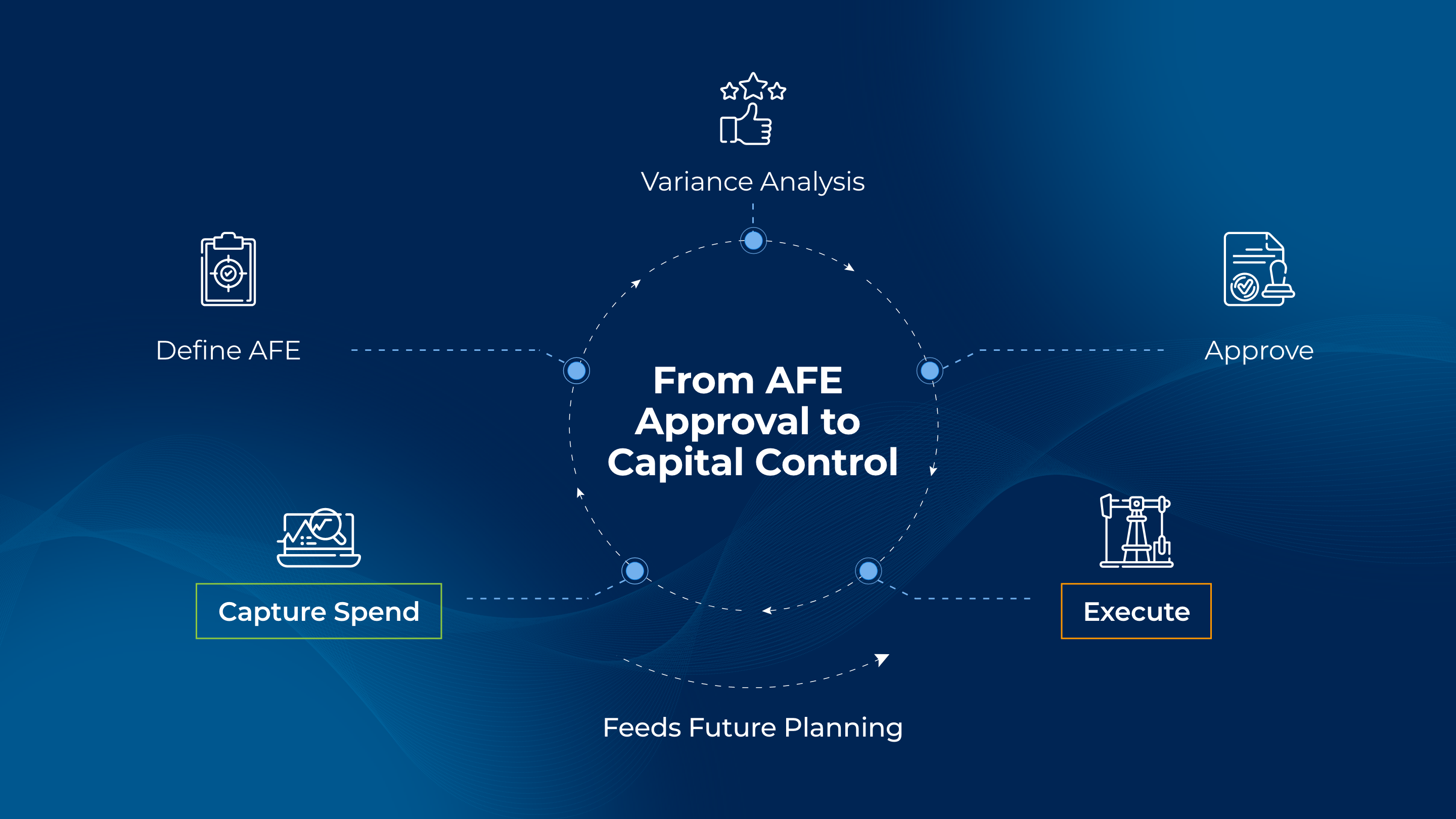
Preventing overruns requires a continuous process:
- Define the AFE with sufficient detail
- Apply approvals aligned to risk and responsibility
- Capture spend consistently during execution
- Compare actuals and commitments to the baseline
- Escalate material variance early
This loop reduces the delay between operational activity and financial understanding. It creates a shared structure where finance and operations can evaluate changes in the same context.
Ownership within this loop must be explicit. Operational teams control many cost drivers, while finance maintains structure and reporting discipline. When both groups work from the same categories, cadence, and escalation rules, variance becomes a shared management issue rather than a reconciliation problem.
As organizations strengthen their response to AFE cost overruns, the ability to maintain continuous visibility into commitments and actual spend becomes central to effective control.
That visibility, however, depends on how the AFE is structured before execution begins. When approval workflows, coding standards, and escalation thresholds are defined at the outset, downstream tracking follows the same framework as the approved plan. At Range Resources, standardizing AFE workflows and approvals ensured that estimates, cost categories, and review triggers were consistently applied before spend started, reducing ambiguity once activity was underway.
With that structure in place, tracking can function as an active control rather than a retrospective report. At Novus, centralizing AFE data and monitoring commitments alongside actuals allowed teams to evaluate variance against the approved baseline throughout execution, not just after costs were posted. This made it possible to identify whether variance was driven by timing gaps, scope changes, or true cost performance issues while operational decisions were still adjustable.
Together, these practices support a closed-loop cost control model where variance is detected, interpreted, and acted on during execution, rather than explained after the fact.
A More Practical Approach to Cost Discipline
Cost control works best when it reduces ambiguity rather than restricting execution. Clear AFE structures, defined escalation points, and consistent reporting shorten the path from field activity to financial visibility. This reduces manual explanation and improves auditability.
Discipline does not require rigidity. Field conditions change, and scope adjustments are expected. A controlled process allows teams to distinguish between expected movement and uncontrolled variance. When that distinction is clear, decisions to adjust scope or revise the AFE can be made without delay
Learn more about Execute AFE.
Frequently Asked Questions About AFE Cost Overruns
What is a variance report in oil and gas?
A variance report compares actual and field costs to the approved AFE baseline and highlights differences by category, timing, and magnitude. Effective reporting separates timing effects, scope changes, and true cost performance issues so each can be addressed correctly.
How do you prevent cost overruns on drilling projects?
Prevention starts with clear scope, structured estimates, defined contingency, and aligned coding standards. After approval, frequent comparison of commitments (commonly referred to as field costs) and actuals to the baseline allows teams to identify trends early and respond before variance becomes material.
What is the difference between a timing variance and a real overrun?
A timing variance reflects delays in cost recognition, such as unposted invoices, while total project cost may still align with the AFE. A real overrun indicates that actual or projected costs exceed the approved authorization and require corrective action or formal revision.
 Previous Page