 7 min read
In oil and gas, supply chain orchestration is the operational problem of coordinating people, cargo, and field resources across a plan that starts in an office and ends on a platform or at a well site. When logistics, personnel scheduling, and field execution run through separate systems and handoffs, the plan and the execution diverge. That gap has a cost which is measured in delayed crew changes, underused charter capacity, and stalled field work.
Key Takeaway
Supply chain orchestration in energy connects planning, logistics, and field execution on a single operational picture. The value is not faster booking. It is tighter control over readiness, fewer delays from coordination failure, and faster response when conditions change.
What Supply Chain Orchestration Means in Energy
Energy supply chain orchestration spans three connected layers: activity planning, logistics execution, and field readiness. An operator plans which personnel are needed, when, and where. Logistics coordinates how they get there — helicopters, crew boats, ground transport. Field readiness confirms each person is cleared before they move. These three layers depend on each other. When they run in isolation, errors compound before anyone can correct them.
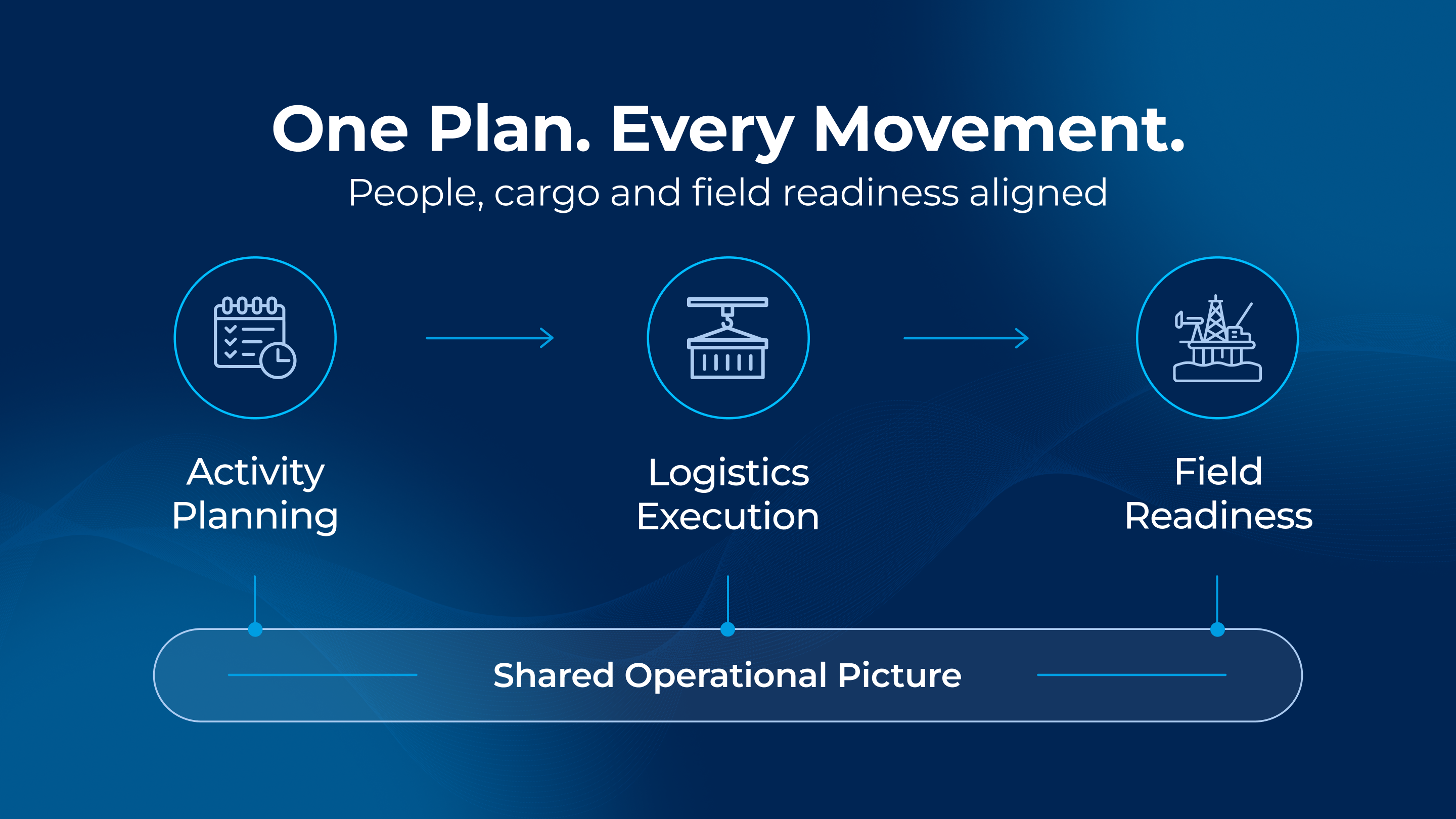
Cargo follows the same logic. Material and equipment flow from suppliers to staging areas to the field. Each step requires coordination between procurement, logistics, and field operations. Without a shared view of status and timing, cargo waits while work stalls.
The Planning-to-Execution Gap
The most consistent source of disruption is the distance between the plan and its execution. A plan built in one system moves into logistics execution in another and into field records in a third. By the time a delay or conflict surfaces, the downstream impact is already in motion.
Personnel logistics compounds this. Readiness checks, certifications, travel approvals, and accommodation assignments each involve different parties and timelines. One unresolved status blocks movement. In high-volume operations — offshore platforms running continuous crew rotations, or remote sites with limited transport windows — the margin for coordination error is narrow. A missed step delays a crew change. A delayed crew change delays production.
Where Coordination Failures Concentrate
Failures accumulate at handoff points. A confirmed booking not reflected in field records. A cargo delivery window not communicated to the receiving team. A personnel status showing cleared in one system and pending in another. These are not technology failures. They are the expected result of running parallel systems without a synchronization layer.
Disruption adds pressure to the same points. Weather events, equipment failures, and demand surges all require the plan to change quickly. If personnel and cargo data live in separate systems, replanning requires manual coordination across each one. Speed and accuracy both suffer.
The Role of Systems and Data
Effective supply chain orchestration depends on one operational picture that connects planning, logistics status, and field readiness in real time. When all three are visible in one place, changes to the plan propagate across the affected workflows. Personnel whose travel is affected see updated instructions. Cargo staging teams see revised windows. Field supervisors see current readiness status without making calls.
Quorum's Supply Chain addresses the planning-to-execution gap at this level, connecting activity planning with logistics execution and field confirmation so that the same operational view drives decisions across all three layers.
Where AI Fits in Disruption Response
AI improves logistics decision quality. It does not replace coordination logic.
Predictive models can flag when a resource constraint or weather pattern is likely to affect a travel window before it becomes a confirmed delay. Route optimization can identify lower-cost alternatives within an approved transport framework. Demand forecasting reduces the manual effort of capacity planning. These capabilities only deliver value when the underlying operational data is connected and current. AI applied to fragmented logistics data produces suggestions that cannot be validated or acted on confidently.
The accuracy of an AI recommendation for crew scheduling, for example, depends on whether readiness status, transport availability, and field demand data are all live and consistent. If they are not, the model is working from an incomplete picture — and so is the coordinator who receives its output.
Scalable Process Control
At scale, supply chain orchestration becomes a process discipline rather than an ad hoc coordination effort. Quorum's Personnel Logistics is built for high-volume operations running thousands of personnel bookings per year across multiple transport modes and regional staging areas, standardizing request workflows, automating approval routing, and maintaining real-time status visibility across all active movements.
Operators who have addressed this systematically have documented measurable outcomes. A regional operation in the Middle East that consolidated logistics coordination across multiple operators on a shared transport contract saw $10M in annual cost savings and a 30% improvement in shared logistics utilization, with reactive travel delays eliminated. When those coordination elements are in place, logistics coordinators work on exceptions. Supervisors have current readiness status without asking for it. Auditors can trace any movement back to the originating request
Keeping Planning and Field Execution Aligned
Supply chain orchestration in oil and gas is the operational discipline of keeping personnel, cargo, and field execution aligned to a shared plan. The coordination challenge is not unusual for the industry — it is a known source of cost and delay. Operators who have addressed it systematically have reduced travel cost, improved readiness visibility, and built logistics operations that respond faster when conditions change.
Frequently Asked Questions
What is supply chain orchestration in energy?
In energy, supply chain orchestration is the process of coordinating personnel logistics, cargo movement, and field execution under a single operational view. It covers the full cycle from activity planning through logistics execution to field readiness confirmation. The goal is to eliminate the coordination gap between what is planned and what is executed in the field.
How can AI improve oil and gas supply chain logistics?
AI can improve logistics decisions in three specific areas: predicting resource constraints or transport delays before they are confirmed, optimizing routes and capacity allocation within an approved framework, and reducing manual effort in demand forecasting and schedule planning. For these outputs to be accurate and actionable, the underlying logistics and personnel data must be connected and current. AI applied to fragmented data returns suggestions that are difficult to validate and act on.
What is the difference between supply chain management and supply chain orchestration?
Supply chain management covers procurement, inventory, and vendor relationships — the commercial layer of getting materials and resources to where they are needed. Supply chain orchestration is the operational coordination layer: how personnel, cargo, and field activity are sequenced and tracked against the plan in real time. In oil and gas, both are necessary. A well-managed supply chain that lacks operational orchestration still produces coordination failures at the field level.
Why is personnel logistics a supply chain issue in energy?
In remote or offshore energy operations, personnel movement is a constrained logistics problem. Transport windows are limited, readiness requirements are mandatory, and a single unresolved status can hold an entire crew. Personnel logistics has the same coordination dependencies as cargo: planning, scheduling, confirmation, and real-time status visibility across all parties involved. Treating it as an administrative task rather than an operational one is the origin of most crew change delays.
 Previous Page