 9 min read
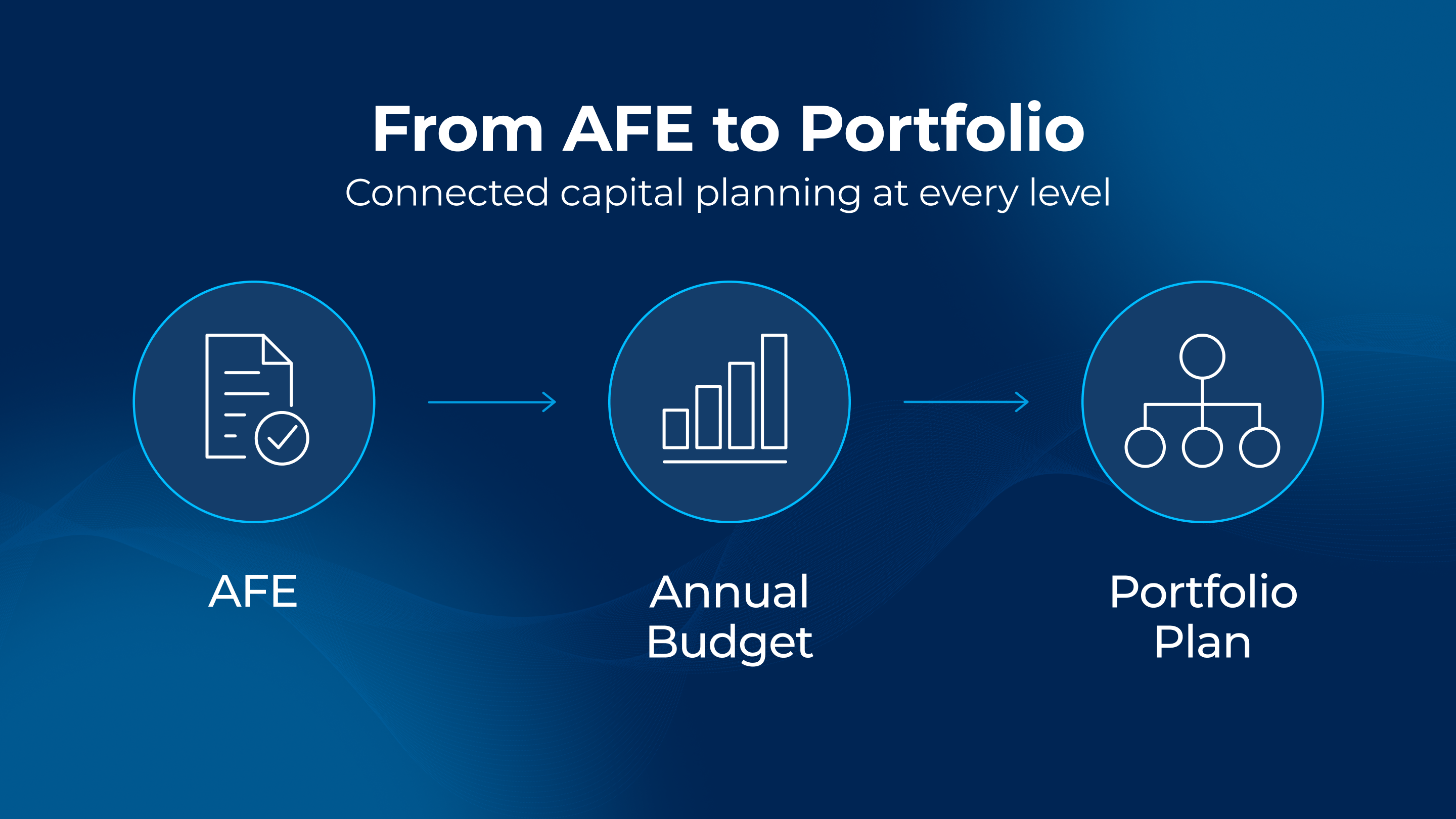
Capital planning in upstream oil and gas runs through three distinct layers: the authorization for expenditure at the project level, the annual capital budget that aggregates across all active work, and the portfolio plan that allocates capital across assets and time horizons. Each layer depends on the one below it, and when the handoffs between them are slow or manual, the numbers at each level diverge quickly. Quorum's Capital Budgeting connects operations and finance teams around a shared capital view so visibility stays current as projects move and field conditions change.
Key Takeaway
Capital budgeting in oil and gas requires more than an annual planning cycle. The AFE creates spending authority at the project level, the annual budget tracks aggregate performance against plan, and the portfolio plan drives resource allocation across assets and price environments. When these three layers share data and update together, finance can steward performance earlier, and operations works from accurate, current spending authority.
How the AFE, Annual Budget, and Portfolio Plan Connect
The portfolio plan is the starting point for capital budgeting in upstream operations. Asset teams submit plans outlining their proposed activity, and the portfolio layer evaluates where capital should go across assets, price environments, and planning horizons. Portfolio decisions involve economic assumptions, production forecasts, and reserve estimates alongside capital figures, and they determine how capital is allocated across the business.
The annual capital budget takes the capital allocated for the year and distributes it among asset teams. These allocation decisions are typically made with corporate targets in mind, so the budget translates portfolio-level strategy into a defined spending envelope for each team. Finance teams use this budget as the baseline for reporting to leadership and tracking performance throughout the year.
The AFE is where budgeted capital becomes approved, project-level spend. Before drilling a well, building a facility, or making a major equipment purchase, a formal authorization establishes the scope, cost estimate, and approval chain. Once approved, the AFE governs how costs are committed and tracked at the project level. Multiple AFEs running in parallel across an operator’s asset base represent the detailed execution of the year’s capital budget.
AFE spend and reporting then roll back up through the same structure, giving companies a summarized view of capital spend that can be tracked against budget and plan. The quality of that view depends directly on how current the underlying AFE data is. When project-level cost estimates are stale or field actuals haven’t been captured, the roll-up reflects a lagging picture of actual commitments, one that can misrepresent where the real exposure sits. Getting inputs from separate systems into a consistent format at each layer is where most of the coordination effort goes, and it’s where the three-layer structure most often breaks down.
Where the Handoffs Break
The gaps between these layers widen whenever data has to move manually. AFE actuals often sit in accounting systems that don't automatically push updates to the capital forecast. Reforecasting a project after a scope change or drilling delay typically means pulling numbers from multiple sources, reconciling them, and rebuilding a summary. That work takes time, and it often falls behind the pace of operations.
General financial planning tools add a different kind of friction. Platforms built for enterprise FP&A handle cost centers, departments, and general ledger accounts. They have no concept of an AFE, a well, or a working interest share. Capital in oil and gas is frequently split across partners under joint operating agreements, and the operator's net share of a project's cost depends on ownership percentages that vary by asset. A general-purpose planning tool has no mechanism to calculate or track partner billing at the project level. Finance teams end up maintaining project-level detail in spreadsheets outside the planning platform, which creates a second set of records to reconcile at close.
Overspend risk also surfaces later than it should. When executive teams review capital performance against plan, they rely on data that may reflect conditions from several weeks prior. Exposure identifiable at the AFE level doesn't reach budget reviews until the project is already overcommitted. That lag is a structural problem in capital processes that depend on periodic manual updates rather than continuous data flow.
The Role of Systems in Keeping Capital Current
Connecting AFE actuals to capital forecasts automatically eliminates most of the manual work in reforecasting. When field costs flow into the forecast as actuals are recorded, the evergreen view updates without requiring a manual reconciliation cycle. Month-to-month comparisons become operational rather than analytical, and finance teams can steward budgets by exception rather than by reconstruction. Budget snapshots can be held against the evergreen forecast at both the project and aggregate level, giving leadership a consistent basis for performance conversations.
Saturn Oil & Gas illustrates what integrated capital tracking looks like at scale. After rapid acquisition growth, Saturn tracked approximately $265 million in capital across more than 200 projects through a connected execution environment, with closed-loop monthly updates keeping the capital plan current as field conditions changed. That model replaced disconnected spreadsheets with a single workflow that moved from planning to execution without manual handoffs.
Read Saturn Oil & Gas: Scaling 100x Growth with Quorum Execute & Val Nav
Scenario Sensitivity and the Portfolio Layer
The portfolio plan introduces a further dependency: capital allocation across assets shifts as price assumptions change. Operators typically maintain multiple price decks, a strip price, a management price, and stress cases, and different assumptions change which projects are economic and which should be deferred or cut. [LINK: scenario analysis article] covers how operators evaluate portfolio sensitivity across price decks and planning scenarios. When those economic inputs connect to the capital figures at the asset level, portfolio reviews draw on a consistent dataset. Quorum's Corporate Planning supports this by connecting financial planning, capital allocation, and portfolio optimization in a single environment, so teams can evaluate scenarios against the same capital and production data rather than aligning numbers from separate systems before the analysis can start.
What an Integrated Capital Process Looks Like
A capital budgeting process that scales reliably has several defining characteristics. AFE actuals move into capital forecasts without manual intervention. Budget snapshots can be compared against evergreen forecasts at the project and portfolio level. Reforecasting happens continuously as conditions change rather than as a discrete periodic event. Finance, operations, and leadership work from the same dataset, so budget performance reviews reflect the same numbers at every level of the organization.
When capital planning connects across these dimensions — AFE, annual budget, and portfolio — the budget becomes a control document rather than a reporting artifact. Finance can steward performance earlier. Operations acts on accurate spending authority. Leadership makes allocation decisions with current information rather than reconstructed estimates.
What to Look For in an Oil and Gas Capital Budgeting System
When evaluating capital budgeting software for upstream operations, the relevant capabilities are specific to how oil and gas capital actually works. The system should support AFE creation and tracking alongside the budget, not as a separate module with a manual connection. It should blend actuals and forecasts automatically so the evergreen view updates without a reconciliation step. It should allow budget snapshot comparisons so prior commitments can be measured against current performance. And it should connect project-level detail to the portfolio level so capital allocation conversations draw on the same data that operations uses to track spending.
General FP&A platforms can handle some of these requirements at the aggregate level, but they fall short on well-level granularity, partner billing, and the AFE structure that governs upstream capital authority. Capital budgeting in oil and gas is an operational process before it is a financial one, and the systems that support it need to reflect that.
FAQ
What is an AFE in oil and gas capital budgeting?
An authorization for expenditure is the formal mechanism operators use to approve capital spending on a specific project. It establishes the cost estimate, the approved spending limit, and the chain of approvals required before work can begin. Once approved, the AFE tracks actual costs against the original authorization. Multiple AFEs running simultaneously across a company's asset base make up the active capital plan for the year.
How is capital budgeting different from operational budgeting in oil and gas?
Capital budgets cover spending on assets — wells, facilities, equipment, and infrastructure — with costs capitalized on the balance sheet. Operational budgets cover ongoing costs to run those assets, including labor, chemicals, maintenance, and overhead. In oil and gas, capital and operating costs are tracked separately because they carry different accounting treatment, different approval structures, and different planning horizons. Capital spending ties to project-level authorizations; operating costs tie to cost centers and ongoing activity.
Why don't general FP&A tools work for oil and gas capital budgeting?
General financial planning platforms are built around cost centers and GL accounts. They don't support well-level tracking, AFE structures, or working interest splits. Capital in oil and gas is frequently shared across joint venture partners, and the operator's net share of any project depends on ownership percentages that vary by asset. Without that structure built in, teams maintain project-level detail outside the planning system and reconcile manually, which undermines the value of the platform.
What is a price deck in capital planning?
A price deck is a set of commodity price assumptions used to evaluate the economics of capital projects and portfolio decisions. Operators typically maintain multiple decks reflecting different scenarios: a strip price based on futures markets, a management price used for internal planning, and stress cases that test portfolio resilience at lower price levels. When price assumptions change, the economic ranking of projects changes, which is why capital allocation decisions are often tied to specific price deck scenarios.
How often should capital forecasts be updated?
Capital forecasts are most useful when they update continuously as actuals are recorded and project conditions change. The traditional model — a quarterly or semi-annual reforecast cycle — leaves too much time between updates for the numbers to reflect current conditions. When field actuals flow automatically into the capital forecast, the evergreen view stays current without requiring a dedicated reconciliation effort, and finance teams can monitor budget performance against plan on a rolling basis rather than waiting for the next scheduled update.
 Previous Page