 7 min read
The mix of products flowing through gas and liquid systems is more complex than it was even two releases ago. Hydrogen blending pilots are running on distribution mains, carbon capture and sequestration (CCS) is becoming more common, and enhanced oil recovery (EOR) economics are taking hold. Federal auditors want granular, standardized fields on every gas analysis report, and IT departments are shutting down the ad hoc scripts and direct database access that measurement teams have quietly depended on for a decade, because those workarounds don't survive a security review anymore.
FLOWCAL, Quorum Software's measurement platform for gas and liquid operations, is built to handle exactly that kind of complexity.
This release touches nearly every corner of that operation: LDC and pipeline workflows, chemistry coverage, API access, and compliance reporting. Whether you're running an LDC, a midstream gas system, or a liquids operation, 10.9 was built with your part of the workflow in mind.
FLOWCAL 10.9 answers each of those pressures directly, rather than asking customers to bolt on a workaround. It's a release built around three ideas: cover more of the chemistry customers are actually measuring, open the data up through infrastructure IT can approve, and close long-standing operational gaps before they become audit findings.
Purpose-Built for LDC Measurement Realities
Most measurement software was designed around midstream custody transfer: a few thousand high-accuracy EFM (electronic flow measurement) meters with live pressure, temperature, and density feeds. Local distribution companies (LDCs) operate a completely different reality: tens of thousands of small-volume diaphragm, rotary, and turbine meters, most reporting simple consumption reads through AMR (automatic meter reading) or AMI (advanced metering infrastructure) with little or no live process data behind them.
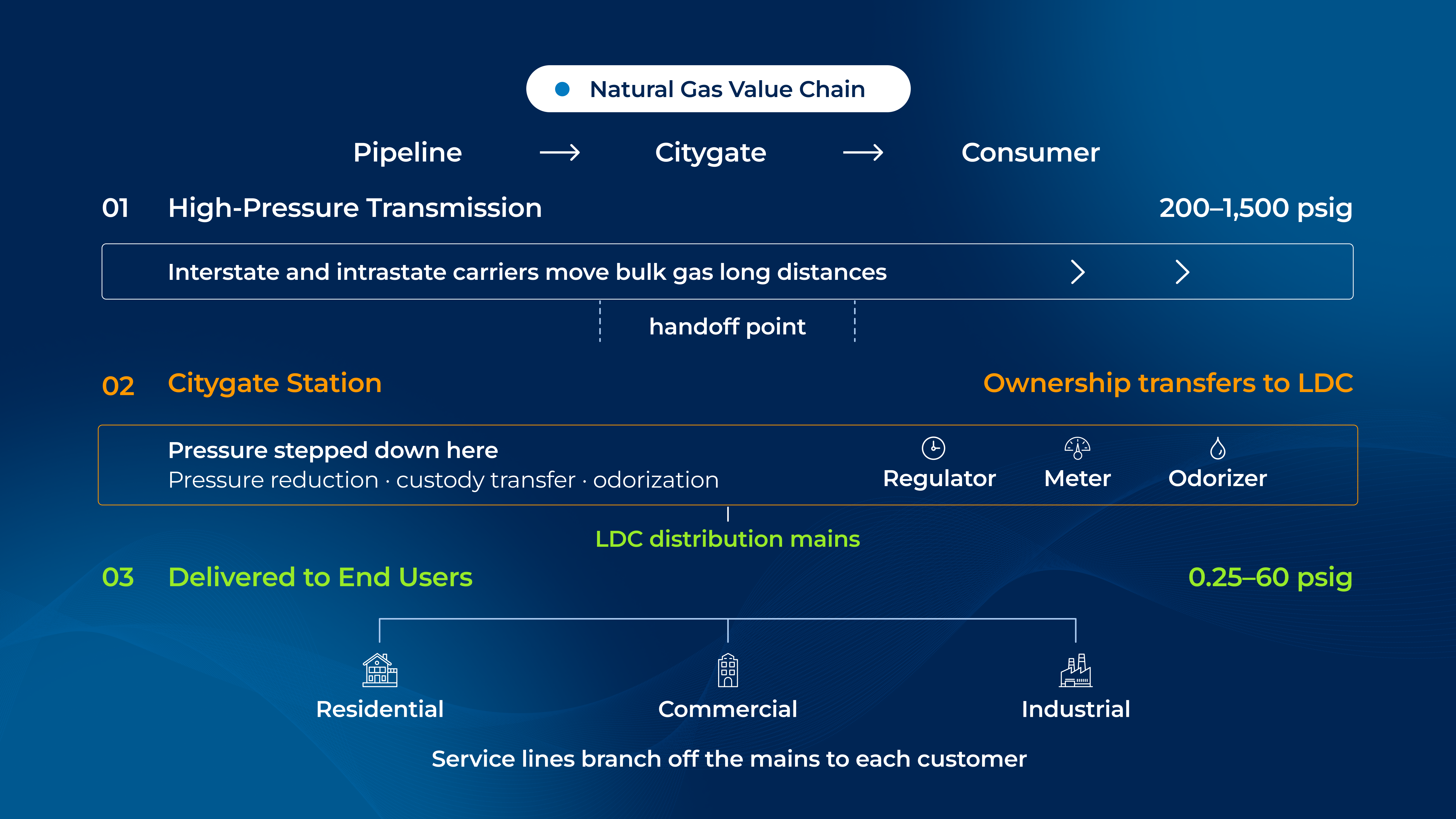
FLOWCAL 10.9 extends its LDC support by closing this gap:
- Fixed Pressure & Temperature Compensation: Linear gas meters can now be configured with fixed, externally or internally compensated pressure and temperature values, pulled from the meter characteristic instead of a live transmitter. It's exactly the situation an LDC lives in every day: regulated, stable line pressure with no transducer in sight. Fixed inputs are flagged in magenta in the Volume Editor so nothing gets mistaken for live data, and compensated meters no longer throw false Missing P/T exceptions.
- Gas Meter Proving via TESTit Integration: Prove results for positive displacement and turbine meters now import directly from TESTit and apply to metered volumes, with PPAs created automatically on approval. Work that measurement techs previously did outside the system, then re-entered by hand, is now audit-ready inside FLOWCAL.
- Calibration Adjustments for Compensated Inputs: Meter Inspection test results for compensated inputs now flow from TESTit straight through to volume adjustments, with no manual recalculation required.
Chemistry Catches Up on Nonhydrocarbon Components
FLOWCAL's measurement of nonhydrocarbon components has historically been limited. That assumption is aging fast. 10.9 adds full support for hydrogen, helium, nitrogen, carbon dioxide, oxygen, hydrogen sulfide, and other measured components across the complete workflow: import, sample analysis, balance, and ticket editing, with dedicated nonhydrocarbon grids added throughout the UI.
For customers watching emerging nonhydrocarbon requirements creep into contracts and lab reports, this closes a real gap rather than a cosmetic one.
A Governed REST API for FLOWCAL Data
Before 10.9, getting data out of FLOWCAL meant one of three things: scheduled report exports that can corrupt or pile up, direct database access that keeps IT fielding custom requests for every reporting group, or PowerShell scripts stitched together by services teams. None of these approaches clears security review in modern cloud environments, and none is supported going forward.
"A secure, performant core approach to data availability has been one of the most consistently requested things we hear from FLOWCAL customers — it's exactly what 10.9 delivers."
— Brian Sowell, Group Product Manager for Measurement Solutions at Quorum
FLOWCAL 10.9 ships a documented, public REST API for meter header, characteristic, quality, and flow data, authenticated through the Quorum Platform Identity Server rather than a home-grown login. Customers can pull data directly into homegrown or third-party systems without custom development, without opening the database, and without a script running unmonitored in the background. IT gets a secure, governed way to grant exactly the access each user needs, while the database itself stays closed.
Compliance Fields Built Into the Standard Report
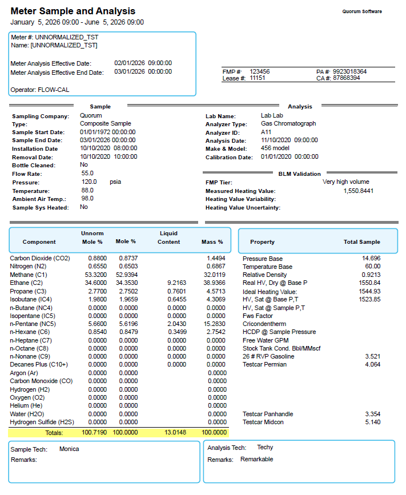
For operators on federal and Indian leases, BLM (Bureau of Land Management) measurement rules under 43 CFR 3175.12 carry real audit scrutiny. FLOWCAL 10.9 updates the Meter Sample and Analysis report with the specific fields examiners look for, including unnormalized mole percent, Analyzer ID, sample and lab technician, and field and office remarks, and aligns terminology with the regulation's own language, so your reporting is ready when an audit comes.
Smarter Gas Day Projections
Interstate pipelines require nominations before the gas day begins and at intraday cycles, and getting those wrong carries real financial consequences: imbalance penalties, cash-out events, even curtailments if a shortfall isn't caught early. 10.9 adds a “Use Current Day Data Only” option to the Gas Day Projection service: instead of leaning on historical trends alone, it averages a configurable window of hours already observed within the current gas day and extrapolates across the hours still missing.
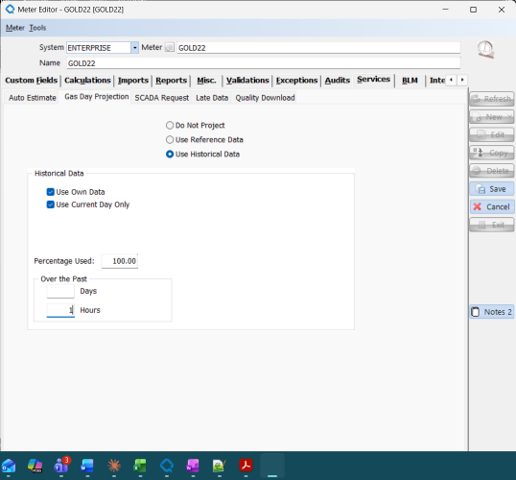
It's a small configuration change with an outsized effect on balancing accuracy and demand forecasting, giving operators an earlier, better-informed read on whether they'll be long or short before the imbalance becomes a cash problem.
Faster Performance Across the Board
10.9 also delivers meaningful performance gains: imports run more than 30% faster, the Volume Editor loads heavily annotated data in seconds instead of up to 30 seconds, the Auto Edits Editor opens twice as fast, and the GPM utility is significantly faster against hourly sources.
10.9 also includes platform work that keeps FLOWCAL current: validated support for Windows Server 2025, Crystal Reports 2025 Runtime, an upgraded Embarcadero API (v2.0), and SOC 2 Type 2 certified.
Why This Matters in a Crowded Measurement Landscape
The flow computer and measurement software market is growing fast. Fortune Business Insights estimates it near $1.47 billion in 2026, headed toward $2.8 billion by 2034 precisely because accuracy, compliance, and integration requirements keep climbing. For most gas and liquids operators, that growth translates into a familiar choice: stitch together custom scripts, disconnected spreadsheets, and point tools for gas proving, chemistry, and reporting, or consolidate onto a system built to handle all of it natively.
That's the gap 10.9 is built to close. Rather than treating gas measurement, liquid measurement, LDC workflows, API access, and regulatory compliance as separate problems requiring separate tools, FLOWCAL brings them into one workflow with native chemistry breadth, automated proving through TESTit, a governed API instead of a script, and report templates that already speak the regulator's language. That's a meaningfully different proposition than assembling several single-purpose tools and relying on each handoff to hold up during an audit.
The bottom line: broader chemistry coverage, a governed API instead of a workaround, and compliance reporting built directly into the standard report template.
Ready to upgrade? Download the FLOWCAL 10.9 brochure and reach out to your Quorum representative.
New to FLOWCAL? Request a demo to see how 10.9 handles gas and liquid measurement for your operation, chemistry, and compliance needs.
Sources
Fortune Business Insights, Flow Computer Market Report: https://www.fortunebusinessinsights.com/flow-computer-market-104962
 Previous Page