 7 min read
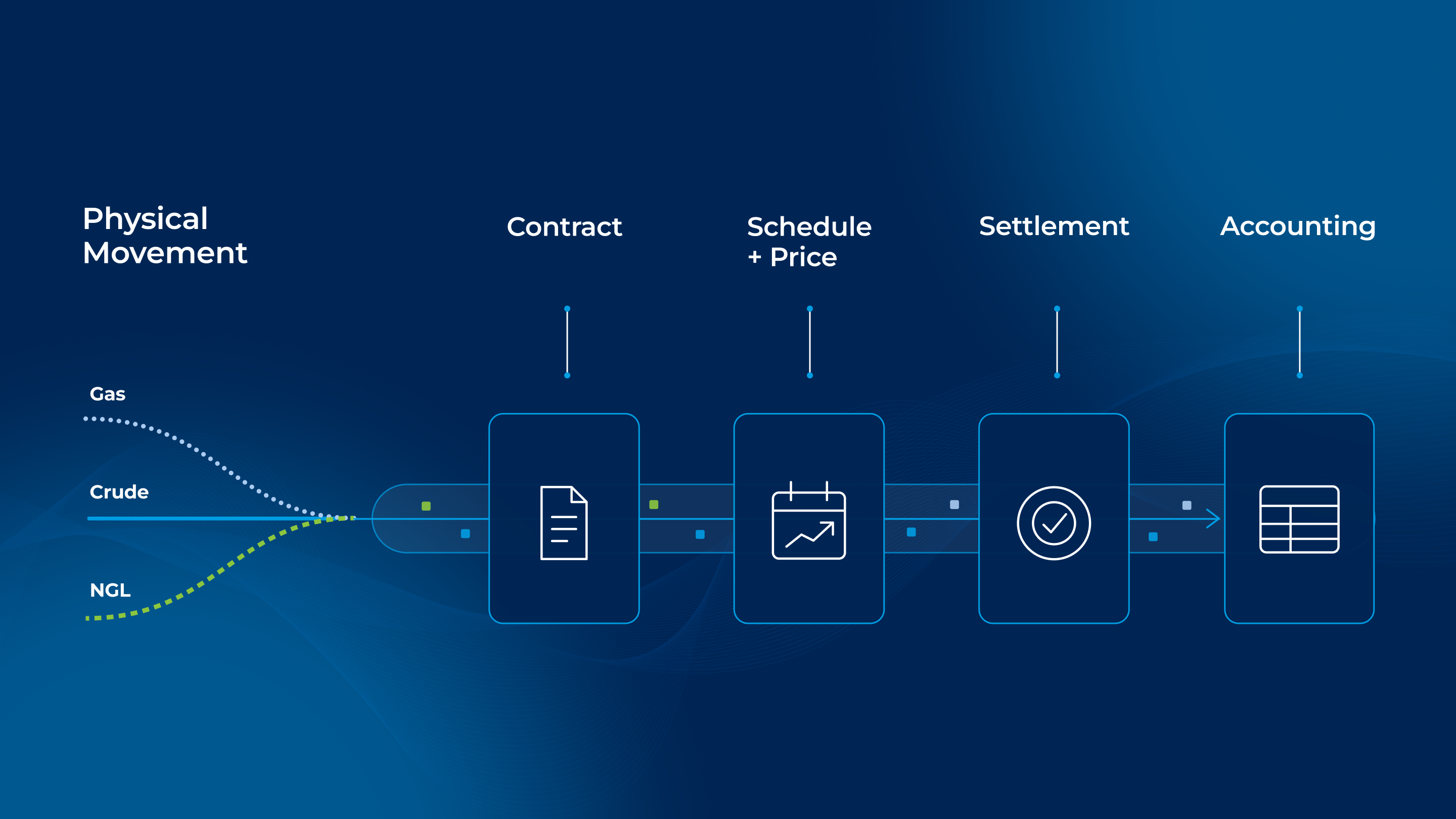
Gas and liquids marketers require energy trading and risk management software that connects a specific set of commercial functions: contract capture, transaction management, inventory tracking, complex pricing, settlement, and accounting integration. Quorum Energy Marketing is built around that process chain, linking front-office deal activity to back-office close without re-entering data across systems. The integration between those steps determines operational accuracy more than any individual feature does. A platform that holds contract terms, transaction data, inventory insight and drives invoice generation, gives teams across the organization a shared view of the business at the same time.”
Key Takeaway
ETRM software manages the commercial lifecycle from contract capture to settlement. For physical gas, crude, and NGL marketers, that lifecycle runs through inventory, pricing, scheduling, and accounting in a tightly connected sequence. Systems that keep that sequence intact reduce manual close effort and improve accuracy across operations and accounting.
What an ETRM System Holds
An ETRM system holds the commercial record of every deal a marketing organization makes and tracks those deals through execution. At the foundation is contract and deal management: the terms under which gas, crude, or NGL moves between counterparties, including complex pricing, volume commitments, delivery points, and payment terms. Those contracts generate transactions, the daily or monthly volume movements that fulfill the deals. Transactions generate the inventory position data that tells a marketing team what it owns, owes, or has already delivered.
Inventory management sits alongside the transaction record. For physical commodity marketers, inventory is product held at a specific facility, valued at a specific cost, and committed to specific counterparties. Real-time facility balances by location and product determine what scheduling decisions are available. Errors in inventory records carry forward into settlement, making the connection between inventory and transaction data a primary control point.
Pricing connects contracts and transactions to financial outcomes. Physical gas and liquids contracts frequently use index-based formulas, tiered structures, and price overrides that shift day to day. Systems that automate price calculations by pulling index data, applying formula logic, and flagging exceptions remove the error exposure created when pricing is managed outside the commercial record.
Settlement converts the commercial record into invoices, accruals, and journal entries. When settlement outputs come from the transaction chain already in the system, the month-end process runs from data that commercial and accounting teams have been working with all month. When settlement is assembled separately, manual effort fills every gap between what the system holds and what close actually requires.
Why Physical Gas, Crude, and NGL Marketing Has Different Requirements
Physical commodity marketing operates under constraints that shape what a system needs to do. Financial energy markets clear on exchanges and settle at published prices, with mark-to-market valuation and value-at-risk modeling as core system functions. Physical gas, crude, and NGL marketing moves real product through real infrastructure under bilateral contracts. The operational complexity of that movement is where the system requirements originate.
Physical gas marketing teams work inside the pipeline scheduling process. Nominations, imbalances, and operational flow orders affect which deals execute and how settlement calculates. Crude marketing involves tank inventory at specific facilities, run tickets, and custody transfer records that connect measurement data to commercial positions. NGL marketing adds fractionation agreements, product splits, and pricing structures tied to individual components.
Each of those workflows draws on data that lives outside a standalone ETRM system: scheduling platforms, measurement tools, and field operations records. A commercial record that does not incorporate those sources leaves gaps. Filling gaps requires manual effort, and manual effort at that point in the process is where errors enter the settlement chain. Quorum Energy Marketing is designed for physical gas and liquids operations, with data flows supporting nominations, scheduling, and accounting as part of the same workflow.
Where Settlement Automation Reduces Month-End Effort
The month-end close for a gas and liquids marketer moves through a fixed sequence. Transactions match contracts. Prices confirm or fix. Invoices go to counterparties and come in from suppliers. Journal entries post for accruals, settlements, and adjustments. Manual coordination at each handoff is where time and accuracy both degrade.
Settlement automation keeps the transaction chain intact from contract capture through financial output. When a transaction is confirmed, pricing logic runs against the relevant index and contract formula. That settlement value moves into invoice generation, payable matching, and accounting entries without a separate keying step for each output. Accruals use the same pricing logic before final prices confirm, and invoice matching runs against the transaction record already in the system.
The impact compounds across the close cycle. Each reduction in manual entry reduces one class of error. Fewer errors produce fewer disputed invoices, and fewer disputes reduce rework at close. For organizations processing hundreds or thousands of transactions per month, that sequence of reductions produces a measurably faster and cleaner close, one that accounting leadership can rely on rather than one that depends on individual staff knowing where exceptions are hiding.
What to Look for in an Energy Marketing System
Integration distinguishes systems built for physical midstream marketing. The questions worth asking before selection are operational. Does the contract record drive pricing directly, or are terms re-keyed into a separate calculation? Do scheduled volumes flow into actualization without manual reconciliation? Does the actualized position produce invoices and accounting entries the general ledger accepts without reformatting?
Those connections should be part of the system’s operational design. Contracts, pricing, scheduling, actualizing, and invoicing form a single chain, and each handoff is a point where errors enter if the link is manual. A platform requiring custom development to bridge those steps, or to carry commercial data into accounting, creates maintenance exposure and limits the traceability that auditors and controllers depend on.
Pricing flexibility matters alongside integration. Index-based formulas, tiered pricing, and contract-specific overrides are standard across gas and liquids marketing. A system that cannot apply complex formula logic at scale adds error exposure where accuracy is most consequential. That logic should be anchored to the contract terms and carry through to the invoice without being rebuilt along the way.
Scalability affects how acquisitions integrate. When new assets and contracts join the organization, the marketing system needs to absorb those positions without a parallel implementation effort. Platforms requiring heavy customization for each deployment slow acquisition integration and add operational strain.
Auditability works through the same infrastructure. When a counterparty disputes an invoice or an auditor questions a volume, resolution depends on tracing from the invoiced amount back through the actualized volumes, the scheduled quantities, the pricing calculation, and the original contract terms. A system that holds that chain end to end supports the trace.
What a Well-Functioning Commercial Process Looks Like
When an energy marketing platform is working correctly, the commercial process runs without parallel workflows. Deals hold the terms, pricing, and delivery information that transactions are driven from. Transactions drive actualization. Pricing runs automatically against confirmed or projected indexes. Invoice generation, payables matching, journal entries, and accruals come from the transaction record already in the system. Month-end reconciliation becomes verification rather than reconstruction.
Organizations that have moved to a connected energy marketing platform report faster close cycles, fewer disputed invoices, and the ability to absorb acquisitions without proportional headcount growth. Those results follow from keeping the transaction chain intact from deal capture through financial output and from maintaining the integrations that prevent data from leaving the chain between commercial activity and close.
Conclusion
ETRM covers a wide range of commercial operations systems. For physical gas, crude, and NGL marketers, the relevant measure is how completely a system connects contract management, inventory, pricing, scheduling, and settlement, and how cleanly those connections extend into accounting and measurement. Energy marketing software built for physical midstream operations addresses that workflow from the process design up, with integrations that standalone financial ETRM systems typically require custom work to replicate.
The operational questions yield the clearest picture when evaluating platforms: how scheduling connects to the commercial record, how pricing automates, how invoices and journal entries generate, and how auditors trace from settlement back to contract. Those questions locate exactly where a process chain holds together and where it depends on manual effort to compensate.
FAQ
What does ETRM stand for?
ETRM stands for energy trading and risk management. The term describes software that manages the commercial lifecycle of energy transactions from deal capture through settlement and accounting. ETRM systems were originally developed for financial energy trading, where mark-to-market valuation and value-at-risk modeling are core requirements. Over time the term has been applied more broadly to commercial operations software used by physical commodity marketers, midstream operators, and utilities, including organizations that do not use financial derivatives or require risk quantification features.
What is the difference between ETRM and CTRM?
ETRM and CTRM refer to overlapping categories with different origins. ETRM developed in the context of financial energy markets. CTRM, commodity trading and risk management, covers physical commodity trading across agriculture, metals, and energy. Systems marketed under each label often carry similar capabilities. The distinction reflects vendor history more than a meaningful functional boundary in how physical marketing operations are actually managed. For a detailed comparison, see [link: ETRM vs CTRM and what the difference means for midstream marketers].
Is cloud-based energy marketing software reliable enough for mission-critical commercial operations?
Cloud-based energy marketing platforms are the standard for organizations that need reliable access, continuous updates, and scalable infrastructure without managing on-premise hardware. For physical gas and liquids marketing, the relevant considerations are uptime commitments, security standards, and how the platform integrates with external data sources including pipeline scheduling systems, price indexes, and accounting platforms. On-premise deployments remain in use where specific data governance or infrastructure requirements apply. Cloud delivery has become the dominant model for new implementations across the sector.
 Previous Page