 9 min read
Every era of energy operations has been defined by a different binding constraint, and for much of the last decade that constraint has been coordination. It shapes how companies are structured, how decisions get made, and how fast they can move.
Even the best-run operators are organized into distinct domains, each with capable systems of record. Depending on the operating model, those domains show up as functional departments, integrated asset teams, or disciplines such as subsurface, operations, commercial, and finance. The systems work and the data exists. What still depends on people is coordination across those domains: context moves through meetings, handoffs, and institutional knowledge, and expertise stays locked inside individual teams.
The operator of 2030 does not work that way. Connected data and governed agency close those seams, working across the systems operators already run so decisions no longer wait on people to assemble the picture. This does not replace people. Operator jobs do not go away, and human expertise becomes the scarce input that decides outcomes. And when intelligence can sense, reason, and act across formerly siloed domains, the org chart built to manage the coordination between them stops being a feature and becomes the bottleneck. This industry has always run inside boom-and-bust cycles, and it always will. What is finally within reach is the capability to navigate that volatility in real time.
From Functional Handoffs to Integrated Judgment
Two capabilities unlock this shift: connectedness and agency. This is the move from systems of record to systems of agency, from software that documents what happened to software that helps run the business.
Connectedness means operational, financial, commercial, and contractual data exist within a shared context rather than disconnected systems of record. Production data, authorization for expenditure (AFE) status, contractual obligations, scheduling constraints, and financial exposure all become part of the same operational picture.
Agency means governed AI can move across that picture, interpret multi-part signals, and recommend (or in some cases initiate) action. The intelligence is not isolated inside a chatbot or reporting layer. It is embedded directly into workflows with transparency, provenance, and oversight.
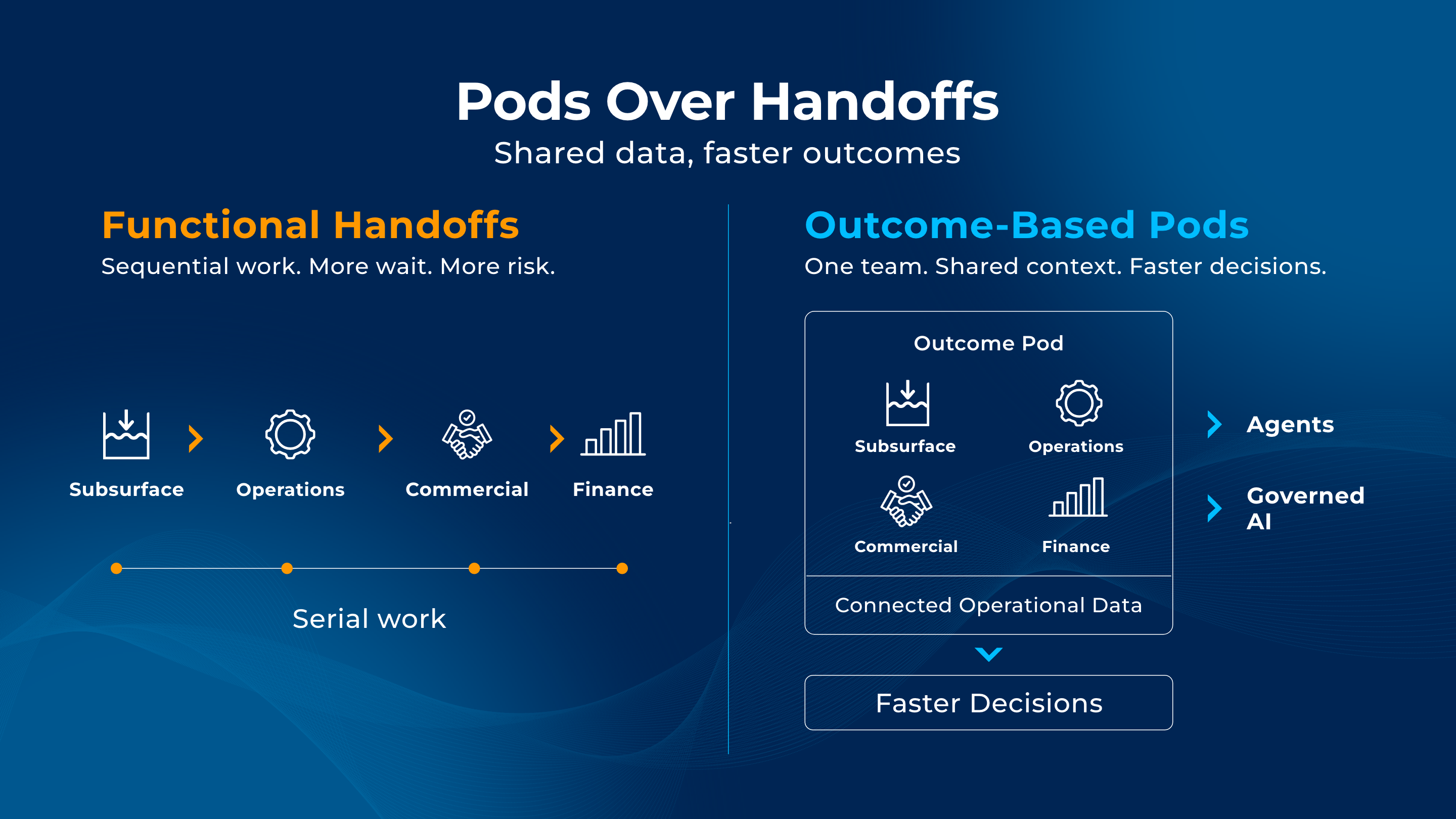
Together, these capabilities collapse the handoffs that define most organizations today.
Data has never been the constraint. The constraint is that it cannot reach the decision fast enough, so teams burn real time assembling context. By the time production, commercial, and finance groups align on what an operational event means, the window to act has often already closed.
Why the Org Chart Becomes the Bottleneck
As this model matures, the organizational structure changes with it.
The operator of 2030 is organized around outcomes rather than functions.
Instead of large, siloed teams passing work across land, accounting, finance, and operations, companies organize around the decisions themselves. Teams form around specific outcomes, pairing deep specialists with generalists who interpret cross-functional signals and own workflows end to end.
Deep domain expertise becomes more valuable, not less. Edge cases, strategic judgment, negotiation, and exception handling are exactly where experience decides the outcome, and that work moves to the center of the job. What leaves is the connective drudgery that consumes analyst time today: gathering information, reconciling systems, assembling context. Agents handle that across unified workflows so people spend their time on the calls that actually require human judgment. The human stays in the loop on every decision and remains accountable for it. That does not change in 2030, and it is what carries the day.
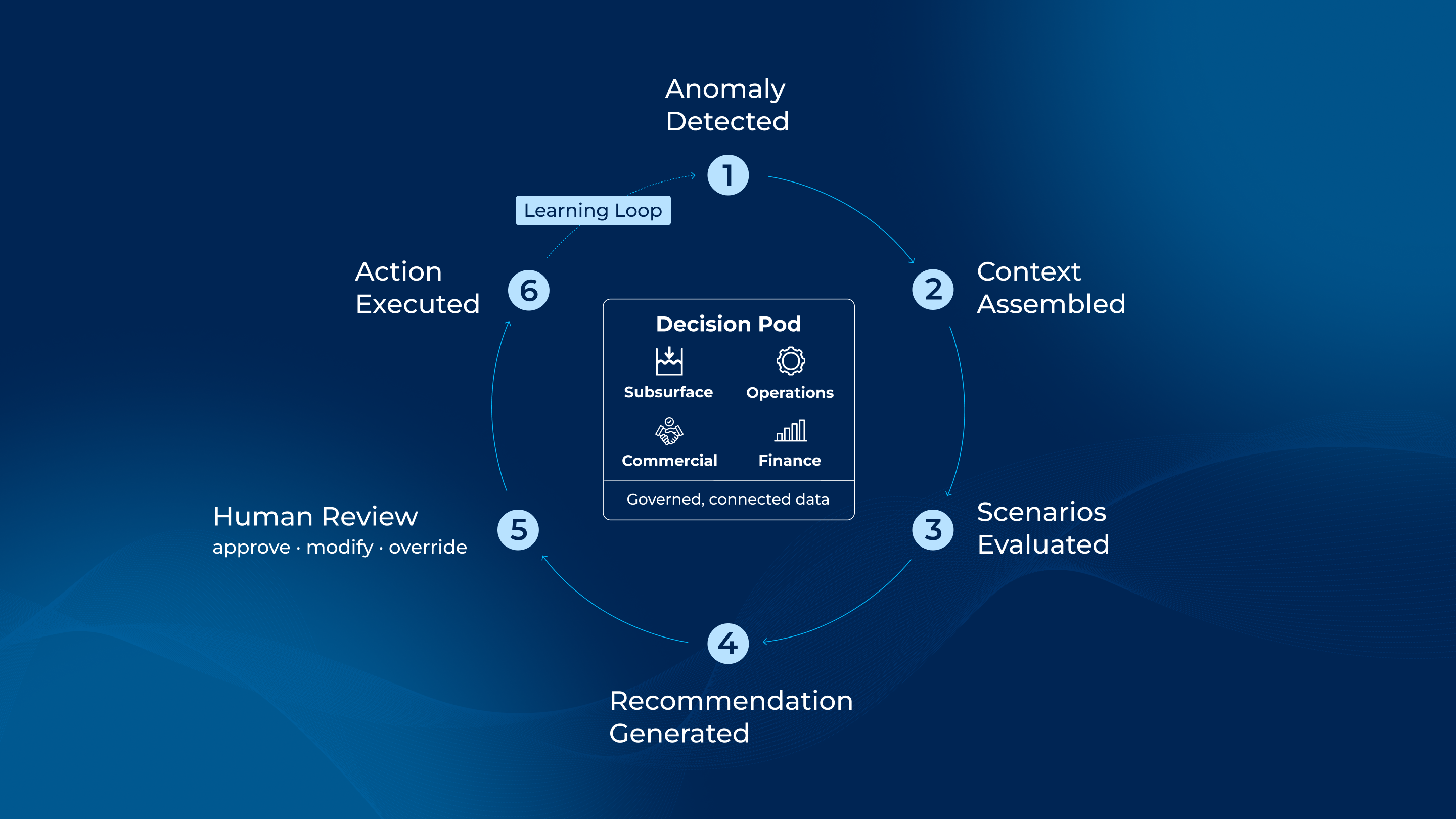
That changes both speed and scale. Work that once required days of coordination becomes reviewable in hours, and institutional knowledge gets captured and made repeatable instead of staying trapped in individual memory. Decisions become more transparent because systems can show not only the recommendation, but the reasoning behind it: what signals triggered the review, what scenarios were considered, why alternatives were ruled out.
The result is a structurally different operating model, not just a more efficient one.
Upstream: When a Well Goes Down
Consider a common scenario: a producing well unexpectedly goes offline.
Today, resolving that event triggers a sequence of disconnected workflows. Production operations assess the deferment. Finance evaluates capital availability. Land checks lease obligations and drilling commitments. Engineering evaluates workover options. Schedulers coordinate resources. The process depends on meetings, spreadsheets, and repeated context-sharing across systems that were never designed to talk to each other.
In the operator of 2030, the response does not wait for a meeting.
An agent detects the production anomaly and immediately opens a cross-domain workup. It quantifies deferred volume and NPV exposure. It evaluates whether lease terms or continuous drilling clauses put acreage at risk. It reviews AFE status, capital constraints, and hedging implications, then assesses operational feasibility in parallel: Which workover rigs are available? What is the estimated downtime under each scenario? What does expedited work cost against the value of restored production?
The result is a coordinated recommendation surfaced to a cross-functional decision-making pod: what was observed, what data was used, which constraints shaped the conclusion, and why one course of action ranked above the others. It can be approved, modified, or overridden. Work that previously took multiple teams and weeks of alignment is compressed into a reviewable package completed in under an hour, with the reasoning captured automatically for future reference.
Midstream: When a Compressor Station Trips
The same model extends downstream of the wellhead.
A compressor station on a gathering system trips offline. Within seconds, an agent detects the pressure and flow anomaly and opens a coordinated operational and commercial assessment.
It identifies affected producers, calculates lost throughput, and estimates disruption duration. On the commercial side, it maps exposure across firm and interruptible agreements, flags minimum volume commitments at risk, and quantifies deficiency payments owed or earned. Schedulers immediately see whether volumes can be rerouted and how those changes ripple into downstream processing nominations and storage withdrawals. Contractual notification windows are surfaced automatically, so counterparties hear what they need to and when.
Finance gains simultaneous visibility into revenue exposure, insurance implications, and warranty considerations tied to the equipment failure. The agent weighs repair crew availability, parts inventory, and expedited service costs against the value of restored capacity, then produces a response plan alongside draft shipper notifications ready for human review.
What would previously require operations, commercial, scheduling, and finance teams working across multiple systems becomes a single workflow with embedded reasoning and clear accountability.
When a Repair Has to Reach an Offshore Platform
The decision to act is only half the problem. Executing it means moving people, parts, and equipment to where the work is, often offshore, on a narrow weather window, across vessels, aircraft, customs, and third-party providers. Today this is its own siloed scramble: calls to coordinate a supply vessel, a separate check on whether the right crew is certified and rotation-eligible, a manual reconciliation of parts against lead times, all racing a forecast.
In the operator of 2030, the same anomaly that triggers a repair recommendation triggers the logistics workup alongside it. An agent confirms the required parts and their location, checks crew availability, certifications, and rotation limits, and sequences people and materials against vessel and aviation schedules and the weather window. It prices expedited options against the cost of deferred production and flags customs or regulatory steps that need lead time. What emerges is a single executable plan: who goes, what moves, on which assets, by when, and at what cost, ready for human approval rather than assembled from a dozen phone calls.
Logistics is where connected decisions become physical. It is also where interconnectedness pays off most visibly, because the cost of a missed window is measured in days of lost production, not minutes.
What Has to Be True First
This future depends on more than layering AI onto existing processes. Three foundations must exist.
A real data foundation. Federated dashboards on top of fragmented systems are not enough. Shared context across operations, subsurface, commercial, and financial systems is a prerequisite. The intelligence is only as reliable as the operational fabric beneath it.
Governed AI with transparency and auditability. Energy is a heavily regulated, operationally sensitive industry. Recommendations must come with provenance, explainability, and appropriate oversight. Black-box outputs will not earn operational trust.
Workflow embedding. Intelligence has to live where work actually happens. If users must leave their operational environment to query a separate AI tool, adoption stays limited and value stays theoretical. The leverage comes from embedding reasoning directly into the decisions people already make.
The Divide Ahead
Operators that reach this model first will run fundamentally different companies, not just more efficient ones.
They are flatter and faster, with institutional knowledge that accumulates instead of fragmenting and data advantages that compound as every workflow deepens the system’s understanding of the operation.
The advantage shows up where it counts, on the metrics operators report every quarter. Faster, better-informed decisions mean less deferred production and less downtime, which flows straight to revenue and margin. Capital gets allocated with sharper discipline, because the trade-offs behind every AFE and workover are quantified in real time rather than reconstructed after the fact. Lease and contract obligations are protected before they become impairments or penalties. Coordination cost, the analyst hours and meeting cycles that produce no barrels, comes out of the operating base. The result is stronger free cash flow, better capital efficiency, and more durable return of capital to shareholders, achieved with a leaner cost structure rather than a larger one.
Most importantly, these companies spend less time coordinating work and more time acting on it.
That shift will become one of the defining competitive advantages of the next decade, and it will be visible in the numbers long before it is visible in the org chart.
Quorum is the connected data and AI foundation that energy companies run on. To see where your operation could start, please reach out.
 Previous Page