 5 min read
Measurement Is Under Pressure: Why Data Alone Isn’t Enough
Oil and gas operators are not short on measurement data. They are short on confidence in it. Across the industry, investment in sensors, connectivity, and monitoring systems has surged. In Forrester’s Networks And Telecom Survey, 2023, 90% of global enterprise telecommunications decision-makers across industries say their firm has adopted IoT solutions or applications or has plans to. (Forrester, 2025). In oil and gas, this same shift has expanded the amount of data captured across assets and systems. On the surface, this should have made measurement easier to manage.
For measurement managers, the issue has become about trust, accountability, and the ability to defend numbers that directly impact revenue and compliance.
Who Needs What in Measurement Today
Measurement breaks across roles.
Measurement managers are accountable for accuracy, audit readiness, and financial integrity. They need confidence that reported volumes are correct and defensible.
Measurement analysts depend on validated, consistent data to balance volumes and reconcile discrepancies. Their work requires clear visibility into what can be trusted.
In the field, technicians are responsible for capturing and verifying data at the source. This depends on structured workflows, accurate calibration processes, and clear documentation of what actually occurred.
How Did We Get Here
The current state of measurement is not the result of a single failure. It is the outcome of how the industry evolved.
- Data collection scaled rapidly. Advances in field systems and measurement technologies made it possible to monitor assets, flows, and conditions in real time. Organizations focused on capturing more data to improve operational visibility.
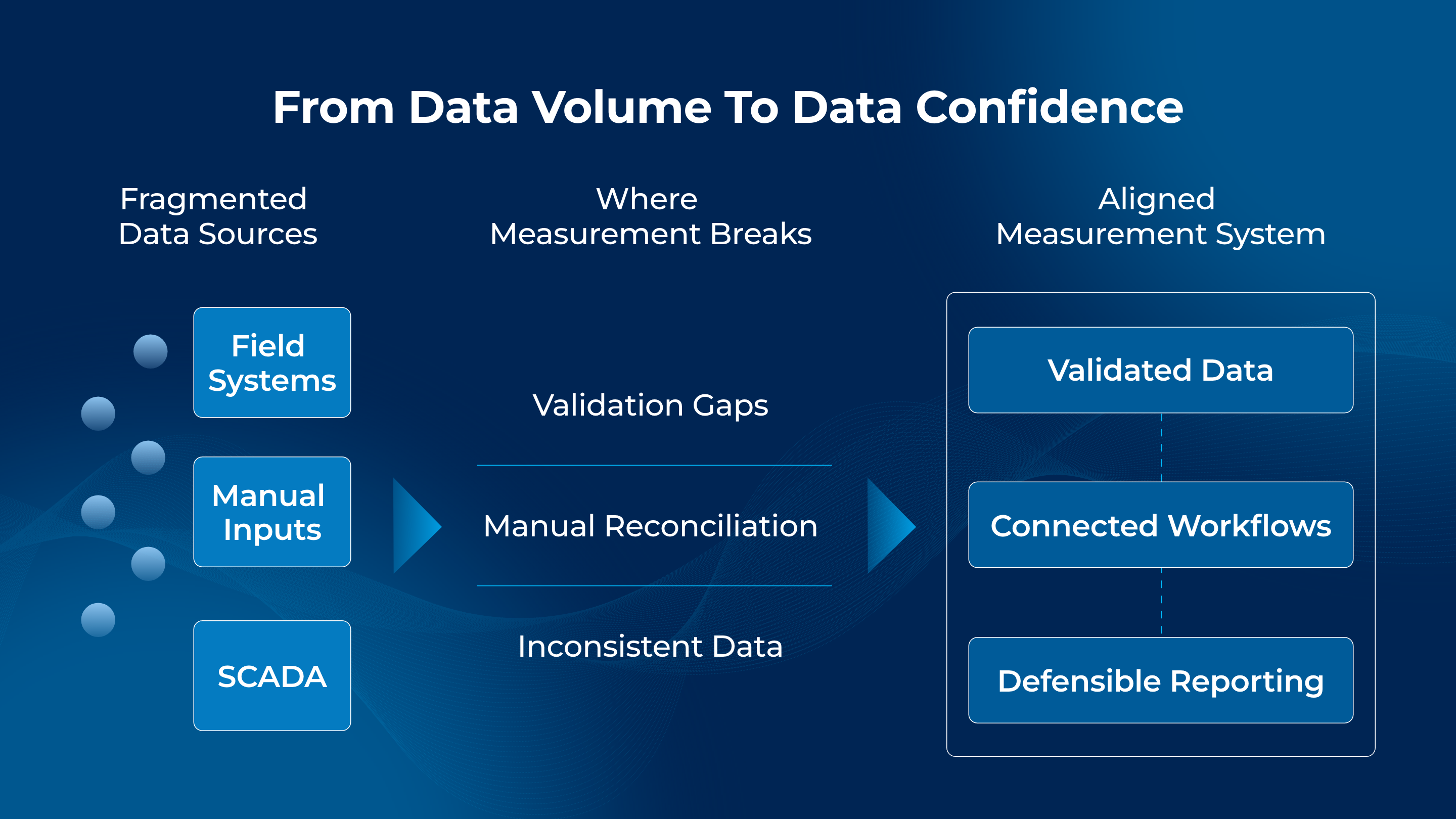
- Systems expanded. Measurement data now flows through a mix of field systems, validation processes, and enterprise applications. These systems often operate independently, creating gaps between where data is captured, validated, and reported.
- Workflows remained disconnected. Field activities such as calibration, inspection, and meter proving are still managed through a combination of digital tools and manual processes. Even when data is captured electronically, the handoff between field and office introduces delays and inconsistencies.
Finally, stakeholder alignment became harder. Measurement initiatives involve multiple teams with different priorities, from operations to IT to finance. These groups define success differently, which makes it difficult to maintain a consistent measurement strategy.
The result is a measurement environment that is highly instrumented but not fully aligned.
The Cost of Measurement Gaps
When measurement systems are not aligned, consequences show up quickly. Inaccurate or unvalidated data leads to incorrect volume calculations, which directly affects revenue. Measurement errors can go undetected without proper validation and anomaly detection processes, increasing the risk of product loss and financial exposure.
Manual processes introduce inefficiencies and increase the likelihood of errors. Tasks such as calibration tracking, inspection scheduling, and data reconciliation become time-consuming and difficult to manage at scale. These challenges point to a broader issue: measurement systems are capturing more data, but they are not designed to keep that data aligned.
What Needs to Change
Fixing measurement does not require more data. It requires a different approach to how data is managed, validated, and connected. This shift moves measurement from data collection to data coordination and validation
Start with Data Integrity at the Source
Accurate measurement begins in the field. Calibration, proving, and inspection processes must be structured, consistent, and recorded in a way that can be verified later. Systems should identify inconsistencies early and ensure that data captured in the field reflects actual operating conditions.
Connect Field and Office Workflows
Measurement breaks down when field activity and office validation are disconnected. Data from inspections, tests, and calibrations should flow directly into validation and reporting processes without manual re-entry or delay. Integration between field and enterprise systems is critical to maintaining alignment.
Build a Single, Defensible Dataset
Organizations need a consolidated view of measurement data that serves as a reliable source for reporting and analysis. This includes validating incoming data, flagging anomalies, and maintaining a clear record of edits and adjustments. A centralized approach reduces duplication and ensures consistency across teams.
Embed Compliance into Daily Operations
Compliance should not be a separate step. It should be built into the measurement process itself. Validation against industry standards, automated checks, and clear audit trails help ensure that data is always ready for review.
Enable Continuous Oversight
Measurement is not a static process. It requires ongoing review, adjustment, and improvement. Workflow controls, review mechanisms, and visibility into task status help ensure that issues are identified and resolved before they impact reporting. Recent advances in workflow management highlight the importance of built-in review and approval processes to maintain accountability.
From Data Collection to Data Confidence
The industry has made significant progress in capturing measurement data. The next challenge is making that data reliable. Measurement managers are not asking for more dashboards. They are asking for clarity. They need to know that the data they rely on is accurate, complete, and defensible.
Closing this gap requires moving beyond monitoring to validation, beyond integration to alignment, and beyond data volume to data confidence. The organizations that address this will not just improve measurement. They will strengthen financial accuracy, reduce risk, and enable faster, more confident decisions across the business.
Source
Pelino, Michele, with Lauren Nelson, Alexander Soley, Kathryn Bell, Meg Bellavance, Sophia Barrett, and Bill Nagel. Internet-Of-Things Heatmaps for Operational Excellence in 2025. Forrester Research, updated January 24, 2025.
 Previous Page