 7 min read
A Framework for Scenario Analysis in Volatile Commodity Markets
Introduction
In volatile commodity markets, planning is less about producing a single forecast and more about understanding how different conditions affect capital timing, development priorities, and financial outcomes.
A single forecast can support budgeting, but it does not show how the business responds when prices move. Planning platforms like Enersight help teams compare development scenarios and align asset plans with value outcomes early in the workflow. Scenario analysis establishes that response by connecting market conditions to capital decisions before those conditions occur.
Key Takeaway
Scenario analysis improves decision speed and confidence by comparing how alternative development approaches perform across different market conditions. Field development planning then takes the selected scenario and further defines how it will be executed through capital allocation, sequencing, timing, and operational planning.
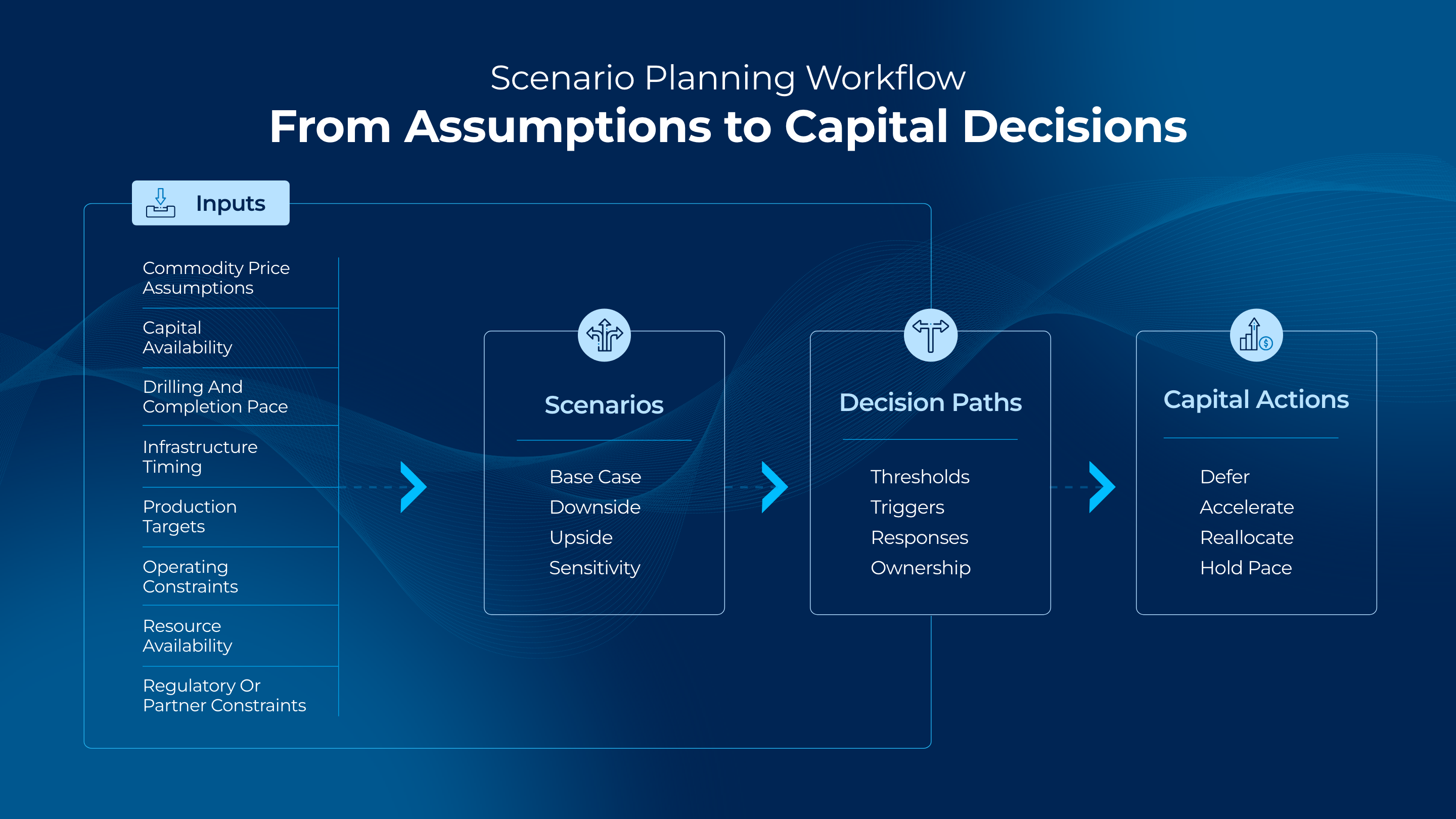
How Scenario Analysis Works in Capital Planning
Scenario analysis starts with a base development concept that reflects the most likely execution approach. Teams then evaluate alternative scenarios by adjusting variables such as price, capital availability, drilling pace, infrastructure timing, or operational constraints.
The objective is not simply to generate more forecasts, but to understand how different development approaches perform under varying conditions. Once a preferred scenario is selected, field development planning further defines the execution strategy, including sequencing, timing, infrastructure, and capital deployment.
A typical framework includes:
- A base case aligned to the current plan
- Downside cases that test reduced development pace, constrained capital availability, or delayed infrastructure timing under weaker market conditions.
- Upside cases that evaluate acceleration opportunities
- Operational cases that test rig availability, takeaway constraints, or sequencing alternatives
- Sensitivity views that isolate variables affecting value, timing, and operational feasibility
Relationship Between Scenario Analysis and Field Development Planning
Scenario analysis and field development planning are closely connected but serve different purposes within upstream planning workflows.
Scenario analysis evaluates multiple possible development approaches across varying market and operational assumptions. The goal is to compare outcomes, understand trade-offs, and identify preferred strategies.
Field development planning begins once a preferred scenario is selected. At that stage, the focus shifts from comparison to execution definition, including development sequencing, infrastructure planning, drilling schedules, capital allocation, and operational coordination.
In practice, organizations continuously move between these activities as assumptions change and plans evolve.
Scenario Structure and Decision Impact
| Scenario Type | What It Tests | Decision It Informs |
| Base case | Most likely execution plan | Capital allocation and development sequencing |
| Downside case | Price declines below planning range | Deferral, scope reduction, cash preservation |
| Upside case | Higher-than-expected prices | Project acceleration and capital deployment |
| Sensitivity view | Individual variable changes | Assumption tracking and monitoring priorities |
In upstream planning, scenarios often represent alternative development strategies rather than simple financial sensitivities. A scenario may include changes to development sequencing, drilling pace, infrastructure timing, production targets, or capital allocation in response to different market and operational conditions.
Each scenario exists to inform a decision. The framework is effective when leadership can see how the same asset or program performs across conditions without rebuilding the model.
Where Variability Enters the Process
Variability enters through the assumptions that drive value. Commodity prices, drilling and completion timing, infrastructure readiness, operating costs, rig availability, production targets, and capital constraints all influence how a development plan performs under different conditions.
These inputs do not change independently. A shift in price may coincide with cost pressure or delays in development timing. Scenario Analysis accounts for these interactions by testing combinations that reflect realistic operating environments.
Translating Scenarios into Decisions
Scenario outputs become useful when they are tied directly to actions. Each case should indicate what the business will do if that environment materializes.
A structured process typically follows three steps:
- Define a limited set of credible scenarios
- Test the variables that most directly affect value and timing
- Translate results into pre-agreed decision paths
This approach reduces the need to rebuild analysis under time pressure. Decisions are guided by predefined thresholds rather than reactive interpretation.
Impact on Capital Discipline and Decision Quality
When leaders can evaluate performance across multiple scenarios, capital decisions are made with a clearer understanding of risk and timing. This reduces reliance on a single planning case and limits overreaction to short-term price movements.
The result is more consistent capital discipline. Projects are evaluated within a range of outcomes, and trade-offs between timing, spend, and value are visible before commitments are made.
As Scenario Analysis frameworks mature, the consistency and usability of outputs become critical to decision-making under volatility. In practice, organizations that standardized scenario analysis—such as in Noble: Financial Scenario Analysis Standardization—were able to compare outcomes across assets more efficiently and link those results directly to capital allocation decisions. This reduced the need to rebuild analysis as assumptions changed and improved alignment between planning teams and leadership. At the same time, accelerating scenario evaluation, as demonstrated in Shell: Scenario Planning and Forecast Acceleration, allowed teams to respond more quickly to shifting market conditions without sacrificing analytical rigor. Together, these capabilities support a more disciplined planning process where decisions are guided by structured scenarios rather than reactive adjustments, improving both speed and confidence in capital planning.
Where Issues Typically Occur
Breakdowns in Scenario Analysis usually come from weak links between assumptions and decisions. Common issues include:
- Too many scenarios without clear purpose
- Sensitivities that do not reflect real operational constraints
- Outputs that are not tied to specific actions
- Rework required each time assumptions change
These issues reduce the usefulness of the framework and slow decision-making when conditions shift.
Role of Systems and Data
Scenario Analysis depends on consistent data and connected models. When planning, engineering, and finance teams work from aligned inputs, scenario outputs become comparable and repeatable.
Systems that support scenario comparison allow teams to evaluate different development paths without rebuilding models. This improves visibility into how changes in assumptions affect value, timing, and capital requirements.
Integration with capital budgeting and portfolio views further strengthens the process by keeping planning outputs aligned with financial decision-making.
Scalable Scenario Analysis State
A scalable Scenario Analysis process is defined by consistency and reuse. Scenarios are updated as conditions change, but the structure remains stable.
Decision thresholds are established in advance, and teams revisit assumptions periodically to ensure scenarios remain relevant. This keeps planning outputs aligned with current market conditions without restarting the process.
Conclusion
Scenario Analysis provides a structured way to evaluate how commodity price volatility affects capital decisions. It connects market uncertainty to defined actions, improving visibility into trade-offs and reducing decision latency.
The framework does not eliminate volatility, but it ensures the business is prepared to respond with clarity when conditions change.
Frequently Asked Questions
What is Scenario Analysis in oil and gas?
Scenario Analysis evaluates business performance under multiple sets of assumptions rather than relying on a single forecast. It tests how price, cost, and production changes affect capital decisions and asset value.
What are examples of Scenario Analysis?
Examples include downside price cases to identify deferrals, cost sensitivity scenarios to evaluate inflation impact, and delayed recovery cases to assess cash flow resilience.
What is a business Scenario Analysis framework?
A Scenario Analysis framework defines how an organization builds, evaluates, and responds to different market conditions using structured cases, sensitivity analysis, and decision thresholds.
Ready to learn more Enersight? Request a Demo today.
 Previous Page