 11 min read
Oil and gas AP automation is software that matches vendor invoices against upstream documents: like field tickets, price books, and AFEs instead of only purchase orders. It validates rates, well-level coding, and joint interest billing allocations automatically, clearing exceptions at the point of capture so invoices post on time and the month-end close moves faster.
Upstream accounts payable runs on documents a standard invoice workflow never sees. Field tickets, authorizations for expenditure, joint interest billing splits, and well-level cost coding all sit between a vendor invoice and a correct payment. Generic accounts payable (AP) automation was built to match an invoice to a purchase order, so it stalls the moment those upstream documents enter the picture.
For an upstream controller, that gap shows up as exceptions: invoices that stop for manual review and pile up when the month-end close needs them cleared. This article covers why generic automation fails upstream, what the oil and gas three-way match looks like, where exceptions come from, and how to evaluate AP software built for the industry.
What Is AP Automation?
Accounts payable automation, also called invoice automation, uses software to capture invoices, match them against supporting documents, route approvals, and schedule payments with minimal manual entry. It replaces spreadsheets and paper-based review with a governed digital workflow, reducing errors, shortening cycle time, and giving finance teams clear visibility into outstanding liabilities.
In oil and gas, AP automation means considerably more. An upstream operator does not receive a clean invoice tied to a purchase order. It receives a vendor invoice supported by field tickets, priced against a negotiated rate schedule, and coded to a specific well, cost center, and AFE. Automation that cannot read those relationships moves the manual work from data entry to exception handling.
Why Does Generic AP Automation Fail Upstream?
Standard AP platforms assume a simple document chain: purchase order, goods receipt, invoice. Upstream operations rarely follow that chain. Five differences explain most of the friction.
Field tickets, not purchase orders. Field services are ordered by contract and confirmed on a field ticket signed at the wellsite. There is often no purchase order to match against, so a purchase-order-based engine flags the invoice as an exception by default.
AFEs govern the spend. Capital work is authorized through an authorization for expenditure (AFE). An invoice has to be validated against the remaining AFE budget, not only the line-item price. Generic platforms have no concept of an AFE.
Costs split across owners. Most properties are jointly owned, so a single invoice is allocated across working interest owners through joint interest billing (JIB). AP coding feeds that allocation directly. A miscoded invoice produces an incorrect JIB statement.
Well-level coding is mandatory. Every cost is coded to a well, cost center, and expense type for lease operating expense (LOE) reporting and division order accounting. A chart-of-accounts-only coding scheme cannot capture that detail.
Approvals follow more than a dollar threshold. Upstream approvals route by AFE owner, operating agreement, and legal entity, not by a single spending limit. A workflow that only escalates on amount cannot enforce who is authorized to approve a given cost. AP workflow automation built for oil and gas routes by those rules — AFE owner, operating agreement, and entity — not by a dollar figure alone.
Each difference turns a routine invoice into a manual exception. Multiply that across thousands of field tickets a month, and AP becomes the function most likely to delay the close.
What Is the Upstream Three-Way Match?
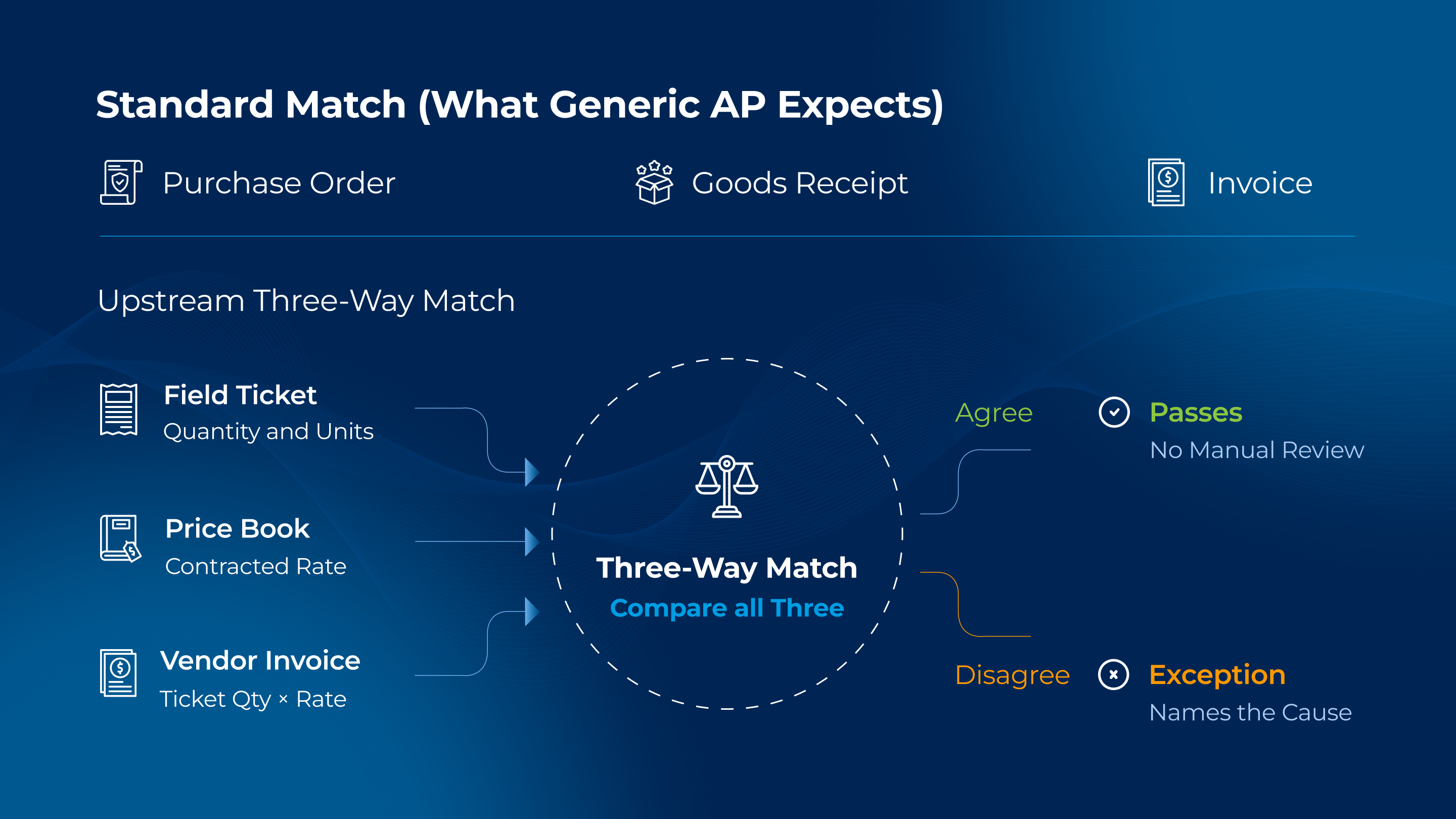
A standard three-way match compares the purchase order, the goods receipt, and the invoice. Upstream AP uses a variant suited to field-based work. The oil and gas three-way match compares three different documents:
- The field ticket, which records the service performed, the equipment used, and the hours or units, confirmed at the wellsite.
- The price book, the negotiated rate schedule or master service agreement that sets the correct price for each service.
- The vendor invoice, which should equal the field ticket quantities priced at the price book rate.
When the three agree, the invoice can pass without human review. When they disagree, the system has enough information to identify why: a rate that does not match the contract, a quantity that does not match the ticket, or a duplicate ticket already billed. That specificity is what separates automation that resolves exceptions from automation that only flags them.
The field ticket carries a second benefit for the close. Because it records the work before the invoice arrives, it lets accounting accrue the cost in the correct period even when the vendor bills late. Capturing tickets in a governed system means those accruals rest on data rather than estimates.
The price book is the linchpin of the upstream match. It reflects master service agreements, negotiated day rates, and any escalation terms, and it changes as contracts are renewed. When the price book is current and connected to AP, rate validation happens automatically. When it lives in a spreadsheet, every rate check becomes a manual lookup, and the match breaks down.
Where Do Invoice Exceptions Come From, and How Does Automation Eliminate Them?
Most upstream AP exceptions fall into a handful of types. Each has a root cause, and each can be designed out.
Unmatched day rates. A vendor bills a day rate that differs from the contracted rate. Matching the invoice to the price book at capture catches the variance before it reaches an approver.
Duplicate field tickets. The same ticket is submitted twice, or billed on two invoices. Ticket-level tracking flags the duplicate on the second submission.
AFE overruns caught late. Capital costs accumulate against an AFE that is already near its limit, and no one notices until the close. Validating each invoice against remaining AFE budget surfaces the overrun when it happens.
Coding errors. An invoice is coded to the wrong well, cost center, or expense type, distorting LOE and JIB. Rules that inherit coding from the field ticket and contract reduce manual entry and the errors that come with it.
Quantity and unit mismatches. The invoice bills more hours, units, or volumes than the field ticket supports, or uses a different unit of measure. Comparing invoice quantities to ticket quantities at capture isolates the difference before approval.
The pattern is consistent. Exceptions come from validating an invoice against missing or incorrect data. Supplying the right data at capture, from the field ticket, the price book, and the AFE, removes the exception at the source instead of routing it to a person.
Exceptions are expensive well beyond the minutes spent resolving them. Each one consumes senior accounting time, delays vendor payment along with the discounts and goodwill that come with paying on schedule, and leaves costs unposted so period reporting is incomplete. A high exception rate is one of the clearest signs that an AP process was not built for upstream work.
How Does AP Automation Affect the Month-End Close?
AP exceptions and the close are the same problem viewed at two moments. An exception created on day three of the month becomes an unposted liability on close day. The faster AP clears exceptions, the less the close inherits.
An upstream close already depends on production volumes, ownership decks, and revenue accruals. See our guide to the upstream month-end close for the full sequence. Adding a backlog of unresolved invoices to that workload extends every downstream step, from expense accruals to JIB.
Upstream On Demand Accounting is a cloud-native accounting platform purpose-built for upstream oil and gas operators. Once invoices are captured and coded, that data has to flow into the close, and this is where a connected accounting platform matters. It automates accounting workflows and reduces the manual reconciliation and data duplication that build up between accounting, land, and production systems, the same backlog that slows a close. Native integration across the Upstream On Demand ecosystem, including Land, Production Operations, Well Operations, and Execute AFE Management, keeps those teams working from shared data instead of separate systems. By reducing manual input and the errors that follow, it gives accounting teams real-time visibility into financial performance and more confidence in their data when the close begins.
What Should You Look for in Oil and Gas AP Software?
Use this checklist of AP best practices to evaluate any platform against upstream requirements:
- AFE validation, so capital invoices check against remaining budget at capture.
- JIB-aware coding, so allocations flow correctly to working interest owners.
- Well and cost-center coding, to support LOE reporting and division order accounting.
- Multi-entity routing, for operators running several legal entities.
- Duplicate detection at the field-ticket/invoice level.
- Reporting on exception rate, cycle time, and cost per invoice.
- Native connection to the general ledger and the month-end close.
A platform built for oil and gas should treat these as standard capabilities rather than customizations added to a generic engine. When you evaluate vendors, ask each to run a live match using one of your own field tickets, its contract rate, and the matching invoice. A platform that handles the upstream match will process it without configuration; a generic platform will ask for a purchase order that does not exist.
Weigh integration as heavily as features. AP does not operate alone. Its coding feeds JIB, its accruals feed the close, and its data feeds LOE and division order reporting. A platform that shares one data model across those functions removes the reconciliation that a standalone AP tool leaves behind, which is often where the real time savings appear.
Which AP Metrics Matter Most?
Four metrics show whether AP automation is working. Track each before and after any change.
Cost per invoice. Total AP operating cost divided by invoices processed. Manual, exception-heavy processes run high, and automation lowers the figure by reducing the number of touches per invoice.
Exception rate. The share of invoices that stop for manual review. In upstream AP, the exception rate is the clearest single measure of how well the system handles field tickets, rates, and AFEs.
Cycle time. The elapsed time from invoice receipt to approved payment. Shorter cycle time means fewer invoices sitting unposted when the close begins.
Touchless rate. The share of invoices that move from receipt to payment with no manual intervention, also called straight-through processing. It is the positive mirror of the exception rate, and it is the metric that best predicts how AP will hold up as invoice volume grows.
One outcome ties them together: close-day impact. When exception rate and cycle time fall, fewer invoices carry into close day, and AP stops being a bottleneck. Establish a baseline for every metric before any change, so the effect of automation is measured rather than assumed. Set a target for each, review them monthly alongside the close calendar, and treat a rising exception rate as an early warning rather than a month-end surprise. Improvement usually compounds, because a lower exception rate frees the team to work the exceptions that remain.
Frequently Asked Questions
What is an AFE?
An authorization for expenditure (AFE) is a document that estimates and authorizes the cost of a capital project, such as drilling or completing a well. Partners approve the AFE before work begins, and actual costs are tracked against it. In accounts payable, invoices for that work are validated against the remaining AFE budget.
How does JIB affect accounts payable?
Most upstream properties are jointly owned. The operator pays vendor invoices, then bills each working interest owner for its share through joint interest billing (JIB). Because AP coding drives that allocation, an invoice coded to the wrong well or expense type produces an incorrect JIB statement. Accurate AP coding is a prerequisite for accurate JIB.
What is touchless invoice processing?
Touchless invoice processing means an invoice moves from receipt to payment without manual intervention, because it matches its supporting documents automatically. In oil and gas, that requires the invoice to match the field ticket and the price book and to validate against the AFE. A higher touchless rate is the goal of any invoice automation effort, because it lowers the cost per invoice.
Request a Demo to see how Upstream On Demand Accounting reduces manual reconciliation and gives upstream teams real-time financial visibility heading into the close.
 Previous Page