 8 min read
Midstream Allocation and Settlement: Reconciling Volumes from Receipt to Residue
Midstream allocation and settlement tracks volumes from receipt into a gathering or processing system through to residue gas and NGL delivery, then applies contract terms to determine what each party is owed. Solutions like My Quorum TIPS apply consistent allocation and settlement logic across gathering and gas processing workflows, while FLOWCAL supports the validated measurement data those calculations depend on. The process depends on accurate measurement, governed allocation rules, and settlement outputs that can be verified by all counterparties.
Key Takeaway
Midstream allocation connects inlet volumes to product entitlements through processing logic, contract terms, and measurement data. Settlement converts those allocations into financial outcomes. When allocation inputs and logic remain consistent, settlement becomes a confirmation process with fewer disputes and less manual reconciliation.
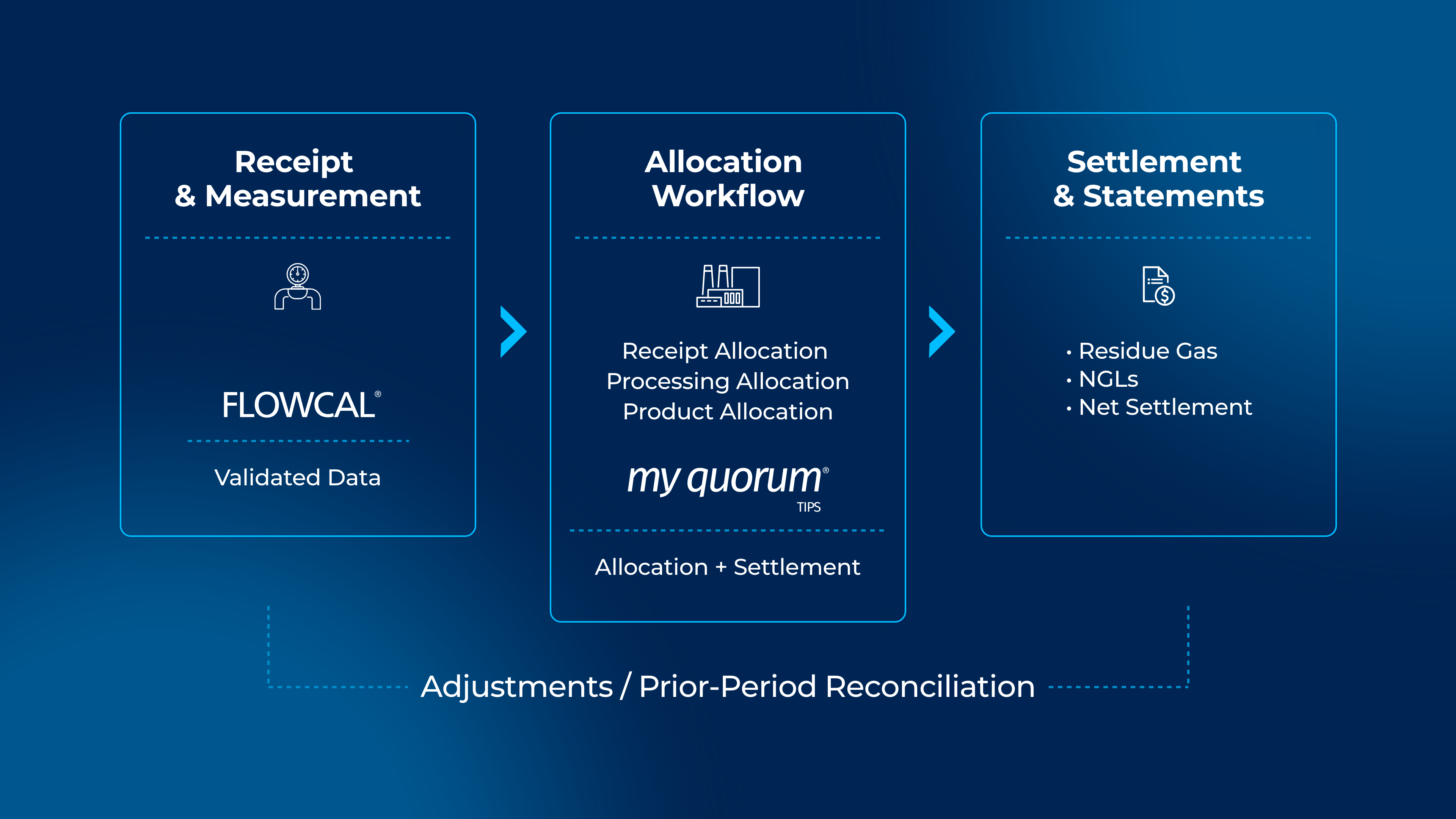
How Allocation Connects Receipt to Product Entitlements
Allocation begins at the point of receipt, where inlet volumes are attributed to each producer or shipper. Those volumes move through processing, where plant performance determines how gas converts into residue and NGL streams. The resulting products are then distributed back to each party based on contractual entitlement structures.
This workflow typically moves through three controlled stages:
- Receipt allocation Assigns inlet volumes using meter data, proration rules, and estimation where required.
- Processing allocation Applies recovery, shrinkage, fuel, and loss factors to translate inlet volumes into product streams.
- Product allocation Distributes residue gas, NGLs, and other products based on contract terms and entitlement logic.
Each stage builds on the prior one. If receipt volumes are estimated or delayed, that variance carries forward into processing. If plant performance inputs are updated after initial runs, allocations shift. Contract terms then determine how those adjusted volumes translate into value, making consistency across all three stages essential for traceable outcomes.
Where Allocation Variability Enters the Process
Allocation depends on inputs that do not always finalize at the same time. Measurement data may require validation or estimation. Plant performance factors can change after initial calculations. Contract terms may vary across producers and over time.
These differences introduce variability at each stage:
| Allocation Stage | Source of Variability | Operational Impact |
| Receipt allocation | Estimation, shared meters, timing gaps | Inlet volumes shift between producers |
| Processing allocation | Updated recovery or shrinkage factors | Product volumes change after initial allocation |
| Product allocation | Contract structure and effective dates | Entitlements vary across parties and periods |
Managing this variability requires consistent application of rules and clear linkage between inputs and outputs. Without that structure, allocation results require repeated explanation rather than serving as a stable basis for settlement.
How Settlement Translates Allocation into Financial Outcomes
Settlement applies pricing, fees, and contractual terms to allocated or contractual volumes to determine what each party owes or is owed. This process typically runs monthly, but underlying inputs often change across periods as corrections and adjustments are applied.
A standard settlement sequence includes:
- Finalizing receipt volumes after measurement validation and corrections
- Applying processing allocation using plant performance data
- Calculating product entitlements based on contract structures
- Applying pricing, deductions, and adjustments
- Generating settlement statements for counterparties
Each step depends on the integrity of the previous one. When allocation inputs shift late in the process, settlement outputs must be recalculated, increasing the volume of prior-period adjustments and extending close timelines.
Settlement statements serve as the operational output of this workflow. They must clearly connect receipt volumes, allocation logic, and final financial results. When that connection is not visible, counterparties question the outcome even when calculations are technically correct.
Where Discrepancies and Reconciliation Issues Occur
Discrepancies appear when expected volumes or values do not align with allocated or settled results. These differences typically originate from measurement gaps, allocation assumptions, or pricing application.
| Discrepancy Source | Where It Appears | Common Causet |
| Receipt measurement gap | Inlet allocation vs. producer records | Estimation, calibration, timing differences |
| Plant performance variance | Residue and NGL output vs. expectations | Actual performance differs from assumptions |
| NGL valuation difference | Settlement value vs. expected pricing | Index selection or pricing timing differences |
| Prior-period adjustment | Changes to previously settled amounts | Late data corrections or reprocessed allocations |
Residue reconciliation is a critical control point because it connects plant output to financial settlement. The total residue delivered must align with the sum of individual entitlements. This requires consistent application of shrinkage, fuel, and loss factors, along with reliable measurement at both inlet and outlet points.
NGL allocation introduces additional complexity because pricing and contract structures vary. Percentage-of-proceeds, fee-based, and keep-whole agreements each require different validation approaches, increasing the importance of consistent allocation logic and pricing application.
Impact on Accounting and Close Workflows
When allocation logic is applied consistently and supported by reliable measurement data, settlement becomes a repeatable process. Accountants spend less time investigating discrepancies and more time validating results. Producers receive statements they can reconcile independently, reducing back-and-forth communication.
Inconsistent allocation creates the opposite effect. Settlement cycles extend as teams investigate differences. Prior-period adjustments increase. Manual effort grows as teams reconcile data across spreadsheets and disconnected systems. These conditions reduce confidence in reported revenue and delay financial close.
As midstream operators work to stabilize allocation and settlement outcomes, the ability to apply consistent planning and data control across assets becomes a key enabler. In practice, organizations that standardized asset planning and allocation logic—such as in A Holistic Approach to Asset Development—reduced variability across workflows, turning settlement into a more predictable and repeatable process with fewer prior-period adjustments. At the same time, strengthening measurement accuracy and data ownership, as demonstrated in Measurement Software Evaluation, ensures that every downstream calculation is grounded in a validated and traceable volume. This combination reduces reconciliation effort during close, improves confidence in settlement statements, and allows both operators and counterparties to rely on results without extended dispute cycles. The outcome is a more controlled allocation-to-settlement workflow that scales with operational complexity while maintaining financial integrity.
The Role of Systems and Data Continuity
Allocation and settlement depend on maintaining continuity across measurement, contract data, allocation rules, and pricing inputs. When these elements are managed in separate systems, timing gaps and inconsistencies increase.
A governed environment connects:
- validated measurement data
- maintained contract terms
- standardized allocation logic
- controlled pricing inputs
This structure reduces manual handoffs and keeps the workflow aligned from receipt through settlement. Measurement validation remains foundational, as errors introduced at the inlet propagate through every downstream calculation.
What a Scalable Allocation and Settlement Process Requires
As midstream systems expand, allocation complexity increases with additional receipt points, contract structures, and product streams. A scalable process maintains consistency as this complexity grows.
Key capabilities include:
- configurable allocation methods that support multiple contract types
- integrated measurement data validation
- consistent handling of prior-period adjustments
- clear, traceable settlement statement generation
When these elements operate within a single workflow, allocation results remain stable as volumes and counterparties increase. This reduces exception handling and supports faster, more predictable settlement cycles.
All About Consistency
Midstream allocation and settlement connects physical volumes to financial outcomes across a multi-stage workflow. Accuracy depends on consistent measurement, governed allocation logic, and transparent settlement outputs. When these elements remain aligned, the process supports traceable, auditable results with fewer disputes and reduced manual effort.
Frequently Asked Questions About Midstream Allocation and Settlement
What is midstream allocation?
Midstream allocation determines how inlet volumes are distributed across producers and how resulting products are assigned back to each party based on contractual entitlements. It links physical measurement to financial settlement.
What is a settlement statement in gas processing?
A settlement statement shows received volumes, allocated product entitlements, pricing application, and the resulting net amount owed or payable. It is the financial output of the allocation process.
What causes disputes in midstream settlement?
Disputes typically arise from measurement discrepancies, inconsistent application of processing factors, NGL pricing differences, and prior-period adjustments. Clear allocation logic and reliable data reduce these issues.
Explore how FLOWCAL and My Quorum TIPS support a more connected midstream allocation and settlement workflow.
 Previous Page