 11 min read
Capital expenditures (CapEx) are costs to acquire or improve long-lived assets — leaseholds, drilling, completions, facilities — capitalized on the balance sheet and expensed over time through DD&A. Operating expenses (OpEx) are day-to-day costs like LOE, workovers, and G&A, expensed when incurred. In E&P, drilling is CapEx; routine well maintenance is OpEx.
Every dollar an exploration and production (E&P) company spends is either a capital expenditure or an operating expense. The distinction sounds academic until month-end, when a single workover invoice can land in either bucket and change reported earnings, per-barrel costs, and the metrics lenders and investors watch.
CapEx and OpEx are the two ways a business accounts for spending. The generic definitions are simple. Applying them to drilling, completions, workovers, and facilities is where oil and gas gets specific, and where consistent classification separates clean financials from restatement risk. This guide opens with the short answer, then works through E&P examples, the gray zones, the accounting treatment, and how to keep classification consistent.
| CapEx | OpEx | |
| Definition | Spending on long-lived assets | Day-to-day operating costs |
| Time horizon | Benefits multiple periods | Benefits the current period |
| Treatment | Capitalized, then DD&A | Expensed when incurred |
| Statement impact | Balance sheet, then income statement over time | Income statement in the period |
| E&P examples | Leasehold, drilling, completions, facilities | LOE, workovers, G&A, production taxes |
| Metric effect | Builds the asset base and DD&A; sits outside EBITDA | Raises LOE per BOE; lowers EBITDA now |
The generic definitions are the easy part. In oil and gas, the harder question is which category a specific cost belongs to, because the same activity can be either one depending on what it accomplishes.
What Counts as CapEx in E&P?
Upstream CapEx creates or extends the productive capacity of a property. These capital costs fall into a few groups:
Leasehold acquisition. The cost of acquiring mineral leases and the associated land work, capitalized as the entry cost of the property.
Drilling. The cost of drilling development wells, and successful exploratory wells, including rig time, materials, and services.
Completions. Casing, cementing, perforating, hydraulic fracturing, and the equipment that brings a well online.
Facilities and equipment. Tank batteries, separators, flowlines, compression, and saltwater disposal infrastructure with a multi-year life.
Intangible drilling costs deserve a note, because they sit inside these groups. Intangible drilling costs (IDC) cover the non-salvageable costs of drilling, such as labor, fuel, and site preparation. For book accounting under successful efforts, IDC on productive wells is capitalized. For US tax, operators can often elect to deduct a large share of IDC in the year incurred. The book and tax treatments differ, so the same cost can be capitalized on the financial statements and deducted on the return.
Related costs can also be capital. Spending incurred while an asset is being built accumulates in a construction in progress account until the asset is placed in service, and certain indirect costs, such as capitalized interest on major projects, may be included. The unifying test is whether the cost is necessary to bring a long-lived asset into productive use.
What Counts as OpEx in E&P?
Operating costs keep existing wells producing, and they are expensed as incurred:
Lease operating expenses (LOE). The recurring cost of operating producing wells: labor, power, chemicals, water handling, and routine maintenance.
Workovers. Well interventions that restore or sustain production from the current zone, such as clearing scale or replacing downhole equipment in kind.
Production and severance taxes. Taxes levied on production volume or value, expensed as production occurs.
General and administrative (G&A). Corporate overhead not tied to a specific property, such as accounting and executive costs.
The G&A boundary is worth defining. Field-level supervision tied to operations is usually LOE, while corporate functions are G&A. Some overhead is allocable to properties under joint operating agreements, which affects what can be billed to partners through joint interest billing.
Costs after the wellhead can also be operating. Gathering, processing, transportation, and marketing costs to move production to the point of sale are generally expensed, and depending on contract terms they may be netted against revenue or reported alongside it. Short-term equipment rentals used in operations are operating costs, while purchasing the same equipment for long-term use is capital.
Workover vs. Recompletion: Which Costs Are Capital?
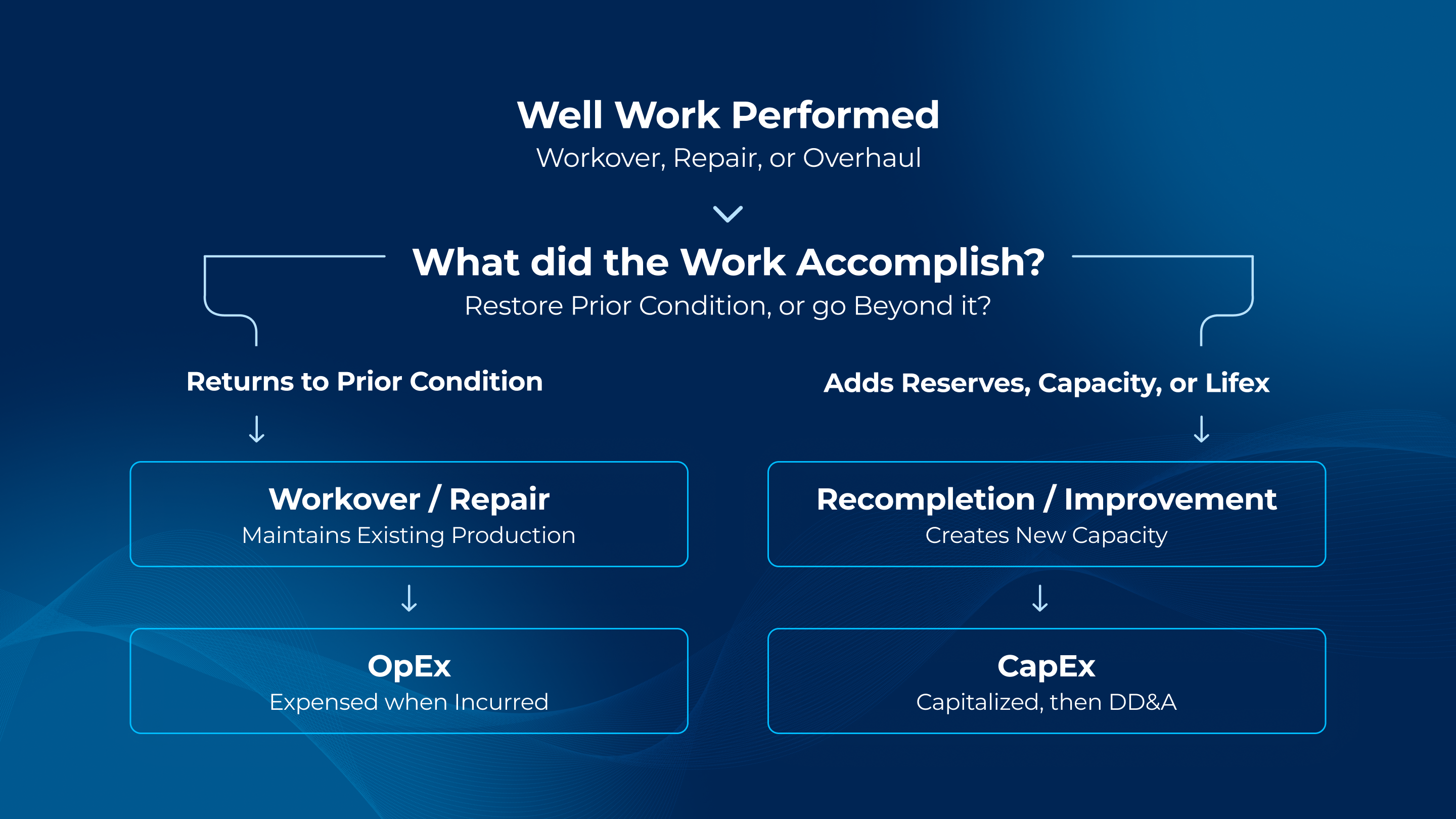
Most classification disputes come from a small number of gray zones. The test in each case is whether the work maintains the existing asset or creates new capacity.
Workover versus recompletion. A workover restores production from the zone a well already produces, and is expensed. A recompletion opens a new zone or adds reserves, and is capitalized. The physical work can look similar, so the deciding factor is what the work accomplishes, not how difficult it is.
Repairs versus improvements. Repairs return equipment to working order and are expensed. Improvements extend an asset's life, increase its capacity, or add reserves, and are capitalized. Replacing a failed pump in kind is a repair. Upsizing to increase throughput is an improvement.
Major maintenance and overhauls. Routine maintenance is expensed. A major overhaul that substantially extends an asset's useful life can be capitalized. The size of the cost alone does not decide it; the effect on the asset's life or capacity does.
A simple test helps: ask whether the work returns the asset to its prior condition or takes it beyond that. Returning to prior condition is a repair or a workover, and is expensed. Going beyond it, by adding reserves, capacity, or years of life, is capital. Suppose a single well intervention clears scale from the producing zone and also perforates a new zone that adds proved reserves. The scale work is a workover and is expensed, while the portion that accesses the new zone is a recompletion and is capitalized, even though one crew did both in the same trip.
Because these calls recur every month, the reliable way to make them consistent is a written policy that defines the threshold in advance, rather than deciding case by case under close-day pressure.
How Are Capitalized Costs Accounted For?
Once a cost is classified as capital, its accounting follows a defined path:
Capitalization. The cost is recorded as an asset, often through a construction in progress account while work is underway, then moved to the producing asset base when the well or facility is placed in service.
DD&A. Capitalized costs are expensed over time through depreciation, depletion, and amortization. In E&P, depletion typically uses the units-of-production method, tying the expense to volumes produced against reserves.
ARO. The estimated cost to plug and abandon wells and restore sites is an asset retirement obligation (ARO). The obligation is booked as a liability, with a matching amount capitalized into the asset and then depreciated, while the liability accretes over time.
Each step depends on the original classification. A cost expensed as OpEx never enters this path, which is why the initial call carries through every downstream number.
Timing matters as well. Depletion does not begin until an asset is placed in service, so costs sitting in construction in progress are not yet reducing earnings. The move from construction in progress to the producing base is itself a point auditors check.
Successful Efforts vs Full Cost: What's the Difference?
Two accounting methods govern how E&P companies capitalize exploration and development costs, and the choice changes which costs become CapEx.
Successful efforts. Costs tied to finding reserves are capitalized only when the effort succeeds. A dry exploratory hole is expensed. Development costs are capitalized regardless of individual well results.
Full cost. All exploration and development costs are capitalized into a cost pool, whether or not a given well finds reserves. The pool is subject to a ceiling test that can force a write-down when capitalized costs exceed the value of reserves.
The practical effect is timing. Under successful efforts, unsuccessful exploration reaches the income statement sooner. Under full cost, more spending is capitalized and expensed later through DD&A. The method is a company-level policy choice, and it determines the treatment of exploration costs before any single invoice is classified.
The choice also affects comparability. Two operators with identical operations can report different earnings and asset values purely because one uses successful efforts and the other full cost. Many larger operators use successful efforts, which more closely matches cost to results, while some smaller operators favor full cost. When comparing companies, confirm which method each uses before reading their cost metrics.
Classification rules depend on your accounting framework and company policy, so treat this guide as a starting point and confirm specific calls with your accounting team and auditors.
Why Classification Accuracy Matters
Classification is not only an accounting formality. It moves the metrics that operators, lenders, and investors use to judge performance.
LOE per BOE. Lease operating expense per barrel of oil equivalent (BOE) is a core efficiency measure. Misclassifying capital work as LOE inflates per-barrel costs and makes operations look less efficient than they are.
Finding and development cost. Finding and development (F&D) cost measures capital spent per unit of reserves added. Misclassified costs distort it in the other direction.
EBITDA and covenants. OpEx reduces earnings now, and CapEx does not. Because lender covenants and investor models often run on EBITDA, classification affects reported compliance and valuation.
Audit exposure. Inconsistent or undocumented classification is a frequent audit finding.
The through-line is consistency. A cost classified the same way every period supports every metric built on it, and it holds up in review. Because inconsistent classification is a common audit issue, this connects directly to audit preparation; see our guide to audit readiness for upstream operators for the documentation auditors expect.
A single misclassification can move several metrics at once. Suppose a $2 million recompletion is expensed as a workover. LOE rises and per-barrel operating cost looks worse, reported earnings fall, and both the asset base and future DD&A are understated. One classification error makes the well look more expensive to run and the company look less capital-efficient, in the same period.
Building a Capitalization Policy Your Team Can Apply Consistently
The gray zones do not resolve themselves. A written capitalization policy turns a judgment call into a rule the whole team applies the same way.
A workable policy covers a few things: a capitalization threshold, so small purchases are expensed rather than tracked as assets; clear definitions of workover versus recompletion and repair versus improvement, with examples; the treatment of IDC and other cost types; and the approval and documentation required when a cost is capitalized. Written once and applied every month, the policy removes the case-by-case debate that slows the close and creates audit findings.
A policy is only as good as its governance. Assign an owner, review it at least annually and after any change in accounting method or acquisition, and tie it to the approval workflow so that capitalizing a cost requires the right sign-off. The AFE is a natural control point, since capital work is authorized there before it is incurred.
Software then makes the policy easier to apply consistently. My Quorum Accounting is built for oil and gas and supports accounting operations from AFEs through to financial statements, so capital authorized on an AFE is tracked to the asset and into reporting in one place rather than across spreadsheets. Its asset management, close-process workflows, and budget and spend monitoring reduce input errors and support the compliance and data quality that consistent classification depends on. Real-time reporting shows capital and operating costs as they accumulate, so variances surface during the period rather than at year-end.
Explore My Quorum Accounting to see how one oil and gas platform tracks capital from AFE to financial statement.
Frequently Asked Questions
Is a workover CapEx or OpEx?
A routine workover is OpEx. It restores or sustains production from the zone a well already produces, so it is expensed as incurred. If the same intervention opens a new zone or adds reserves, it becomes a recompletion, which is capital. The deciding factor is whether the work maintains existing production or creates new capacity.
Are intangible drilling costs capitalized?
It depends on whether you mean book or tax treatment. For financial reporting under successful efforts, intangible drilling costs (IDC) on productive wells are capitalized. For US tax, operators can often elect to deduct a large portion of IDC in the year incurred. The two treatments commonly differ for the same well.
What is DD&A?
DD&A stands for depreciation, depletion, and amortization. It is how capitalized costs are expensed over time. In E&P, depletion usually follows the units-of-production method, matching expense to the volumes produced against a property's reserves, so the asset is written down as it is produced.
 Previous Page