 6 min read
AFE in Oil and Gas: How Authorization for Expenditure Drives Capital Control
An AFE in oil and gas establishes the baseline for capital work before spending begins. Where capital approvals are part of the process, tools like Execute AFE help keep AFE creation, approval, and spend visibility connected. The AFE defines scope, expected cost, ownership, and timing, so operations and finance are working from the same reference point as activity moves into execution.
Key Takeaway
The AFE is the control point that links planned work to actual spend. When scope, cost structure, and approval conditions are clearly defined and remain visible after approval, teams can track performance against plan, explain variances, and maintain confidence in capital reporting.
What an Authorization for Expenditure Covers
An authorization for expenditure defines both the work to be performed and the cost framework that supports it. In upstream operations, this typically includes drilling, completions, workovers, facility projects, or abandonment activity. The AFE identifies the asset or well, outlines the scope, structures cost categories, and documents the assumptions behind the estimate.
A complete AFE relies on three elements that support execution and reporting:
- Defined scope that aligns operations, accounting, and leadership on the same activity
- Structured cost framework that separates categories, assumptions, and contingencies
- Revision triggers that establish when supplemental approval is required
When these elements are clear, downstream processes such as coding, invoice review, and reporting align naturally. When they are not, teams spend time interpreting intent after costs have already been incurred, which introduces rework and delays.
In joint venture environments, the AFE also serves as the formal cost proposal for non-operating partners. The structure and clarity of the authorization directly affect approval timelines and influence the likelihood of downstream billing disputes.
How the AFE Approval Workflow Connects to Execution
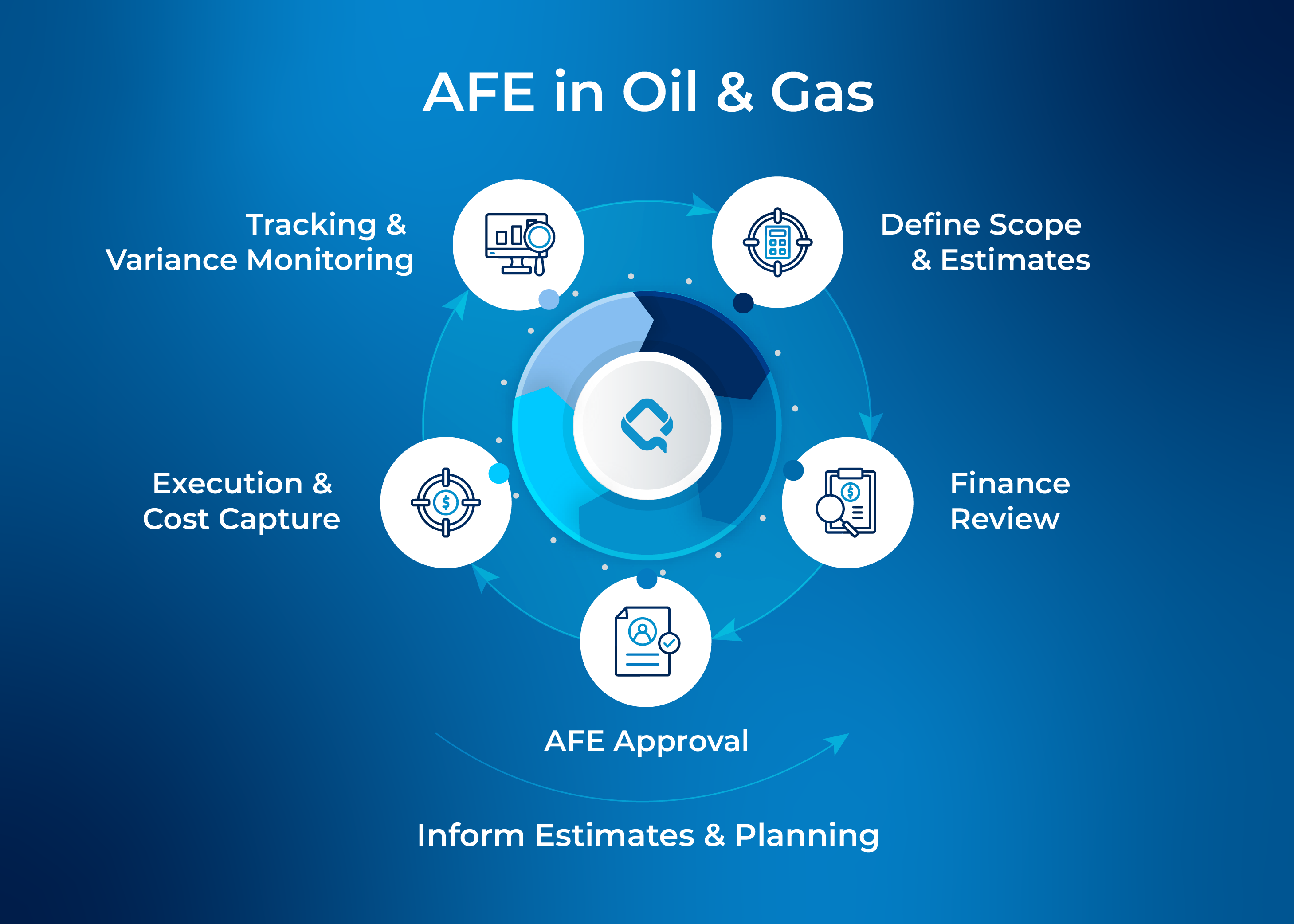
The AFE workflow begins with scope development in operations or engineering. The team defines the objective, builds an estimate, and documents the assumptions that support the cost structure. Finance or accounting reviews the estimate to confirm that categories, detail, and structure support reporting requirements.
A consistent workflow follows a defined sequence:
- Define and estimate the work with enough detail for reporting
- Route for approval based on thresholds, ownership, and context
- Maintain visibility after approval so actuals and commitments can be tracked
After approval, the AFE becomes the reference point for commitments, invoices, accruals, and variance analysis. The document must remain active within the workflow so teams can compare actual spend to the original plan and respond to changes as they occur.
Process Variability Across Organizations
AFE workflows vary based on governance structure, asset complexity, and joint venture involvement. Approval management varies widely across industry. Finance, land, operations, partners and leadership all play a role, but that will vary from one organization to another.
These variations affect how quickly AFEs move through approval and how consistently they are applied. Organizations with clearly defined thresholds, structured estimates, and consistent routing maintain tighter control over capital spend and reduce delays in execution.
Impact on Capital Reporting and Outcomes
The quality of individual AFEs directly affects portfolio-level reporting. When each authorization is structured consistently, capital performance can be aggregated across assets and business units with less interpretation.
Clear AFEs improve:
- Accuracy in cost tracking and reporting
- Traceability between approved scope and actual spend
- Auditability of capital decisions and outcomes
- Visibility into project performance during execution
When AFEs lack structure, these outcomes degrade. Reporting becomes less reliable, and leadership confidence in capital performance declines.
As AFE workflows mature, maintaining visibility from approval through execution becomes critical to sustaining capital control. For example, streamlining approval workflows, as demonstrated in Range Resources: AFE Workflow Automation and Approvals, helped standardize how AFEs were created and routed, reducing delays and ensuring consistency in how projects entered execution. Together, these capabilities support a more controlled AFE process where approvals, spend, and reporting remain aligned, improving both operational efficiency and financial visibility.
Where the AFE Process Breaks
Most AFE issues begin with small disconnects between approval and execution. These gaps accumulate and create reporting friction over time.
| Common Breakdown | Root Cause | Impact on Reporting |
| Scope too broad at approval | Scope not defined at operational level | Actuals do not align to plan |
| AFE treated as one-time event | No monitoring after approval | Variances identified late |
| Weak connection to field costs | Charges not tied to AFE baseline | Gaps between authorized and actual spend |
These issues reduce the usefulness of the AFE as a control point. Finance is forced to reconstruct the cost story after the fact rather than monitoring it during execution.
Role of Systems and Data in AFE Control
A structured AFE process depends on maintaining continuity between approval and execution. The approved AFE must remain visible as costs are committed, invoices are processed, and accruals are recorded.
When systems maintain that connection:
- Costs are coded consistently against the approved structure
- Commitments and actuals can be tracked in real time
- Variances are identified earlier in the project lifecycle
- Teams spend less time reconciling data across disconnected sources
This continuity reduces manual effort and supports more consistent reporting across the organization.
A Scalable AFE Process State
A scalable AFE process provides a consistent structure for defining work, approving spend, and tracking performance.
In a stable process:
- Operations, engineering, and finance work from the same baseline
- Cost categories align with reporting requirements from the start
- Variance discussions focus on timing, scope changes, or execution differences
- Supplemental approvals are based on defined triggers rather than interpretation
This structure supports both governance and day-to-day execution. Teams move faster because expectations are clear, and leadership has a more reliable view of capital deployment.
Leveraging Control
The AFE defines how capital moves from approval into execution. Its value depends on how well it connects scope, cost structure, and ongoing activity throughout the project lifecycle.
When the AFE remains visible and aligned with execution, it functions as a control tool that supports accurate reporting, clearer variance analysis, and more confident capital decisions. When it is treated as a standalone approval document, that connection breaks, and the organization loses visibility into how capital is deployed.
Frequently Asked Questions About AFE in Oil and Gas
What does AFE stand for in oil and gas?
AFE stands for authorization for expenditure. It defines the scope, estimated cost, and approval framework for a capital project before spending begins.
How does the AFE approval process work?
The process begins with scope and estimate development, followed by finance review for reporting alignment. The AFE is then routed for approval based on thresholds and responsibility, after which it becomes the baseline for cost tracking and variance analysis. If there are working interest partners for an AFE, it will be routed for their approval as well.
What is the difference between an AFE and a capital budget?
An AFE authorizes a specific project at a defined cost. A capital budget aggregates multiple AFEs and other commitments across the organization, linking project-level approvals to portfolio-level planning.
See how Execute AFE keeps approvals, spend, and reporting aligned from day one.
 Previous Page