Upstream Energy Management Solutions

End-to-End Hydrocarbon Management
Gain Revenue with Less OPEX
Aid early intervention by quickly identifying well performance issues, enabling operators to take proactive actions for intervention operations.
Full Hydrocarbon Tracking
Collaborate effectively for production and reservoir engineers, and production accountants. Improve accuracy, profitability, and end-to-end hydrocarbon tracking.
Advanced Allocation Traceability
Maintain compliance for crucial regulatory and sustainability goals. Allocate production and sales quantities with precision. Ensure traceable, auditable data and reporting.
Streamline Operations with Automated Data Insights
Boost operational efficiency by automating the collection and validation of well and equipment data. From production engineers to control room operators - enable key personnel to make informed decisions based on reliable, up-to-date data.
Efficient Production Planning and Forecasting
Make quicker, more informed decisions as you store and calculate production plans and forecasts with multiple scenarios or through basic import. Compare different scenarios and analyze opportunities by viewing well-production curves.
Enhance the Hydrocarbon Value Chain with Chemical and Emissions Management
Add value to hydrocarbon accounting by including chemical and analysis management for flow assurance and operational integrity. Track and manage environmental impact through integrated emissions management.
Energy Components for Emissions Management
As the world moves towards net zero carbon emissions, new regulatory requirements emerge to monitor and manage emissions. This overview document demonstrates how Energy Components can help energy businesses to keep track of their environmental footprints.

650+
Active Licenses
Across 55 Countries
100+
Energy Customers
Globally
25+
Years of Experience
in Energy Accounting
Energy Components Key Features
Ensure accurate allocation and reporting of exported, injected, and disposed quantities by tracing and validating production and injection quantities.
Optimize the return on investment across asset portfolios and identify dominating performance constraints by defining, categorizing, and accounting for downtime and deferments.
Strengthen the quality and traceability of well test data and utilize historical well test data to detect deviation and performance trends. Improve alignment and consistency between well test data and how these are being utilized in related business processes, such as allocation, fluid sampling, PVT calculations and flow metering.
Enhance value of chemicals in operations by managing chemical inventories, usage, and performance. Integrated with upstream and analysis management to monitor and optimize flow assurance and operational integrity.
Track your environmental impact with automated emissions calculation, reporting and monitoring integrated into the hydrocarbon value chain. Track and report GHG emissions by source, totals, or include in production allocation.
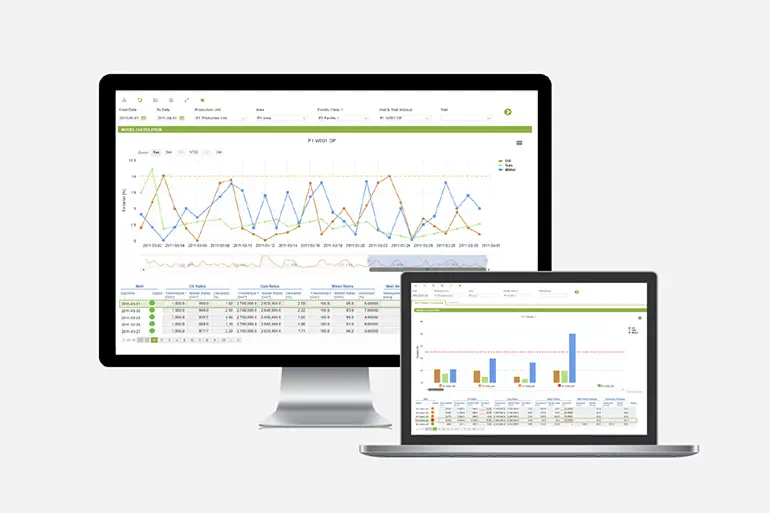
Optimize Well Performance With Dedicated Management Dashboards
Gain invaluable insight from data, already existing in the Energy Components ecosystem, enabling opportunities for increased asset profitability to be identified and assessed.
FAQs
Energy Components Upstream is Quorum Software's end-to-end hydrocarbon accounting and production allocation solution for upstream oil and gas operations.
It tracks production volumes from the wellhead through to sales, covering all flows including injection, flaring, and disposal, across onshore and offshore assets.
Core modules include ownership allocation, cost and revenue allocation, inventory valuation, sales contract calculations, royalty and production sharing agreements, price calculations, and invoicing.
Add-on modules extend the platform with deferment management, well testing, regulatory reporting, emission management, and simulator integration.
Energy Components Upstream is available as a fully managed cloud service (EC Upstream SaaS) and is deployed by IOCs, NOCs, and independent operators across more than 30 countries.
Energy Components Upstream is a complete hydrocarbon accounting and production allocation solution, covering the full upstream production lifecycle from wellhead to sales.
- Tracks production volumes from wellhead through sales, injection, flare, and disposal flows.
- Allocates production to reservoirs, leases, and contracts with traceable, auditable workflows.
- Supports energy equivalents and emissions integrated into the production accounting process.
- Includes deferment and exception tracking to ensure accurate accounting relative to the physical production picture.
- Standard commercial modules: Ownership Allocation, Cost and Revenue Allocation, Inventory Valuation, Sales Contract Calculations, Royalty and PSA, Price Calculations, and Invoicing.
These capabilities ensure full upstream production reporting and allocation compliance across onshore and offshore assets.
Yes. Energy Components Upstream includes a dedicated Royalty and Production Sharing Agreements module as part of its standard commercial package.
Supported structures:
- Production Sharing Contracts (PSCs): Full PSC mechanics — cost recovery, profit oil splits, and entitlement calculations for international upstream agreements.
- Royalty management: Volume- and price-based royalty calculations for partner and government reporting.
- Joint venture ownership: Production and revenue allocated to multiple equity owners, auditable to barrel level.
- Custom entitlement rules: Configurable logic for complex contractual provisions and PSA terms.
All calculations integrate with the production allocation workflow, ensuring consistent data across hydrocarbon accounting, regulatory reporting, and partner statements.
Energy Components Upstream includes a dedicated Regulatory Reporting add-on that generates standardised production reports for government agencies, regulators, and equity partners.
Reporting capabilities:
- Government production reports: Submission-ready outputs aligned to national regulatory frameworks across multiple jurisdictions.
- Partner and equity statements: Auditable production and revenue attribution for joint venture partners.
- Allocation reports: Traceable allocation outputs from wellhead to sales point, meeting audit and dispute-resolution requirements.
- Deferment and loss reports: Documented deferments, flare volumes, and losses for compliance.
- Emissions reports: When Emission Management is deployed, environmental data integrates with production records for combined regulatory reporting.
Government reporting workflows are documented in ECPedia, ensuring country-specific alignment.
Energy Components Upstream includes a dedicated Deferment Management module for systematic tracking of all production shortfalls and losses.
- Deferment recording: Logged against specific wells or facilities with cause codes, timestamps, and responsible parties.
- Potential vs actual: EC compares actual production to expected (potential) rate and categorises the shortfall
- Allocation integration: Deferred volumes are correctly excluded from sales and ownership calculations.
- Loss accounting: Flaring, venting, fuel consumption, and measurement discrepancies tracked separately, with optional Emission Management integration for environmental reporting.
- Performance reporting: Historical deferment data supports field optimisation decisions and regulatory submissions.
Energy Components provides a modern integration architecture that connects to SCADA systems, data historians, ERP platforms, laboratory (LIMS), and cloud data services.
- ECIS Agent: A lightweight standalone application deployable close to the data source — integrates historian and SCADA data without complex network configuration.
- Public APIs: Full domain-layer APIs including GraphQL and REST — insert, update, delete across the EC data model with full audit trail.
- Dataloader: Bulk import for historical and batch data.
- Pre-built connectors: Data historians (OSIsoft PI), ERP systems, LIMS, simulators, reservoir management tools, and financial platforms.
In EC SaaS, all integration is secured via OIDC and HTTPS, and all API operations are governed by EC's built-in access control and auditing layer.
Energy Components Upstream maintains complete audit trails for all production data changes and allocation adjustments, meeting the traceability requirements of regulators, auditors, and equity partners.
- Audit trails: Every production change, allocation adjustment, and approval action is logged with user, timestamp, and reason.
- Data versioning: Production and allocation datasets are version-controlled for regulatory review, partner disputes, and internal governance.
- Approval workflows: Review and approval workflows ensure that reported data is validated before submission to partners or regulators.
- API-level auditing: All EC API operations respect EC's journaling and auditing layer, ensuring consistent traceability regardless of integration method.
- SOC 2 compliance: In EC SaaS, audit and access control mechanisms are independently verified under SOC 2 Type 2 certification.
Energy Components (EC) is Quorum Software's integrated hydrocarbon management platform, designed to track and manage hydrocarbons from the wellhead through to delivery and commercial settlement.
Available for upstream oil and gas operations, midstream transport and terminal management, and as a fully managed cloud service (EC SaaS) on AWS.
Key capabilities: production allocation, hydrocarbon accounting, commercial contract management, emissions tracking, regulatory reporting, and integration with SCADA, ERP, and data historian systems.
Energy Components is used by IOCs, NOCs, and independents across more than 30 countries. EC SaaS is SOC 2 Type 2 certified with 99.5% availability SLA and continuous software upgrades.
EC SaaS (Energy Components as a Service) is Quorum's fully managed, cloud-hosted delivery of Energy Components, built on AWS and certified to SOC 2 Type 2.
Vs self-hosted:
- Evergreen upgrades: Always on the latest version, no upgrade projects.
- Reduced TCO: No hardware, DBA, or DR costs.
- 24/7 support: Unlimited incidents under enterprise plans.
- Security: SOC 2 Type 2, ISO/IEC 27001-aligned, annual penetration testing.
- Resilience: 99%–99.5% SLA, multi-AZ redundancy, RTO as low as 24 hours.
- Scalability: Auto-scaling infrastructure tuned to customer workloads.
Woodside Energy deployed EC SaaS globally, confirming on-budget delivery and improved compliance.
Energy Components includes an Emission Management add-on for both Upstream and Midstream, enabling accurate emissions tracking and regulatory reporting.
- Integrated accounting: Flaring, venting, fuel combustion, and fugitive emissions captured within the hydrocarbon workflow.
- Auditability: Version-controlled, auditable emission data meeting national and international regulatory requirements.
- Regulatory output: Scope 1 emissions reporting aligned to applicable environmental frameworks.
- Real-world deployment: Woodside Energy used EC SaaS Emission Management for the Sangomar greenfield project in Senegal — emissions tracked from first production.
- SaaS updates: EC SaaS customers receive automatic add-on updates as emission regulations evolve.
What API and system integration options does Energy Components provide?
- ECIS Agent: Lightweight standalone application deployable close to the data source — no complex firewall configuration required.
- Public APIs: Full domain-layer APIs including GraphQL and REST — full insert/update/delete with audit trail.
- Dataloader: Bulk import for historical and batch data.
- Event-based integration: Real-time event-driven patterns for high-frequency operational data.
- Pre-built connectors: Data historians (OSIsoft PI), ERP, simulators, optimisers, and financial platforms.
In EC SaaS all integration is secured via OIDC and HTTPS, governed by EC's built-in access control and auditing layer.
Energy Components is used by international oil companies (IOCs), national oil companies (NOCs), mid-size operators, and LNG producers across more than 30 countries.
Notable deployments include:
- Woodside Energy: Deployed EC SaaS across global operations including USA, Trinidad and Tobago, and the Sangomar greenfield project offshore Senegal. Selected for hydrocarbon management accuracy, Emission Management add-on, and cloud integration with Power BI.
- The platform is deployed for upstream hydrocarbon accounting, midstream terminal and LNG management, and cloud-hosted operations at scale.
- Energy Components has been in continuous development for over 30 years, built on industry best practices from serving global energy operators.
Yes. Energy Components balances industry-standard best practices with flexible customization for company-specific requirements.
- EC Extension Framework: Governed framework for unique configuration and custom functionality — version-controlled and security-scanned.
- Business Process Modelling and Automation (BPM): Define and automate multi-step workflows — data validation, allocation runs, approval chains, report generation.
- Asset templates: Pre-built templates for upstream fields, LNG terminals, and pipelines — adaptable to company requirements.
- Self-service tools: EC Class Model Editor and EC Configuration Tool allow CoE teams and partners to maintain EC independently.
In EC SaaS, all customisations pass formal extension review and automated QA, ensuring compatibility with continuous upgrades.