 6 min read
Volumetric balancing starts with the reliability of measurement data. Solutions like FLOWCAL establish a validated measurement foundation before volumes move into allocation, reporting, or accounting workflows. When that foundation is consistent, downstream processes remain aligned. When it is not, imbalances appear and require investigation.
Key Takeaway
Volumetric balancing is a measurement-driven control that keeps physical volumes and reported data aligned. Most imbalances originate from timing gaps, data quality issues, or mismatches between measurement inputs and operational reality. Effective workflows isolate the issue at the source and resolve it before it moves downstream.
What Volumetric Balancing Means in Practice
Volumetric balancing compares measured volumes at receipt and delivery points across wells, facilities, and gathering systems. The objective is to confirm that the physical movement of hydrocarbons is reflected accurately in the data record.
This process functions as an ongoing control. Teams are not trying to force exact agreement across every data point. They are identifying where differences exceed expected thresholds, determining the cause, and resolving those exceptions before they affect reporting.
In day-to-day operations, this becomes a disciplined review process. Measurement data is checked for completeness, timing, and consistency before it is used elsewhere. When gaps or inconsistencies appear, they are treated as indicators of a breakdown in the measurement chain.
Why Volume Imbalances Happen
Most imbalances originate from a small set of conditions within the measurement and data capture process.
| Imbalance Driver | How It Appears | Typical Resolution |
| Timing gap | Field activity recorded before all related measurements are finalized | Align data timing; confirm completeness before analysis |
| Data quality issue | Missing readings, incorrect inputs, or delayed corrections | Validate source data; investigate equipment or inputs |
| Measurement error | Errors with measurement equipment produce various errors with varying degrees of impact. | Reconcile errors with appropriate adjustments |
| Data mismanagement? | Differences from rounding, timing, or unit conversion across systems | Trace variance back to the originating measurement step |
How Teams Resolve Imbalances
Effective workflows focus on isolating where the imbalance enters the process before attempting resolution. A big piece of imbalance research is reviewing the physical measurement data and determining where the physical measurement error is: incorrect gas quality reading, transmitter error, meter failure, missing data, etc. Teams narrow the scope by identifying whether the issue begins at the well, facility, or during data transfer.
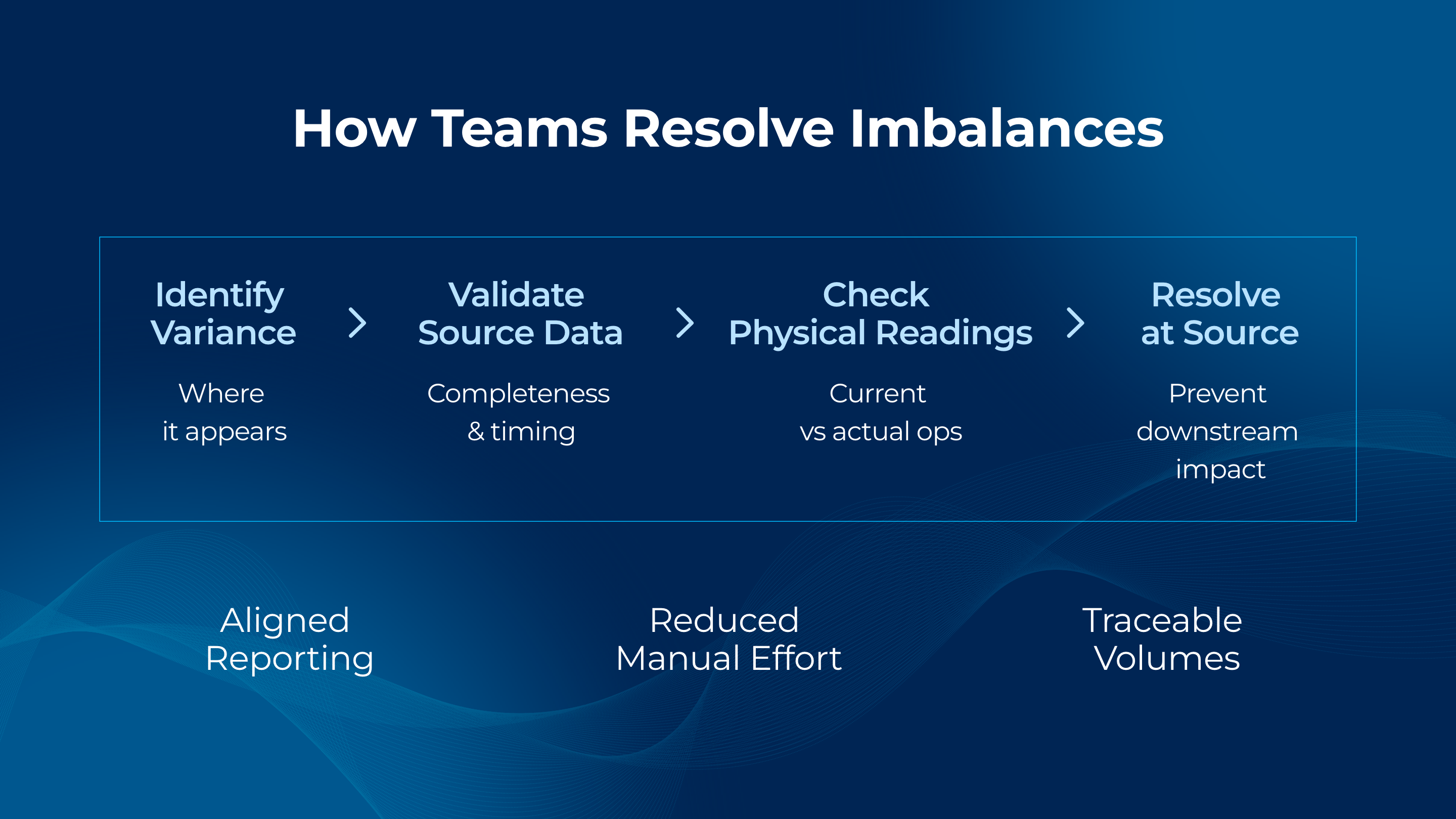
A consistent process typically includes three steps:
- Confirm measurement completeness and timing before investigating downstream calculations or reports.
- Validate measurement inputs against operating conditions to ensure they reflect actual flow and equipment behavior.
- Resolve the exception at the source, correcting the underlying data so the issue does not persist through the system.
This approach limits repeated corrections and reduces the need for downstream adjustments.
Process Variability Across Operations
Balancing workflows vary based on asset complexity and measurement infrastructure. In environments with stable measurement configurations, imbalance patterns tend to repeat and can be addressed through targeted checks.
In more dynamic operations, frequent changes in flow paths, equipment, or operating conditions require more active validation. Measurement assumptions must be reviewed regularly to ensure they still reflect how volumes are moving through the system.
Where multiple systems are involved, additional effort is required to trace how measurement data is transformed. Differences introduced during data transfer can mask the original source of the imbalance.
Impact on Production Reporting
Reliable measurement data supports consistent production reporting. When imbalances are identified and resolved early, production statements reflect a tested data set rather than a collection of unresolved differences.
This reduces the need for reconciliation later in the reporting cycle. It also improves confidence in the production record, since exceptions are addressed before they propagate into multiple reports.
Over time, teams develop a clearer understanding of recurring imbalance patterns. This allows them to focus on known control points and reduce the effort required to validate each reporting period.
As volumetric balancing workflows mature, the consistency of measurement inputs becomes the primary factor in reducing recurring imbalances. In practice, organizations that strengthened measurement accuracy and data ownership—such as in Howard Energy: Measurement Accuracy and Data Ownership—were able to resolve discrepancies at the source rather than repeatedly correcting them downstream. By ensuring that volume data is validated, traceable, and consistently managed, teams reduce the noise that often drives imbalance investigation. This leads to fewer recurring exceptions, more stable production reporting, and less time spent reconciling the same issues across periods. The result is a balancing process that functions as a proactive control, improving both operational efficiency and confidence in the production record.
Where Issues Commonly Occur
Imbalances typically emerge at points where measurement data is captured, adjusted, or transferred:
- Initial data capture from meters and field systems
- Data validation and correction workflows
- Transitions between measurement and downstream systems
- Timing cutoffs between operational activity and reporting periods
These points represent the highest risk for introducing inconsistencies into the production record.
Role of Systems and Data
Systems that manage measurement data provide the structure needed to maintain consistency. They enforce validation rules, track corrections, and preserve a record of how volumes were derived.
Consistency across systems is critical. Differences in timing conventions, units, or rounding introduce avoidable discrepancies. Standardizing these elements ensures that balancing efforts focus on real operational issues rather than system artifacts.
What a Scalable Balancing Process Looks Like
A scalable volumetric balancing process includes:
- Defined validation steps at the measurement level
- Consistent timing and completeness checks
- Clear ownership of imbalance investigation and resolution
- Documented patterns of recurring issues
- Systems that preserve traceability from measurement through reporting
This structure keeps the focus on resolving meaningful discrepancies while maintaining control over the production record.
Conclusion
Volumetric balancing is a measurement control that ensures the production record reflects actual physical movement. By focusing on data accuracy at the source, teams reduce the need for downstream corrections and maintain consistency across reporting processes.
When supported by structured workflows and validated measurement systems, balancing becomes a repeatable process that strengthens both operational and reporting confidence.
Frequently Asked Questions About Volumetric Balancing
What is volumetric balancing in oil and gas?
Volumetric balancing compares measured and expected volumes across the production system to confirm that physical flows are accurately reflected in the data. It is a control process used to identify and resolve discrepancies early.
What causes volume imbalances?
Common causes include timing gaps in measurement data, missing or incorrect readings, and inconsistencies introduced during data handling. Differences across systems can also contribute when data is transferred or transformed.
How is volume reconciliation different from volumetric balancing?
Volume reconciliation is a broader review of production data across systems and time periods. Volumetric balancing focuses specifically on whether measured input and output volumes align at defined points in the production process.
Visit FLOWCAL today.
 Previous Page