 8 min read
Lease operating expense (LOE) is the recurring cost of operating and maintaining producing wells and lease equipment. It includes field labor, power, chemicals, water disposal, and routine maintenance, and it excludes capital costs, general and administrative expense, and production taxes. Operators often express it per barrel of oil equivalent to compare efficiency.
Lease operating expense is the cost of keeping a well producing. It is one of the most closely watched numbers in upstream oil and gas, because it sits between a barrel's price and its profit. When operators discuss how cheaply they can run a field, or whether a well is still worth producing, they are usually talking about lease operating expense.
This guide sets out exactly what is included and excluded, explains fixed versus variable cost behavior, and works through how to calculate LOE per barrel of oil equivalent. It closes with why LOE tends to rise as wells age and how operators track it.
What is lease operating expense?
LOE is sometimes called lifting cost, because it is the cost of lifting hydrocarbons to the surface and readying them for sale. It covers the ongoing operation of a well that already produces, not the capital spent to drill and complete it.
What does LOE include?
LOE captures the day-to-day costs of running producing wells and the surface equipment on a lease:
- Field labor. Pumpers and lease operators who monitor and maintain wells, including contract labor.
- Power and fuel. Electricity for pumping units and fuel for field engines and equipment.
- Chemicals. Treatments for corrosion, paraffin, scale, and emulsion that keep production flowing.
- Water handling and disposal. Gathering, trucking, and injecting produced water, often through saltwater disposal.
- Repairs and maintenance. Routine upkeep of pumping units, separators, tanks, and flowlines.
- Well servicing. Routine interventions and light workovers that sustain production from the current zone.
- Compression and rentals. The operating cost of compression and short-term equipment rentals used in production.
The common thread is that each cost recurs and each keeps existing production online. None of it builds new capacity.
What is not included in LOE?
Several costs are easy to confuse with LOE but belong on their own lines:
- Capital costs. Drilling, completions, facilities, and capital workovers or recompletions are CapEx, not LOE. The workover versus recompletion line is a frequent gray zone, covered in our CapEx vs OpEx guide.
- General and administrative expense. Corporate overhead such as accounting and executive costs is G&A, separate from field-level operating cost.
- Production and severance taxes. Taxes on production volume or value are usually reported separately from LOE, even though both are operating costs.
- Gathering, processing, and transportation. Midstream costs to move and process production to the point of sale are their own category.
- Royalties. The mineral owner's share of revenue is not an operating expense.
Keeping these out of LOE is what makes the number comparable across wells and periods. Mixing them in distorts every efficiency metric built on LOE.
Fixed vs Variable LOE
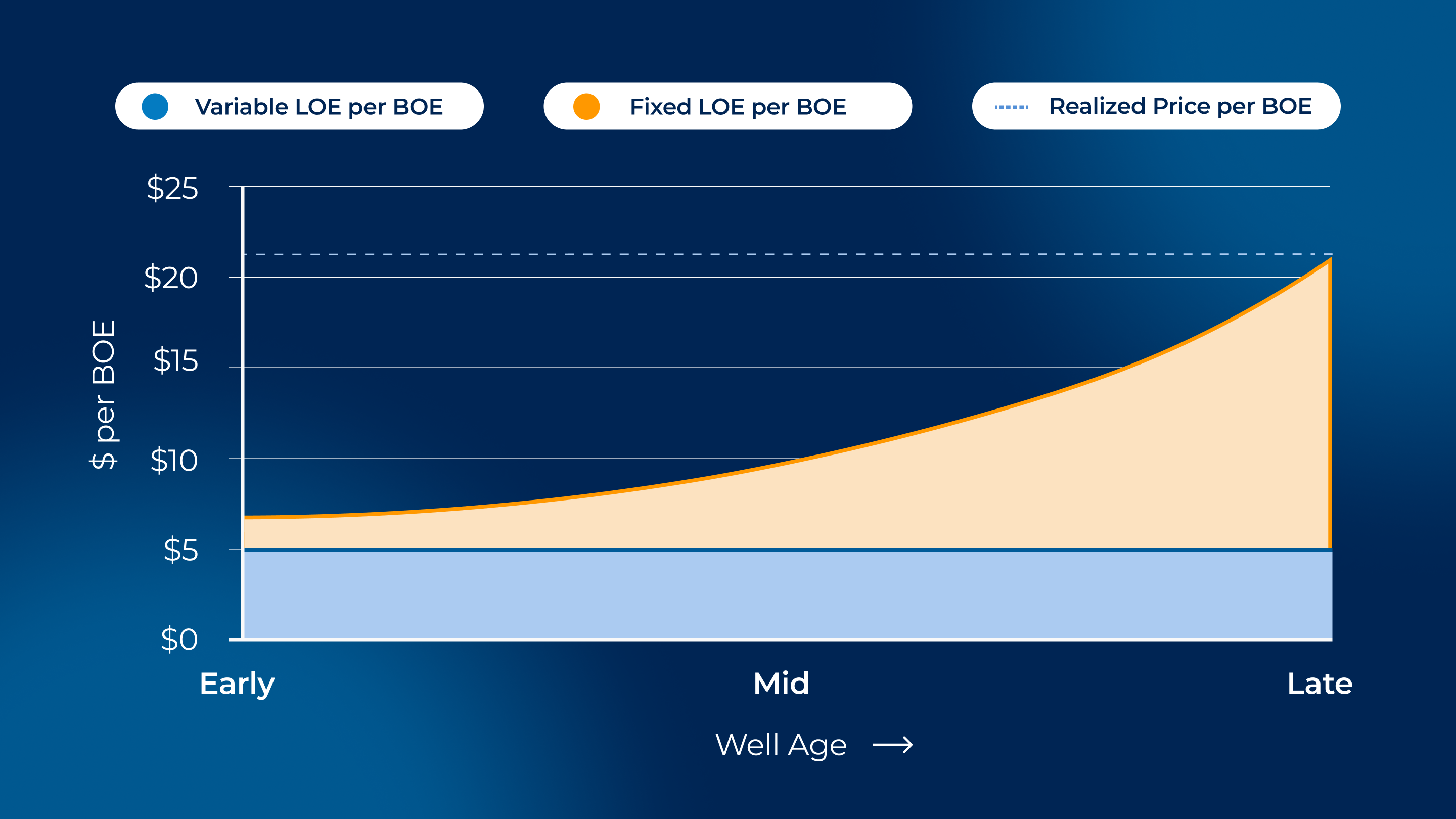
LOE has two cost behaviors, and the split drives how the number moves as production changes.
Fixed LOE stays roughly constant regardless of how much a well produces. Pumper routes, equipment rentals, and baseline maintenance cost about the same whether a well makes 20 barrels a day or 200.
Variable LOE rises and falls with activity and volume. Power to lift fluid, chemicals, and water disposal all scale with how much is produced and handled.
The split matters most for forecasting. As a well declines, fixed costs spread over fewer barrels, so LOE per barrel climbs even when total spending holds steady. Separating fixed from variable lets an operator project per-barrel cost across the decline curve and see when a well approaches its economic limit.
The mix itself shifts over time. Early on, variable costs dominate as high volumes drive power and water handling. Later, fixed costs dominate as volumes fall, which is a central reason per-barrel LOE rises even when a field is run exactly the same way.
How Do You Calculate LOE per BOE
LOE per barrel of oil equivalent is the standard efficiency measure, and the formula is straightforward:
LOE per BOE = total lease operating expense ÷ total production in BOE
A barrel of oil equivalent (BOE) converts gas to an oil-equivalent basis, typically at six thousand cubic feet (Mcf) of gas to one BOE, so oil and gas can be summed into a single volume. Suppose a lease incurs $60,000 of LOE in a month and produces 8,000 barrels of oil and 12,000 Mcf of gas:
| Step | Calculation | Result |
| Convert gas to BOE | 12,000 Mcf ÷ 6 | 2,000 BOE |
| Total production | 8,000 bbl + 2,000 BOE | 10,000 BOE |
| LOE per BOE | $60,000 ÷ 10,000 BOE | $6.00 / BOE |
The result, $6.00 per BOE, is the figure an operator compares against prior months, against other leases, and against the realized price per BOE to judge profitability. Expressing cost per BOE, rather than in total dollars, is what puts a small gas well and a large oil lease on the same scale.
What Good Looks Like: Benchmarking LOE
There is no single benchmark for LOE per BOE. It varies widely, and a number that is strong in one setting is weak in another. Three factors drive most of the difference:
- Basin and geology. Depth, pressure, and formation characteristics set how much lift and handling a well needs.
- Lift method. Naturally flowing wells cost less to operate than wells on artificial lift, and lift types differ in cost among themselves.
- Water cut. The volume of water produced alongside hydrocarbons is often the single largest swing factor, because gathering and disposing of water is expensive.
- Product mix. Oil, gas, and natural gas liquids carry different lift and handling costs, so a gas-weighted well and an oil-weighted well are not directly comparable on LOE per BOE.
Because of these factors, meaningful benchmarking compares like with like: similar basin, similar lift, similar water cut, and similar well age. Comparing a mature waterflood to a new well tells you little. Read with those caveats, public operator disclosures are a useful external reference.
Why Does LOE Rise as Wells Age?
LOE per barrel almost always climbs over a well's life, for reasons that compound:
- Declining production. Output falls along the decline curve, spreading fixed costs over fewer barrels.
- Rising water cut. Older wells produce more water per barrel of oil, raising handling and disposal cost as revenue falls.
- More maintenance. Aging equipment needs more frequent repair and servicing.
- Added artificial lift. Wells that once flowed on their own often need pumps or other lift as reservoir pressure declines.
Eventually LOE per BOE approaches the revenue a barrel earns. That crossover is the well's economic limit, the point at which continued production stops making money and plugging and abandonment comes into view.
How Do Operators Track LOE?
Operators track LOE through the lease operating statement, a monthly report of revenue and operating cost by lease or well. The lease operating statement is where a controller sees per-well cost, spots a lease trending the wrong way, and compares actual cost to budget.
Accurate tracking depends on well-level coding. Every operating cost has to be coded to the right well, lease, and expense type, and shared costs allocated across the wells on a lease. When that coding is clean, LOE per BOE is reliable. When costs sit in spreadsheets or are coded to the wrong well, the number cannot be trusted, and the decisions built on it are compromised.
On Demand Accounting supports that tracking with a reporting suite built for upstream operators and native integration to On Demand Production Operations, which supplies the validated volumes behind expense allocation and per-BOE reporting. Operating costs coded in one system, rather than reconciled across spreadsheets, feed operational and management reporting in real time. That visibility is what lets a team catch a cost trend during the period instead of at year-end.
Explore On Demand Accounting to see how connected upstream data turns well-level costs into real-time LOE visibility.
Frequently Asked Questions
Is a workover LOE?
A routine workover is LOE. It sustains production from the zone a well already produces, so it is expensed as an operating cost. A workover that opens a new zone or adds reserves is a recompletion, which is capital rather than LOE. The test is whether the work maintains existing production or creates new capacity.
Is LOE the same as lifting cost?
The terms are used interchangeably in most contexts. Lifting cost refers to the cost of lifting hydrocarbons to the surface and readying them for sale, which is what LOE measures. When people say lifting cost, they usually mean LOE expressed per barrel of oil equivalent.
Does LOE include royalties?
No. Royalties are the mineral owner's share of production revenue, not a cost of operating the well. LOE covers operating costs such as labor, power, chemicals, and water handling. Royalties are accounted for separately as a deduction from revenue.
 Previous Page