 5 min read
Coordination Across Systems, Teams, And Data Has Always Been The Constraint That Expertise Alone Cannot Solve.
It is Friday morning. As the head of corporate planning at a major operator, you sit down to a message from the executive team. OPEC production increases and rate hikes have leadership worried about hitting year-end targets. They need scenarios exploring a 15 percent expenditure cut and they need it by Monday.
You know immediately what this means: calls to multiple teams, manual movement of data across systems, rushed assumptions, and only having explored a handful of scenarios. You will get something in front of leadership by Monday. But the decision they make will be based on a highly manual process that was only able to explore a small subset of the available optionality.
This is the gap that has defined planning for decades: disconnected systems and manual processes force organizations to spend more time connecting planning than actually planning.
As a result, the number and quality of scenarios an organization can evaluate are constrained not by business need, but by the effort required to coordinate people, processes, and systems.
The next era of planning is about closing that gap.
The Constraint Has Always Been Coordination
The planning systems energy operators rely on today were built through decades of specialization. Economics tools became more sophisticated. Scheduling engines became more powerful. Corporate planning frameworks became more disciplined. Each advancement delivered real value.
The challenge emerged between those domains. As capabilities deepened, the work of connecting them remained dependent on people. Assumptions move manually. Outputs get reconciled by hand. Context is lost at every handoff. Most organizations have become remarkably good at managing this burden but managing coordination friction is not the same as eliminating it. The cost appears in inefficient planning cycles, limited scenario exploration, and decisions made before the full picture is available.
Visibility Was Necessary. It Is No Longer Sufficient.
For years, the industry focused on visibility. Better dashboards. Better analytics. Better forecasting and reporting. That work mattered. Organizations today have more information available than at any point in history.
A variance report can identify that production exceeded expectations, capital spending came in below plan, and operating costs shifted. Those insights tell teams where to investigate. What they often do not provide is the context behind the change. Why production increased? Which permits were delayed? Which development decisions created the variance?
The industry has become skilled at making information visible. The harder challenge is making it move. The next step is not generating more insight; it is creating planning environments where insight carries its context and implications and drives the necessary actions across the business.
Orchestration: Where Planning Becomes Proactive
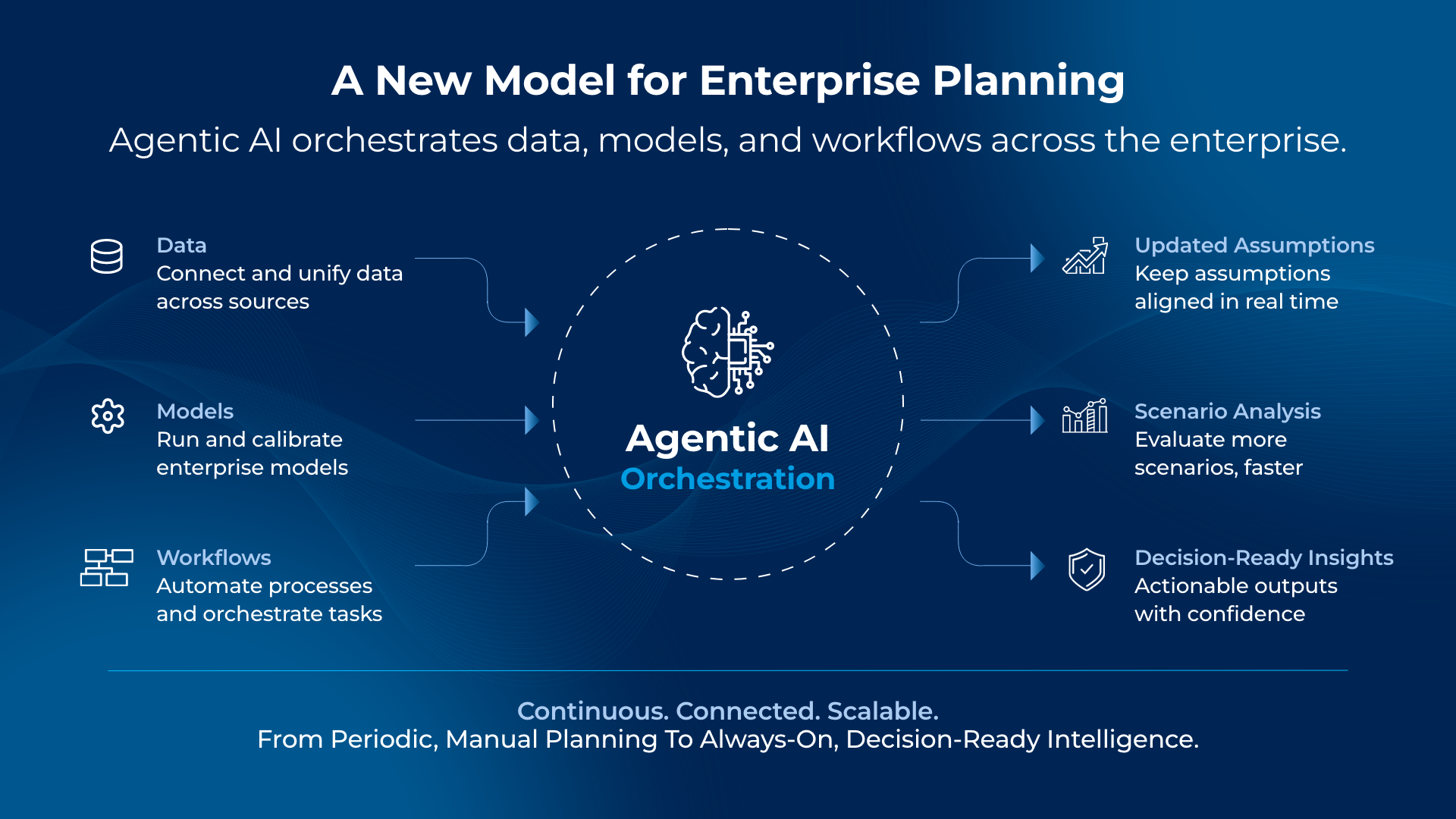
The next era of planning is not defined by faster spreadsheets or more efficient workflows. It is defined by orchestration. An environment where market signals trigger action automatically, where changes in production, commodity prices, regulations, or capital assumptions flow through connected systems, models update, scenarios are evaluated, and tradeoffs are surfaced without waiting for the next planning cycle.
By Monday morning, the work of assembling information is already complete. The planner's role does not disappear in this model. It changes. Rather than acting as the connective tissue between systems, planners focus on evaluating tradeoffs, applying judgment, and aligning decisions with corporate strategy.
The Larger Prize Is Optionality
The near-term benefits of orchestration are straightforward: faster planning cycles, better-informed decisions, less time spent assembling information. Those gains matter. They are not, however, the ceiling.
The signal that a new era of planning has truly arrived will not be a planning cycle that finishes faster. It will be a strategic decision that was never considered before. One that only became visible because the full range of operational, financial, and development options could finally be evaluated together. That is what orchestration ultimately enables: not faster execution of known options, but the discovery of options that were previously invisible.
See What Orchestrated Planning Looks Like in Practice
Quorum is building the planning environment that closes the gap between data and decisions. Connecting systems, automating coordination, and giving planning teams the speed and visibility to act with confidence. Request a demo to learn more.
 Previous Page